

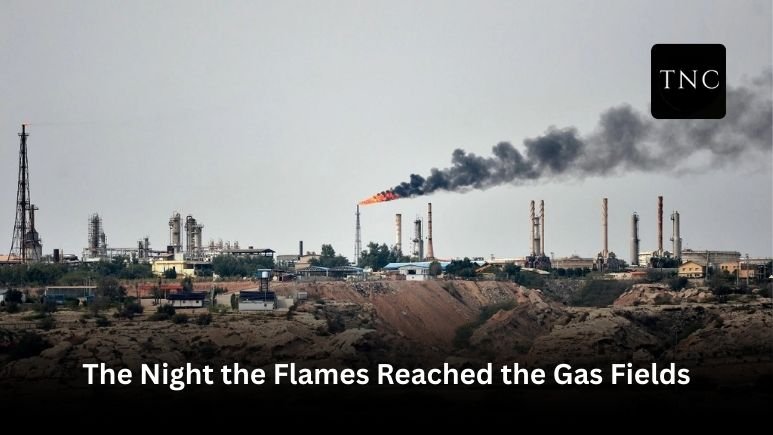

The fire didn’t look like war at first.
It looked like an accident, an industrial blaze licking the night sky above Iran’s southern coast. Workers at the South Pars complex, hardened by years of sanctions and shortages, watched as orange light spilled across pipelines that feed homes, power plants, and entire cities. Within hours, operations slowed. Then stopped.
Across the Gulf, in the United Arab Emirates, engineers at the Shah gas field were already dealing with their own shock. A precise, deliberate drone strike had forced a shutdown of a facility responsible for a fifth of the country’s gas supply.
Two sites. Two countries. One message: the war had moved underground into the systems that keep modern life running.
The strikes on South Pars in Iran and the Shah gas field in the UAE mark a turning point because they break a long-standing, unwritten rule of conflict: don’t hit the source of energy itself.
Until now, attacks in the region largely avoided upstream production of the wells and fields that generate oil and gas. That restraint is gone.
What replaces it is something more dangerous: a shift from military confrontation to economic warfare, where the real target isn’t just an enemy state, it’s the global energy system that connects them all.
South Pars is not just another gas field. It is the largest natural gas reserve on Earth, supplying up to 70–80% of Iran’s gas and anchoring its electricity and industrial output.
Strike it, and the effects ripple outward immediately:
- Domestic power shortages in Iran
- Industrial slowdowns
- Rising pressure on already strained economies
But the shock doesn’t stop at Iran’s borders.
The field is shared with Qatar, whose side fuels a major share of global LNG exports. Damage, even partial, creates fear. And in energy markets, fear moves prices faster than actual shortages. Within hours of the attacks, oil surged toward $110 per barrel and gas prices spiked in Europe.
This is the new battlefield: not territory, but supply chains.
By targeting energy production, both sides are signaling a willingness to weaponize interdependence. The logic is simple and brutal:
- Disrupt energy → trigger economic pain
- Economic pain → force political pressure
- Political pressure → reshape the conflict
It also opens a dangerous feedback loop. Iran has already warned it could strike energy facilities across Saudi Arabia, Qatar, and the UAE. Each retaliation risks widening the map of destruction from isolated strikes to a regional infrastructure war.
And beneath it all lies the Strait of Hormuz, the narrow corridor through which roughly 20% of the world’s oil flows. Disrupt that, and this stops being a regional crisis. It becomes a global one.
What changed is not just the target but the scale of consequences.
This is no longer just a war of missiles and borders.
It is a war over energy, the invisible system that powers cities, economies, and daily life across continents.
And once wars start targeting the world’s power supply, they stop being local conflicts. They become everyone’s problem.
Also Read / Oil Shock, Strategic Windfall: Why the Iran War Could Quietly Strengthen Russia.











Leave a comment