

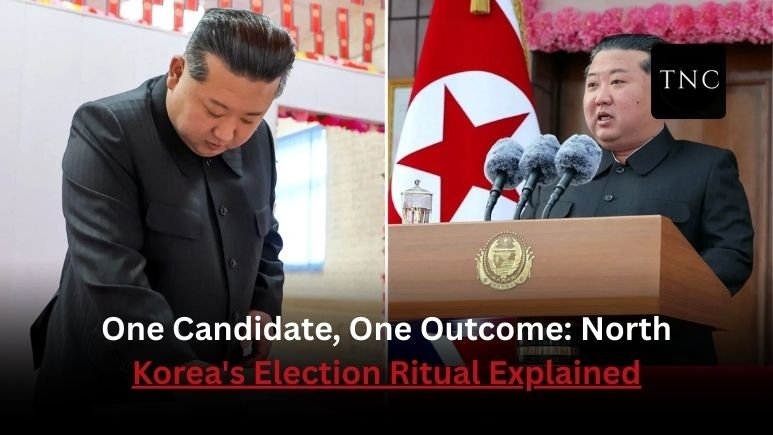

The line outside the polling station in Pyongyang barely moved, but no one complained. A factory worker in a gray uniform clutched her ballot, eyes fixed ahead. Inside, two boxes waited: one to approve, one to reject. Officials watched closely. Neighbors stood nearby. The room was quiet enough to hear paper slide against wood.
She stepped forward, unfolded the ballot, and did what nearly everyone else would do that day drop it, unmarked, into the approval box.
By evening, the result was already certain.
North Korea’s latest parliamentary election delivered a familiar outcome: a reported 99.99% turnout and 99.93% approval for state-backed candidates.
On paper, it looks like the most unified democracy in the world. In reality, it reveals something else entirely: a political system where elections function less as a contest of ideas and more as a ritual of loyalty. Understanding how and why these numbers exist is key to understanding how power operates inside one of the world’s most closed regimes.
Start with the ballot. There is only one name.
Every candidate in North Korea is pre-selected by the ruling Workers’ Party. Voters are not choosing between alternatives; they are endorsing a decision already made.
Technically, there is a choice: approve or reject. But rejecting requires crossing out the candidate’s name often under observation. Privacy is limited. The act itself becomes visible, even risky.
Participation, too, is not optional. Voting is treated as a civic duty bordering on obligation. Historically, turnout hovers just below perfection, with the state explaining that only those “abroad or working at sea” fail to vote.
The result is a system engineered for near-total consensus. Analysts often call it a “show election” , a process designed to demonstrate unity rather than measure public opinion.
But dismissing it as meaningless misses the point.
These elections serve three critical functions:
1. Surveillance disguised as participation
Voting allows the state to monitor attendance and behavior. Who shows up—and how they vote can signal loyalty or dissent.
2. Ritualized legitimacy
The regime transforms compliance into spectacle. A 99% result is not just a statistic; it’s a message to citizens and the world: opposition does not exist.
3. Internal discipline
Even within the elite, elections reinforce hierarchy. Candidates are approved through party channels, ensuring alignment with leadership before they ever appear on a ballot.
The numbers, then, are not evidence of popularity. They are evidence of control.
North Korea’s elections are not designed to reflect the will of the people. They are designed to display it uniformly, unquestioned, and absolute.
The near-perfect turnout isn’t a sign of democracy working.
It’s a sign of a system where the outcome is never in doubt and where the act of voting says less about choice, and more about obedience.
Also Read / Kim Jong Un Shows Off Military Muscle at North Korea’s Big Party Meeting.








Leave a comment