

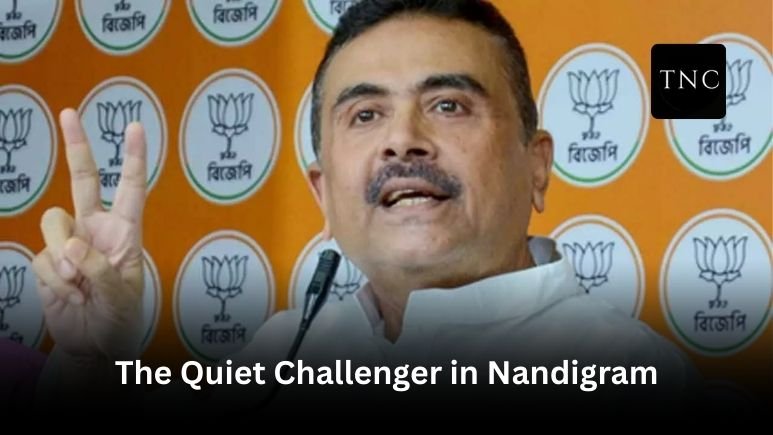

By mid-morning, the tea stall near Sonachura crossing had already picked a side. A hand-painted wall just behind it carried a familiar name, bold, deliberate strokes spelling out Suvendu Adhikari. A few feet away, someone had scrawled another name, less polished, almost tentative: Pabitra Kar.
“Dekha jaak,” the shopkeeper muttered, pouring another cup. Let’s see.
In Nandigram, elections don’t begin with speeches. They begin with walls, whispers, and the memory of battles fought before the first vote is cast.
The entry of Pabitra Kar, once an aide to Suvendu Adhikari into the Nandigram contest adds a new layer to one of India’s most politically charged constituencies. Nandigram is not just another seat in the West Bengal Assembly Elections 2026; it is the symbolic ground where power, betrayal, and political identity collide.
Kar’s candidacy is not about numbers alone. It represents a shift in the micro-politics of loyalty where former insiders step out of the shadows to challenge the very figures they once helped build.
Nandigram has always been personal. In 2021, Adhikari narrowly defeated Mamata Banerjee by just under 2,000 votes, turning the constituency into a national headline and a personal rivalry.
Now, in 2026, the battlefield is evolving again.
Adhikari is back this time not just defending Nandigram but also expanding his political footprint by contesting from another high-profile seat, signaling a broader strategic push by the Bharatiya Janata Party.
And then comes Kar.
Unlike heavyweight leaders, Kar’s strength lies in familiarity, not fame. He understands the booth-level machinery, the local grievances, the internal fractures. In Indian politics, that kind of knowledge can be more dangerous than charisma.
His move reflects three deeper trends:
1. Fragmentation within political ecosystems
When aides turn contenders, it signals cracks. Kar’s candidacy suggests that internal networks once tightly controlled are loosening.
2. The localization of power
Nandigram voters are no longer swayed only by party symbols. They remember faces, favors, and betrayals. Kar’s proximity to Adhikari could cut both ways credibility for some, opportunism for others.
3. The rise of second-line actors
Indian elections increasingly feature not just marquee leaders but also mid-level operatives stepping into the spotlight. These are the people who know where the real votes are buried sometimes literally, in booth lists and ward loyalties.
Even on paper, the stakes are clear. Candidate lists already show Kar directly pitted against Adhikari in Nandigram, formalizing what was once an internal equation into a public contest.
This is no longer just a rematch of giants. It’s a test of political memory versus organizational muscle.
In Nandigram, elections aren’t just fought between parties. They’re fought between past and present loyalties.
Pabitra Kar’s entry doesn’t guarantee an upset. But it does something more important: it complicates the script. And in a place where every vote carries the weight of history, even a small disruption can change the ending.
Also Read / Bangladesh Election Results Point to Big Political Shake-Up as Counting Drags On.












Leave a comment