


At 3:10 a.m., the departure board inside Delhi’s Indira Gandhi International Airport flickered again.
“Cancelled.”
The word appeared beside another flight bound for Dubai. A businessman from Kochi stared at the screen, suitcase handle still in his grip. He had been waiting for three hours, refreshing his airline app every few minutes. Around him, dozens of passengers crowded the help desk construction workers returning to Gulf jobs, families heading to Abu Dhabi, students connecting to Europe.
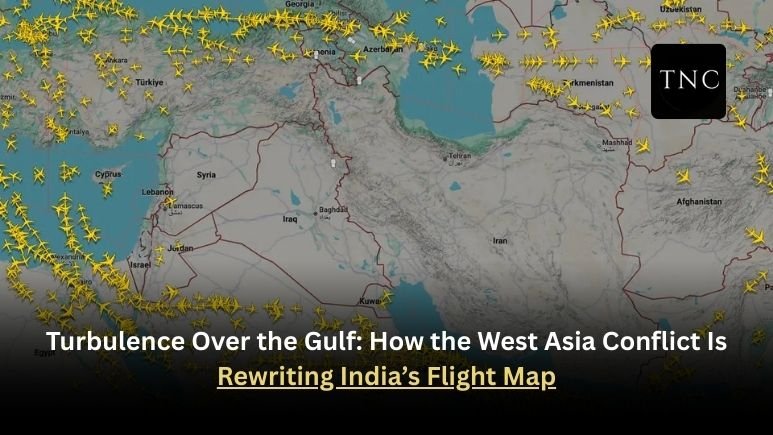
Airlines staff offered apologies and vouchers, but no clear departure time. The sky above West Asia had become unpredictable no-fly zones, missile alerts, and sudden airspace closures. For travelers thousands of kilometers away in India, the geopolitical shockwaves were arriving in the form of blinking red letters on airport screens.
The ongoing conflict in West Asia has quietly triggered one of the largest aviation disruptions affecting India in recent years. According to Civil Aviation Minister K. Rammohan Naidu, Indian airlines have cancelled more than 4,335 flights, while foreign carriers have cancelled around 1,187 services because of airspace closures across the region.
The cancellations highlight how deeply India’s aviation network is tied to the Middle East. Millions of Indians travel to Gulf countries each year for work, business, and transit connections to Europe and North America. When geopolitical tensions erupt in the region, India’s air corridors are often among the first to feel the impact.
The immediate reason for the disruption is simple: closed airspace.
When missiles, drones, or military operations threaten a region, aviation regulators quickly shut down flight corridors. Commercial airlines cannot risk flying through potential conflict zones. As the minister told Parliament, if the airspace itself is unsafe, flights simply cannot operate.
But the ripple effects go far beyond cancellations.
1. Longer and costlier routes
Airlines that continue operating must reroute flights around restricted zones. That often means flying thousands of extra kilometers, sometimes detouring over Africa or Central Asia. Longer routes burn more fuel, increase crew costs, and reduce aircraft availability.
2. Pressure on ticket prices
Fewer flights and longer travel times typically lead to higher ticket prices especially on busy routes between India and the Gulf. Aviation authorities in India are already monitoring airfare spikes to protect passengers during the disruption.
3. Stranded passengers and emergency operations
Thousands of travelers, especially migrant workers in Gulf countries have found themselves stuck between sudden cancellations and limited alternative flights. Some airlines have begun arranging special services from safer regional airports to bring passengers back to India.
4. A broader aviation vulnerability
The crisis also exposes a structural reality: India’s international aviation network relies heavily on West Asian air corridors. Flights to Europe, Africa, and North America often pass through the region. When conflict closes that corridor, the entire network must adjust.
Even so, the system hasn’t collapsed. Government data shows that over 2.19 lakh passengers still managed to travel during the crisis period, thanks to rerouted flights and limited operational windows.
In aviation terms, the sky may be turbulent but it’s not completely closed.
A war thousands of kilometers away can ground flights in Mumbai or Delhi overnight.
The cancellation of more than 4,000 Indian flights isn’t just a travel inconvenience, it’s a reminder that modern aviation depends on fragile corridors of peace in the sky. When those corridors close, the consequences ripple through airports, economies, and the lives of ordinary passengers waiting beside a flickering departure board.
Also Read / The War at Machine Speed: How Artificial Intelligence Is Rewriting the Rules of Combat.












Leave a comment