

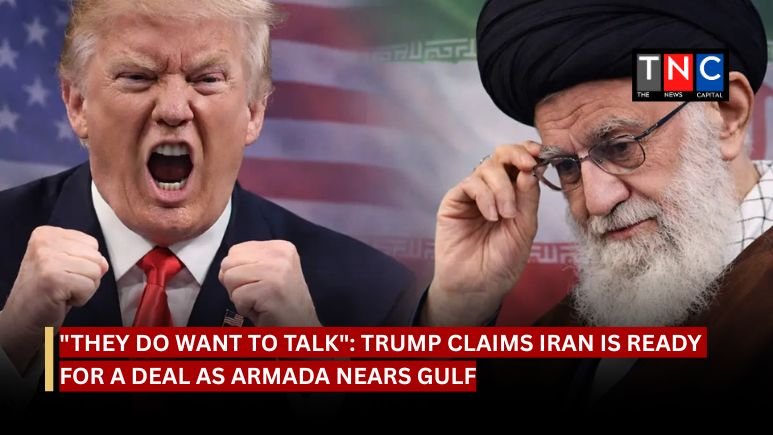

One carrier strike group. Twenty-eight points of negotiation. A 24-hour ultimatum that has the world watching. And somewhere between Washington’s deadline and Tehran’s defiance, two nations are playing the most dangerous game of brinkmanship since last June’s devastating airstrikes on Iran’s nuclear facilities.
President Donald Trump stood before reporters at the White House on Friday (January 30, 2026) and declared what seemed impossible just days ago: Iran wants to make a deal. “They do want to make a deal. I know so. They called on numerous occasions,” Trump stated, mixing confidence with the strategic ambiguity that has become his trademark. Yet even as he spoke of diplomatic breakthrough, he revealed he’s imposed a firm deadline for Tehran to enter formal talks, though he deliberately refused to specify when that clock runs out.
The statement came as the USS Abraham Lincoln carrier strike group entered the Middle East, bringing with it enough firepower to reshape the region in hours. Trump didn’t mince words about the deployment: it’s “larger than the one sent to Venezuela” and prepared to act with “speed and violence” if diplomacy fails.
Istanbul becomes ground zero for diplomacy
While American warships steamed toward the Persian Gulf, the real action Friday was happening in Turkey. Iranian Foreign Minister Abbas Araghchi flew to Istanbul for urgent talks with Turkish Foreign Minister Hakan Fidan in what could be the last diplomatic offramp before things spiral out of control.
Araghchi came with a carefully crafted message: Tehran will talk, but only as equals, not as a defeated nation accepting terms. “Negotiation cannot be dictated,” he told the press conference after three hours of closed-door meetings. He drew clear red lines that define any potential talks: Iran’s missile program is completely “non-negotiable,” and no discussions will happen under “coercion or intimidation,” a direct shot at the carrier group now approaching Iranian waters.
He also threw an accusation into the mix that revealed the regional complexity: Israel, he claimed, is actively pushing Washington toward war, trying to drag the U.S. into a conflict that serves Israeli interests rather than American ones.
Turkey’s Fidan confirmed what many suspected: Ankara has been running shuttle diplomacy, holding intensive talks with U.S. envoy Steve Witkoff. As a NATO member that maintains channels to Tehran, Turkey might be the only country that can actually facilitate direct talks, assuming both sides genuinely want them.
The military option looms larger
The diplomatic dance in Istanbul unfolds against a military backdrop that grows more ominous by the hour. Trump has repeatedly reminded Tehran of last June’s strikes that crippled Iran’s nuclear program, and intelligence sources say this time the target list is far more extensive.
Unlike 2025’s surgical strikes on nuclear facilities, the 2026 options reportedly include Iranian Revolutionary Guard command centers across the region, leadership infrastructure traditionally considered off-limits, and the communication networks Tehran uses to direct proxy forces from Lebanon to Yemen. It’s a fundamental shift from constraining Iran’s nuclear program to potentially decapitating its ability to project regional power.
Araghchi fired back with his own warning: Iran is “even more ready than in June last year.” Translation: hardened defenses, retaliatory capabilities including potential attacks on U.S. bases and disruption of oil shipments through the Strait of Hormuz, and proxy forces ready to activate across multiple countries. More ominously, he suggested a U.S. attack would “ignite a regional conflagration,” opening multiple fronts simultaneously against American interests.
Markets are already feeling the pain
This isn’t just geopolitical theater. Real economic damage is already happening:
| What’s Being Hit | The Damage |
| Oil Prices | Jumped 7% this week to over $70 per barrel as traders price in the risk of Strait of Hormuz disruptions |
| Gold | Hit record ₹1.62 lakh per 10 grams in India on safe-haven buying |
| Iranian Currency | Plunged to new record lows, devastating ordinary Iranians’ purchasing power |
| Trade Threats | Trump threatening 25% tariffs on any nation doing business with Iran |
Insurance for ships in the Persian Gulf has spiked 30%. Airlines are rerouting to avoid Iranian airspace. Investment in Middle Eastern markets has frozen.
What would a deal actually look like?
Despite Defense Secretary Pete Hegseth’s “War Department” rhetoric, the Trump administration keeps pushing its 28-point “Great Bargain” framework:
- Complete dismantlement of uranium enrichment beyond peaceful energy levels
- Major constraints on Iran’s ballistic missile program (the very thing Araghchi says is non-negotiable)
- Cutting support for Hezbollah, Syrian militias, Iraqi groups, and Yemen’s Houthis
- In exchange: lifting sanctions, unfreezing assets, normalizing banking access
Trump summed it up on Truth Social: “We seek a deal that ensures NO NUCLEAR WEAPONS, one that is good for all parties. Time is running out; it is truly of the essence.”
The fundamental problem: nobody’s speaking the same language
Here’s the disconnect that might make this whole thing blow up: Washington and Tehran aren’t even talking about the same thing when they say “negotiations.”
Trump apparently believes Iran is economically desperate and militarily vulnerable, ready to accept terms that amount to strategic surrender in exchange for economic relief.
Tehran views “negotiations” as discussions between equals where Iran’s security concerns get addressed, not dismissed. Araghchi’s insistence on “equal footing” suggests Iran expects a very different process than Trump’s take-our-terms-or-else approach.
“Both sides are using the word ‘negotiation’ but meaning completely different things,” a former senior State Department official observed. “Trump thinks he’s made an offer Iran can’t refuse. Iran thinks it’s being asked to surrender everything for money that could vanish with the next president. Those aren’t positions that lead to talks. They’re positions that lead to war.”
What happens next?
Multiple sources say Trump’s undisclosed deadline falls within days, creating a compressed timeline for diplomacy. Several scenarios are possible:
The breakthrough: Iran agrees to preliminary talks through Turkey, both sides step back, Trump claims his pressure worked.
Extended standoff: No talks, but no military action either. Markets stay volatile, tensions stay high, but immediate escalation is avoided.
Military option: Deadline passes, Trump authorizes strikes on expanded targets, Iran retaliates, potential regional war begins.
Face-saving compromise: Talks begin under some formula allowing both sides to claim they haven’t backed down.
The White House says Iranian leadership is making backchannel contact. Tehran says it’s open to dialogue but only if Washington withdraws military threats and accepts certain capabilities are off the table.
Someone has to move first. Someone has to risk appearing weak. Someone has to decide the alternative is too catastrophic.
The carrier group keeps approaching. The diplomatic phones keep ringing between Ankara, Washington, and Tehran. Oil markets keep rising. Deadlines keep approaching.
“Both sides are playing chicken with aircraft carriers and nuclear programs,” a senior European diplomat noted. “The problem with chicken is that sometimes both drivers refuse to swerve, and when that happens with nations instead of cars, a lot of innocent people get hurt.”
Nobody knows how this ends. But we’re about to find out.
Also Read / Diplomatic Brinkmanship: Trump Deploys Second ‘Beautiful Armada’ to Gulf, Demands Iran Deal.












Leave a comment