

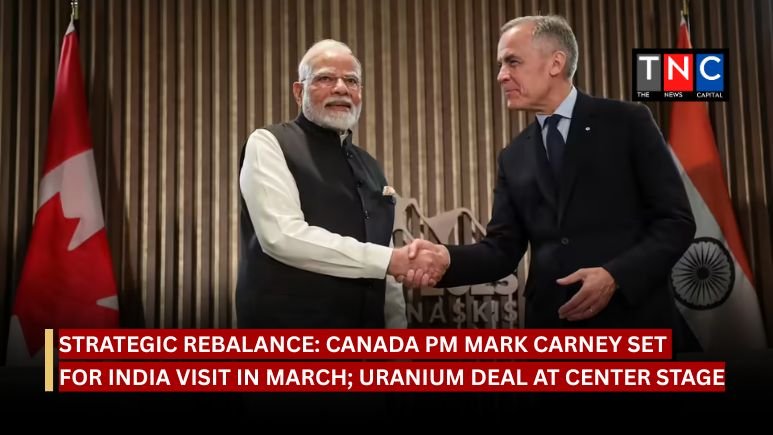

Following a high-profile “reset” with Beijing, Canadian Prime Minister Mark Carney is reportedly preparing for a landmark diplomatic mission to New Delhi, with the visit aimed at securing a long-term uranium supply agreement that signals Canada’s aggressive pursuit of a “Third Path” in global trade amid escalating tensions with Washington. Prime Minister Mark Carney is expected to visit India in March 2026, confirmed by diplomatic sources on Tuesday, January 27, 2026, just days after his historic trip to China, with the finalization of a major uranium trade pact at the top of the agenda intended to power India’s rapidly expanding civil nuclear program while diversifying Canada’s energy export markets away from a volatile United States.
The centerpiece of the upcoming March summit will be a long-term agreement for the supply of Canadian uranium to Indian reactors, addressing critical energy security needs for both nations.
- India’s Energy Security: India, which aims to triple its nuclear power capacity by 2030 to meet climate goals and reduce dependence on imported fossil fuels, views Canada’s high-grade uranium reserves in Saskatchewan as a critical resource for its energy security.
- Beyond the 2015 Framework: The deal represents a significant deepening of the 2015 Civil Nuclear Cooperation Agreement, moving from framework principles to concrete long-term supply commitments with specified volumes and timelines.
- “Stable, Long-Term Partnerships”: Analysts suggest that Carney is eager to lock in “stable, long-term partnerships” with democratic growth centers like India to offset the unpredictability of “transactional diplomacy” currently emanating from the White House under Trump.
- Saskatchewan Reserves: Canada’s uranium reserves in Saskatchewan represent some of the world’s highest-grade deposits, making Canadian uranium particularly valuable for efficient reactor operations and fuel cycle economics.
Beyond uranium, the two leaders are expected to discuss a broader “Critical Minerals Corridor” addressing multiple elements essential for India’s development ambitions and Canada’s export diversification.
- Lithium for EVs: Canadian lithium deposits are essential for India’s electric vehicle manufacturing ambitions, with New Delhi seeking to build a domestic EV industry rather than remaining dependent on Chinese battery supply chains.
- Potash for Agriculture: Canada’s massive potash reserves are crucial for India’s agricultural productivity and food security, with fertilizer access directly impacting crop yields for India’s 1.4 billion population.
- Supply Chain Resilience: The “Critical Minerals Corridor” concept reflects both nations’ desire to build supply chains independent of Chinese control, aligning with broader de-risking strategies.
- Value-Added Processing: Discussions may include not just raw material exports but potential joint ventures in processing and refining, creating value-added opportunities in both countries.
Carney’s visit to New Delhi is being viewed as a delicate balancing act following his recent visit to Beijing, where he signed a strategic partnership with President Xi Jinping that raised concerns among India’s strategic community.
- Managing Indian Concerns: The “China Pivot” raised eyebrows in New Delhi, given the ongoing border tensions between India and China following the 2020 Galwan Valley clash and continued military standoffs in Ladakh.
- Reassurance Mission: Carney’s March visit is seen as a “reassurance mission” to prove that Canada’s diversification strategy is not a tilt toward Beijing, but rather a pursuit of multiple independent global hubs without choosing between Asian powers.
- The ‘Third Path’ Doctrine: Carney has frequently cited his “Third Path” philosophy a doctrine that encourages middle powers to build resilient, bilateral bridges that bypass the “weaponized trade” of the two largest economies (U.S. and China).
- Democratic Partnership: The emphasis on partnering with “democratic growth centers” allows Carney to frame India engagement as values-based rather than purely transactional, distinguishing it from the China relationship justified on economic necessity.
U.S. Pressure: The Strategic Context
The timing of the visit is no coincidence, arriving as Canada faces unprecedented pressure from the Trump administration across multiple fronts that make Indian partnership strategically crucial.
| Strategic Pressure Point | Impact on Canada-India Ties |
| Greenland Dispute | Canada’s support for Denmark has strained ties with the U.S., making India a vital “alternative ally” |
| Tariff Threats | Potential 25% U.S. tariffs on Canadian autos force Ottawa to seek broader CEPA with India |
| Board of Peace Snub | After exclusion from Trump’s “Board of Peace,” Carney looks to New Delhi for regional security collaboration |
| “51st State” Rhetoric | Trump’s annexation jokes drive Canada toward partnerships that reinforce sovereignty |
| USMCA Uncertainty | Questions about U.S. commitment to trade agreements push diversification urgency |
- Greenland Solidarity: Canada’s vocal support for Danish sovereignty over Greenland and criticism of U.S. tariff threats has created friction with Washington that makes alternative partnerships more valuable.
- Trade Diversification Urgency: Facing potential 25% tariffs on automobiles and other exports, Canada urgently needs alternative markets to reduce its 75% trade dependence on the United States.
- Comprehensive Economic Partnership Agreement (CEPA): Ottawa is seeking to expand the limited existing trade relationship with India into a broader CEPA that could absorb exports currently vulnerable to U.S. tariffs.
- Security Alternatives: Excluded from Trump’s Board of Peace Gaza reconstruction initiative, Carney is exploring regional security collaborations with India and other partners outside U.S.-led frameworks.
The March visit marks a definitive “thaw” in Indo-Canadian relations, which were severely strained in late 2023 and 2024 by accusations and counter-accusations related to Khalistani activism and alleged foreign interference.
- 2023-2024 Crisis: Relations reached a nadir when Prime Minister Justin Trudeau alleged Indian government involvement in the killing of a Khalistani activist on Canadian soil, triggering diplomatic expulsions and bilateral tensions.
- Carney’s “Pragmatism-First”: Under Carney’s leadership, which began in mid-2025 following Trudeau’s resignation, Ottawa has reportedly adopted a “pragmatism-first” approach, focusing on intelligence-sharing and economic convergence.
- Behind Closed Doors: Previous diplomatic friction is being managed “behind closed doors” rather than through public recriminations, allowing both sides to pursue shared interests without relitigating past disputes.
- Reset Opportunity: Carney’s new leadership provides both nations an opportunity to reset the relationship with a clean slate, focusing on future cooperation rather than past grievances.
The Prime Minister has articulated a vision of complementary strengths that position Canada and India as ideal long-term partners despite geographic distance.
“Canada and India are natural partners for the next century. We have the resources India needs to grow, and India has the innovation and market scale that Canada needs to remain a global player.” Mark Carney, speaking to business leaders ahead of the announcement
- Resource-Market Synergy: Canada’s abundant natural resources (uranium, lithium, potash, oil, gas, timber) complement India’s massive market and manufacturing capacity, creating natural trade flows.
- Innovation Exchange: India’s technology sector, pharmaceutical industry, and startup ecosystem offer Canadian firms market access and innovation partnerships that extend beyond commodity trade.
- Demographic Complementarity: Canada’s aging population and labor shortages align with India’s young, educated workforce seeking opportunities, though immigration remains a sensitive bilateral issue.
- Democratic Values: Both nations are parliamentary democracies with independent judiciaries, free press, and commitment to rule of law, providing values alignment that distinguishes the partnership from Canada’s China relationship.
The March timing reflects multiple converging factors that make early 2026 the optimal window for cementing the Canada-India partnership.
- Post-China Reassurance: Coming shortly after the Beijing visit allows Carney to immediately demonstrate that China engagement doesn’t come at India’s expense or represent abandonment of democratic partnerships.
- Trump Administration Chaos: As Trump’s first year creates ongoing uncertainty in U.S. relationships, Canada and India both see value in cementing alternatives before potential reconciliation with Washington reduces urgency.
- Nuclear Timeline: India’s 2030 nuclear capacity tripling goal requires securing fuel supplies now to avoid construction delays and maintain aggressive buildout schedules.
- Budget Cycles: March timing allows agreements to be incorporated into both nations’ budget planning for fiscal years beginning April (India) and October (Canada).
The India visit represents one component of Carney’s broader “Third Path” strategy for Canadian foreign policy in a multipolar world.
- Multiple Hubs: Rather than choosing between U.S., China, or any single partner, the strategy seeks to build strong bilateral relationships with multiple economic centres.
- Weaponized Trade Resistance: The approach specifically aims to reduce vulnerability to economic coercion by ensuring no single partner can threaten Canadian prosperity through trade restrictions.
- Middle Power Coalition: Carney envisions Canada leading a coalition of middle powers (possibly including Australia, South Korea, Nordic nations) that collectively possess sufficient economic weight to maintain autonomy.
- Rules-Based Alternative: While acknowledging the “rupture” of the U.S.-led order, the Third Path seeks to preserve rules-based trade among willing partners rather than accepting pure power-based transnationalism.
Despite the optimistic framing, significant obstacles could complicate the Canada-India partnership and broader Third Path strategy.
- Trade Imbalance: Canada runs a significant trade deficit with India, which will require careful management and addressing of market access barriers in both directions.
- Regulatory Barriers: India’s complex regulatory environment, protection of domestic industries, and non-tariff barriers have frustrated previous Canadian business attempts to access Indian markets.
- Geopolitical Constraints: India’s strategic autonomy doctrine and non-aligned traditions may limit how much New Delhi is willing to explicitly align with Canadian positions against U.S. or Chinese interests.
- Diaspora Tensions: The large Indian diaspora in Canada includes significant Sikh populations with diverse views on Indian domestic politics, creating potential friction points around Khalistan activism.
Mark Carney’s March India visit following closely on his controversial China reset represents his “Third Path” strategy in action, seeking to secure long-term uranium supplies for India’s nuclear expansion while diversifying Canadian trade away from an unpredictable United States that has threatened tariffs, joked about annexation, and excluded Canada from the Board of Peace the delicate balancing act requires reassuring New Delhi that engagement with Beijing doesn’t compromise the India partnership while demonstrating to Washington that Canada has alternatives if Trump continues treating America’s closest ally as a subordinate rather than partner.
Also Read / ‘A Rupture, Not a Transition’: PM Mark Carney Declares Old World Order Dead in Davos.











Leave a comment