

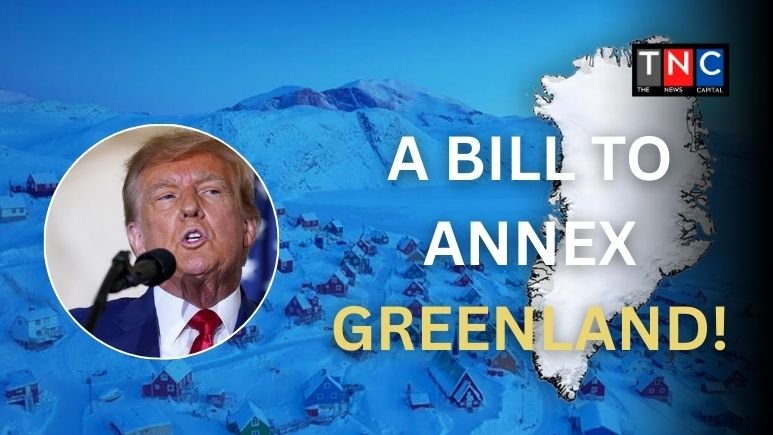

The conversation that once seemed like an eccentric presidential distraction has transformed into actual legislation sitting in the halls of Congress. What began as Donald Trump’s surprising 2019 suggestion to purchase Greenland met with laughter and disbelief at the time has evolved into competing bills that would either authorize the island’s annexation as America’s 51st state or explicitly prohibit any such attempt. The joke, it turns out, wasn’t a joke at all.
The Arctic became the newest and perhaps most surreal frontier in American legislative warfare on Monday (January 12, 2026), as the Trump administration’s persistent interest in Greenland shifted decisively from provocative rhetoric to formal policy planning with real legislative backing. Representative Randy Fine (R-Florida) introduced the “Greenland Annexation and Statehood Act,” extraordinary legislation that would authorize the President to pursue “all necessary means” language deliberately vague enough to include military force to bring the massive island under American sovereignty. The proposal was immediately countered by Representative Jimmy Gomez (D-California), whose “Greenland Sovereignty Protection Act” seeks to strip all federal funding from any attempt to purchase, coerce, or invade the autonomous Danish territory.
The two bills present diametrically opposed visions for the future of the world’s largest island, which has suddenly found itself at the center of what strategic analysts are calling the “Arctic Chessboard” a high-stakes competition for resources, military positioning, and geopolitical influence in a region being dramatically transformed by climate change.
The competing legislative visions:
- The Pro-Annexation Argument: Representative Fine characterized Greenland as a “vital national security asset that cannot be allowed to fall under the influence of hostile powers,” arguing that American control is strategically essential to prevent China and Russia from establishing permanent military or economic footholds in the strategically critical North Atlantic region. His bill requires the President to submit a comprehensive report to Congress within 180 days outlining specific steps for admitting Greenland as a full U.S. state, contingent on the territory adopting a “republican form of government” compatible with the U.S. Constitution essentially requiring Greenland to fundamentally restructure its political system as a precondition for annexation.
- The Anti-Annexation Shield: Representative Gomez’s countermeasure would categorically prohibit the use of any federal funds from any agency, for any purpose to facilitate the “invasion, annexation, purchase, or coerced acquisition” of Greenland. In floor remarks, Gomez lambasted the annexation push as an “imperial fantasy straight out of the 19th century” that dangerously destabilizes the NATO alliance, violates fundamental principles of international law, and treats 56,000 Greenlandic people as property to be traded rather than citizens with rights to self-determination.
“We’re watching in real-time as some members of Congress attempt to resurrect Manifest Destiny for the Arctic age. This isn’t about national security it’s about resource extraction and geopolitical dominance dressed up in security language,” Gomez stated during a press conference announcing his bill.
“Greenland represents the single most strategically valuable piece of real estate on Earth that isn’t currently under American control. We can negotiate, we can purchase, we can partner but we cannot allow adversaries to get there first,” Fine countered in his own statement, framing the issue as existential competition with China and Russia.
America’s suddenly intense interest in Greenland is driven by converging strategic realities that go far beyond simple geography or nostalgic imperialism:
The strategic and economic rationale:
- Critical Minerals Bonanza: Recent geological surveys have confirmed that 25 of the 34 minerals officially classified by the U.S. government as “critical raw materials” substances essential for modern technology, renewable energy systems, and advanced weapons exist in economically viable quantities in Greenland’s geology. These include massive deposits of neodymium and dysprosium (rare earth elements vital for electric vehicle motors, wind turbines, and precision-guided missile systems), along with substantial reserves of uranium, copper, zinc, and other strategic materials. Currently, China dominates global production of many of these minerals, creating supply chain vulnerabilities that worry Pentagon planners.
- The GIUK Gap: Greenland’s geographic position is militarily priceless. The island essentially guards the GIUK Gap (Greenland-Iceland-United Kingdom), the critical maritime corridor connecting the Arctic Ocean to the North Atlantic. NATO has monitored this chokepoint since the Cold War to track Russian submarine and surface fleet movements. Any hostile power controlling Greenland could potentially interdict shipping lanes, monitor Western naval operations, and project power into both the Arctic and Atlantic domains.
- Existing Military Infrastructure: The United States already maintains Pituffik Space Base (known until recently as Thule Air Base) in northwestern Greenland, a facility that houses critical early-warning radar systems designed to detect incoming ballistic missiles and monitor satellite activity. The base represents America’s northernmost permanent military installation and serves as a vital node in continental defense architecture. However, this presence exists under agreements with Denmark that could theoretically be terminated a vulnerability that concerns some defense planners.
- Climate Change Opens New Routes: As Arctic ice coverage continues declining dramatically due to climate change, previously impassable maritime routes are becoming commercially viable for significant portions of the year. The Northern Sea Route along Russia’s Arctic coast and the Northwest Passage through the Canadian Arctic archipelago could eventually become major shipping corridors, fundamentally altering global trade patterns. Greenland sits adjacent to these routes, making it strategically positioned to control or monitor traffic.
The legislative developments in Washington have triggered alarm bells throughout European capitals, with Danish and European Union officials expressing shock that a NATO ally would even contemplate forcible acquisition of another member’s territory.
The international reaction:
- Danish Defiance: Copenhagen summoned the U.S. Ambassador for what diplomatic sources described as an “extremely tense” meeting to formally protest what Denmark characterized as “unacceptable interference” in its internal sovereignty. Danish Prime Minister Mette Frederiksen issued an unusually blunt warning that any attempt by the United States to acquire Greenland through force or coercion would mark the “effective end of the NATO military alliance as it has existed for 75 years,” essentially threatening that such action would be treated as an attack on a NATO member.
- Greenlandic Unity: In a remarkable display of political consensus, Greenland’s Prime Minister Jens-Frederik Nielsen convened an emergency meeting with leaders of all major political parties spanning the ideological spectrum from left to right, from independence advocates to those favoring continued Danish association and issued a joint statement: “We don’t want to be Americans. We are Greenlanders. The future of Greenland must be decided by Greenlanders alone, not by Washington, not by Copenhagen, but by the people who actually live here.”
- The Venezuela Precedent: Political analysts note that the Trump administration’s recent success in militarily extracting Venezuelan President Nicolás Maduro and effectively seizing control of that country’s oil infrastructure has emboldened what’s being called the “Maximum Pressure” faction within the White House. The Venezuela operation demonstrated that the administration is willing to use military force unilaterally against foreign governments when it deems such action strategically necessary, making threats regarding Greenland seem more credible than when Trump first raised the idea in 2019.
“In 2019, when Trump suggested buying Greenland, we all laughed. Denmark’s prime minister called it absurd. But now we have actual legislation, actual military options being discussed openly, and the precedent of Venezuela showing this administration will act on these impulses. This is no longer funny,” observed Dr. Marc Jacobsen, a senior researcher at the Royal Danish Defence College specializing in Arctic security.
The diplomatic confrontation is expected to reach a critical juncture on Wednesday (January 14) when Danish Foreign Minister Lars Løkke Rasmussen and Greenlandic Foreign Minister Pele Broberg are scheduled to meet with Vice President JD Vance and Secretary of State Marco Rubio in Washington for what’s being billed as urgent consultations. While the White House has maintained publicly that “utilizing U.S. military capabilities remains an option on the table for all strategic objectives” language carefully chosen to be non-specific yet threatening European diplomats are hoping to steer the conversation toward “expanded bilateral cooperation” within existing treaty frameworks rather than outright territorial annexation.
Potential compromise frameworks being quietly discussed include:
- Enhanced U.S. investment in Greenlandic infrastructure development
- Expanded American military presence through renegotiated basing agreements
- Joint U.S.-Danish-Greenlandic governance of mineral extraction
- Greenlandic independence with immediate association or statehood offers
- Long-term leasing arrangements for strategic territories
Whether any of these alternatives can satisfy an administration that appears increasingly interested in outright control rather than partnership arrangements remains highly uncertain.
“The fundamental question is whether the United States still believes in the post-World War II international order it created, or whether we’ve decided that might makes right and strategic value justifies territorial seizure. Greenland is the test case,” stated Senator Chris Murphy (D-Connecticut), a member of the Senate Foreign Relations Committee who has criticized the administration’s approach.
What’s undeniable is that Greenland a territory most Americans couldn’t locate on a map five years ago has become a genuine flashpoint in early 21st-century geopolitics. The convergence of climate change opening Arctic resources, great power competition with China and Russia, critical mineral supply chain concerns, and an American administration willing to contemplate use of force has transformed a remote Arctic island into contested strategic territory.
The 56,000 people who actually live in Greenland, who have their own language, culture, and political aspirations, find themselves suddenly at the center of forces far beyond their control pawns in a game being played by superpowers who view their homeland primarily as strategic real estate rather than as a community of actual human beings with rights and preferences.
As Wednesday’s high-stakes diplomatic meeting approaches, three things are clear: the Trump administration is serious about acquiring Greenland through some mechanism, European allies are drawing hard lines against coercive acquisition, and the people of Greenland themselves want no part of becoming Americans.
How this collision of incompatible positions resolves through creative diplomacy, dangerous escalation, or alliance-fracturing confrontation will likely define transatlantic relations for years to come.
And somewhere in the Arctic, the ice continues melting, revealing resources that empires want and creating tensions that threaten the very alliances that kept the peace for three-quarters of a century.
Also Read / Leverage Over ‘Blood Money’: Trump Greenlights 500% Tariff Bill Targeting India and China.












Leave a comment