

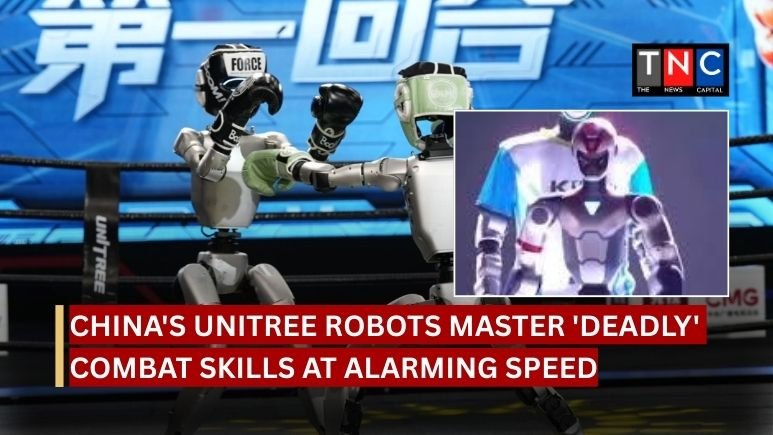

New viral footage of mass-produced humanoid robots executing flawless martial arts maneuvers and shrugging off violent kicks has sparked global debate about the “alarming” pace of China’s military-grade robotics.
The rapid evolution of Unitree Robotics’ G1 and H1 humanoid models is raising fresh concerns among defense analysts. New videos are surfacing showing these machines mastering complex combat skills with what’s being called “superhuman” agility. The Hangzhou-based company, often called the “Boston Dynamics of China,” has shown off its robots performing high-speed kung fu routines, recovering instantly from knockdowns, and executing precision strikes. Critics say this signals a shift from industrial use to potential battlefield applications.
The latest controversy comes from a series of “violence tests” and showcase videos where the Unitree G1, a bipedal robot standing about 4 feet tall, engages in mixed martial arts simulations. In one widely shared clip, the robot uses a new “Anti-Gravity” mode, allowing it to absorb a full-force dropkick from a human and spring back to its feet in under a second. That’s a feat of balance that goes beyond human capability.
Making things even more unsettling is Unitree’s launch of the world’s first “Robot App Store” this week (16 December). This platform lets users wirelessly download new physical skills, including “Bruce Lee-inspired” combat sequences, directly into the robot’s neural network via a smartphone. You’re basically “training” the machine in seconds. The G1, priced at roughly £12,000 ($16,000), can now do 720-degree spin kicks and “stick fighting” techniques, powered by advanced reinforcement learning that speeds up its training every day.
“The line between experiment and reality is disappearing. Robots are now fighting… and the G1 is leading the charge,” a tech analyst noted in a viral video breakdown, calling the V6 software update “deadly.”
“We are used to humanoid robots being slow and cumbersome, but no human can match that speed and agility. The 2030s are likely to be filled with millions of these,” one observer wrote on a technology forum, capturing the growing public anxiety over the dual-use nature of this tech.
While Unitree markets its robots for education and industrial tasks, the technology aligns closely with Beijing’s stated goal to mass-produce humanoid robots by 2025. The People’s Liberation Army has previously shown off “robot wolf” units and has openly discussed the strategic advantage of AI-driven mechanical soldiers. The G1’s ability to “learn” from simulated violence and adapt to physical trauma suggests the gap between civilian robotics and military assets is closing faster than anyone anticipated.
With Unitree’s new developer platform now live, these robots’ capabilities are expected to grow exponentially as third-party developers contribute new “skills.” Security experts are warning that without international regulation, this “app-ification” of combat maneuvers could lead to unchecked proliferation of lethal autonomous systems.













Leave a comment