

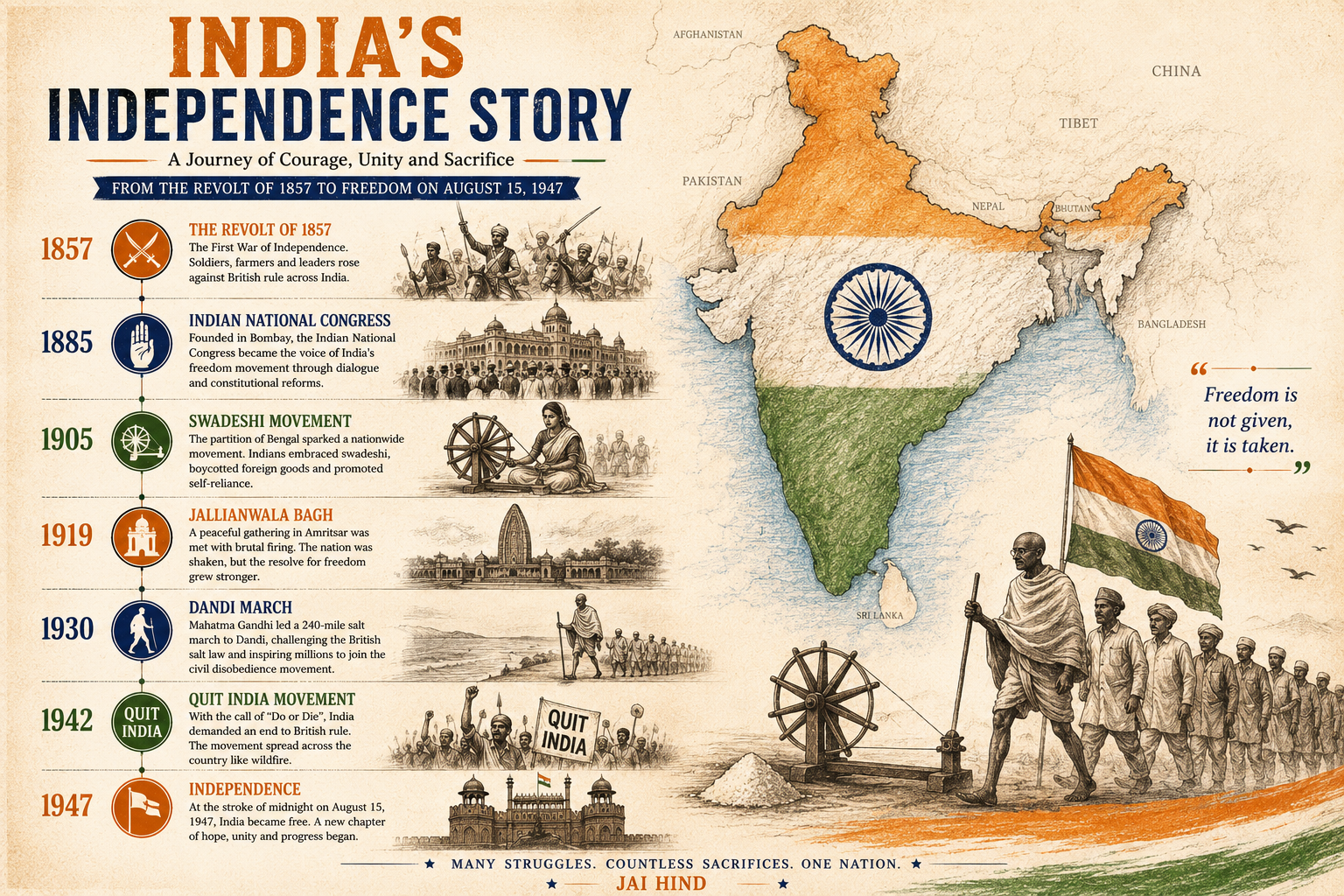

India’s Independence Story was shaped by nearly a century of protests, reforms, sacrifices and mass movements. The struggle against British rule did not follow one single path. Soldiers, farmers, workers, students, writers, women, political leaders and revolutionaries all contributed to the campaign for freedom.
India finally became independent on August 15, 1947. The Indian Independence Act created the independent dominions of India and Pakistan and ended British rule over the subcontinent.
1. The Revolt of 1857
The Revolt of 1857 became the first major armed challenge to British authority in India. Soldiers, rulers, farmers and civilians joined the uprising in different regions. Although British forces suppressed the revolt, it changed the way Indians viewed colonial rule.
2. Crown rule begins in 1858
After the revolt, the British Crown took direct control of India from the East India Company. The new system strengthened colonial administration but also created deeper political opposition.
3. Rise of Indian political associations
During the late nineteenth century, educated Indians formed political groups to demand administrative reforms, greater representation and civil rights. These organisations created an early foundation for national politics.
4. Indian National Congress forms in 1885
The Indian National Congress was founded in Bombay in 1885. It provided a national platform where Indian leaders could discuss political rights and challenge unfair colonial policies.
5. Economic criticism of British rule
Leaders such as Dadabhai Naoroji explained how colonial policies drained India’s wealth. The “Drain of Wealth” theory helped people understand the economic impact of British rule and encouraged wider political awareness.
6. Partition of Bengal in 1905
Lord Curzon divided Bengal in 1905. Many Indians saw the decision as an attempt to weaken national unity. The partition triggered large protests and gave strength to the Swadeshi Movement.
7. Swadeshi and boycott
The Swadeshi Movement encouraged Indians to use locally made goods and boycott British products. It connected political freedom with economic self-reliance and brought students, women and traders into the movement.
8. Formation of the Muslim League in 1906
The All-India Muslim League formed in Dhaka in 1906. It initially sought political safeguards for Muslims but later became a major force in negotiations over India’s constitutional future.
9. Surat split in Congress
The Congress split between moderates and assertive nationalists at Surat in 1907. The disagreement showed that Indian leaders differed over methods, but both groups opposed colonial domination.
10. Home Rule Movement
Bal Gangadhar Tilak and Annie Besant led the Home Rule Movement during the First World War. They demanded self-government and helped spread political education beyond major cities.
11. Lucknow Pact of 1916
The Congress and the Muslim League reached the Lucknow Pact in 1916. The agreement showed that cooperation between major political groups was possible.
12. Gandhi returns to India
Mahatma Gandhi returned to India in 1915 after leading campaigns in South Africa. He introduced methods based on non-violence, civil resistance and mass participation.
13. Champaran movement
In 1917, Gandhi supported farmers in Champaran, Bihar, who faced unfair conditions under the indigo system. The campaign became one of his first major successes in India.
14. Rowlatt Act
The British government passed the Rowlatt Act in 1919. The law allowed detention without trial and limited civil liberties. Indians across the country protested against it.
15. Jallianwala Bagh massacre
British troops fired on a large gathering at Jallianwala Bagh in Amritsar on April 13, 1919. Hundreds of people died, according to official accounts, while Indian sources reported a higher toll. The tragedy destroyed faith in British promises of fair governance.
16. Non-Cooperation Movement
Gandhi launched the Non-Cooperation Movement in 1920. Indians refused government jobs, schools, courts and foreign goods. The movement became one of the first nationwide campaigns against British rule.
17. Chauri Chaura incident
Violence broke out at Chauri Chaura in 1922, leading Gandhi to withdraw the Non-Cooperation Movement. His decision showed his commitment to non-violence, even when many supporters wanted stronger action.
18. Simon Commission protests
The Simon Commission arrived in India in 1928 without an Indian member. Demonstrators protested across the country with the slogan “Simon Go Back.” Lala Lajpat Rai suffered injuries during a protest and later died.
19. Declaration of complete independence
At the Lahore session in 1929, the Congress adopted the goal of complete independence, or Purna Swaraj. Leaders observed January 26, 1930, as Independence Day.
20. Dandi March
Gandhi began the Salt March in March 1930. He walked from Sabarmati Ashram to Dandi to protest the British salt monopoly. The campaign turned a simple tax into a powerful symbol of freedom.
21. Civil Disobedience Movement
The Salt March launched a wider Civil Disobedience Movement. People broke colonial laws, refused taxes and joined protests across India.
22. Government of India Act
The Government of India Act of 1935 introduced provincial elections and limited self-government. Although the Act did not grant independence, it gave Indian leaders experience in administration.
23. Subhas Chandra Bose and the INA
Subhas Chandra Bose led the Indian National Army and sought military support to fight the British. His slogan and leadership inspired many Indians, even though the INA campaign did not achieve military victory.
24. Quit India Movement
The Congress launched the Quit India Movement in August 1942 with the demand that Britain leave India immediately. The British arrested major leaders, but protests continued across the country. The movement convinced many observers that colonial rule could no longer continue
25. Independence and Partition
The British Parliament passed the Indian Independence Act in July 1947. The law came into effect on August 15, creating India and Pakistan. Freedom brought joy, but Partition also caused mass displacement, violence and lasting pain.
Conclusion
India’s Independence Story includes far more than a single date or one leader. It reflects the combined efforts of millions of people who challenged colonial power through protest, reform, sacrifice and resistance. The 25 turning points above show how a scattered opposition gradually became a nationwide movement for freedom. India’s independence ended British rule, but it also began the difficult work of building a democratic republic.







Leave a comment