

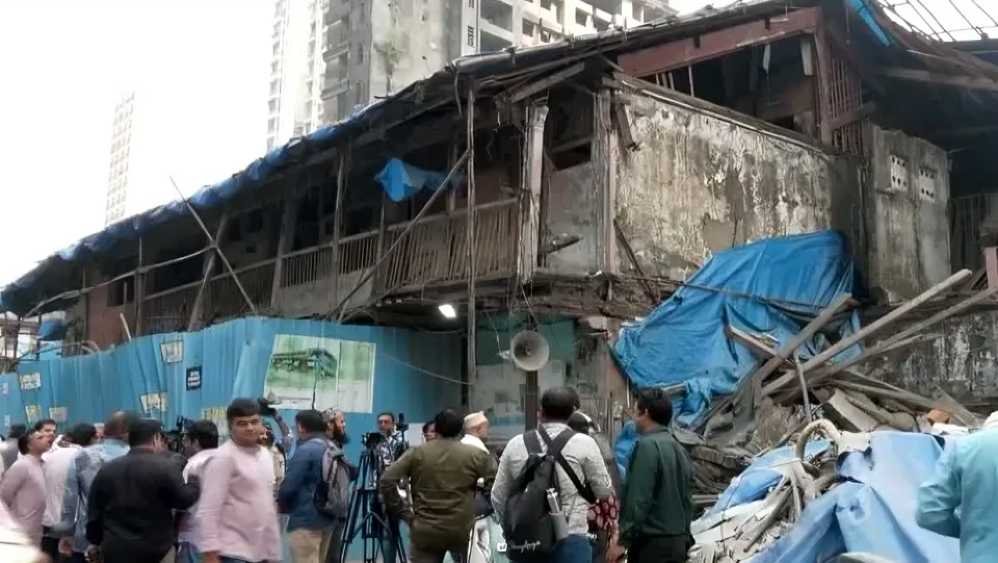

The Musafirkhana building demolition in Bhendi Bazaar began on November 19, 2026, bringing attention to one of South Mumbai’s old properties. The Brihanmumbai Municipal Corporation, or BMC, started pulling down the Haji Ismail Haji Habib Musafirkhana on Pakmodia Street after classifying it as dangerous. Police were deployed around the site as civic teams carried out the operation.
Deputy Commissioner of Police Maneesh Kalwaniya said engineering staff and other BMC teams were present and safety precautions had been taken. He described the operation as peaceful and said police personnel had been deployed to secure the surrounding area.
The action followed a demolition schedule covering November 18 and 19. Although the work did not begin on Wednesday, reports on Thursday morning confirmed that it had started. Earlier reports describing a delay referred to the previous day’s developments, before machinery began working at the site.
The BMC had placed the building in the C-1 category. Under the civic body’s classification system, this means a structure is unsafe and requires evacuation and demolition. According to the BMC’s communication, an inspection found that the property posed a risk to people using its prayer hall and to passersby.
Musafirkhana’s original purpose was connected to travel and hospitality. It provided temporary accommodation for Haj pilgrims travelling through Bombay, as Mumbai was then known, on their way to Mecca. For travellers arriving from different parts of the subcontinent, such accommodation offered a place to rest before continuing their journey.
Over time, fewer pilgrims used the premises and rooms on the upper floors were rented out as homes. Shops and storage areas also became part of the property’s everyday life. The Indian Express reported that rental income helped support charitable activities, including assistance for education and medical treatment.
The building’s precise age remains unclear across published accounts. The Indian Express reports that it was built in 1939, while Free Press Journal cites local accounts placing its construction in 1864. Both accounts describe a building whose use changed over time, from providing shelter for travellers to accommodating local residents.
The property also attracted attention because of its association with fugitive gangster Dawood Ibrahim and his family. News reports identify it as a former family residence. That connection explains much of the public interest, while the BMC’s stated reasons for demolition concern its dangerous condition and the surrounding redevelopment work.
A ground-floor prayer hall became the main point of disagreement before demolition. Reports said other portions of the building had been vacated while the hall remained in use. Local residents and people using the space objected to relocation and questioned whether they had received enough time to respond.
Free Press Journal reported that local MLA Amin Patel raised concerns about legal proceedings and the arrangements for the prayer hall. Occupants sought a permanent prayer space at the same location after redevelopment. Their concerns extended beyond finding somewhere to pray temporarily during the demolition and construction period.
The Saifee Burhani Upliftment Trust, known as SBUT, said it had offered two alternatives. Occupants could use temporary prayer premises at An Nasr Tower in Sector 4, or receive rental compensation to arrange another location. The trust said it was cooperating with civic authorities over the demolition.
SBUT also referred to a Bombay High Court order dated August 31, 2020, as part of the basis for the action. Separately, AIMIM leader Waris Pathan said legal efforts were being made to seek relief. Pathan said lawyers planned to seek an urgent hearing on Thursday morning.
The Musafirkhana property falls within Sector 8 of SBUT’s Bhendi Bazaar cluster redevelopment project. Reporting on civic communications says part of the structure lies along a proposed internal road. Clearing the site is therefore connected to plans for changing the street layout as well as removing an unsafe building.
The scale of the wider project helps explain the importance of these changes. SBUT’s official website describes redevelopment across 16.5 acres, covering more than 250 old buildings, approximately 3,200 families and 1,250 shops. Its plans include new homes, wider roads, commercial spaces and improved infrastructure. Its website says the wider redevelopment area is divided into nine sectors for planning purposes.
The trust also lists footpaths, open areas, parking and community facilities among its proposed improvements. For residents and shopkeepers, these plans concern the places where they live, work, shop and meet neighbours. Moving premises can change those familiar routines while construction continues across different parts of the area.
SBUT’s master plan includes religious structures alongside housing and commercial premises. The trust says the project aims to retain the neighbourhood’s social and cultural character. At Musafirkhana, occupants have asked for a permanent prayer space at the same location after redevelopment, according to a report published by Free Press Journal.
Also Read | India and Japan to review defence ties during Rajnath Singh and S. Jaishankar’s Tokyo visit












Leave a comment