


The United States lost its measles elimination status on 17 November, ending a 26-year public health achievement. The decisive finding was that one chain of infections had continued inside the country for at least a year. The Pan American Health Organization (PAHO) traced the start of that chain to 20 January 2025. By the time officials announced their decision, the US had recorded 5,412 confirmed measles cases in 2026, more than double the total for all of 2025.
What did measles elimination mean?
When the US achieved elimination in 2000, Americans could still catch measles abroad and bring it home. Some of those infections led to local outbreaks. The achievement was that those outbreaks came to an end. Vaccination protected enough people, and health teams found and contained cases quickly enough, to keep the virus from circulating continuously. Even in 2019, when the country recorded 1,274 cases, it retained its elimination status.
That history explains why the 2026 decision came months after the outbreak passed its first anniversary. An independent commission had to establish whether infections over that period belonged to the same chain. Experts reviewed laboratory results alongside investigations into where and when people fell ill. On their own, similar virus samples could also reflect separate introductions from abroad. Taken together, the evidence showed that local spread had continued past 20 January 2026.
Why did measles keep spreading?
One part of the answer can be found in school vaccination records. In the 2019–20 school year, 95.2% of US kindergartners had received the required measles, mumps and rubella (MMR) vaccine doses. By 2025–26, coverage had fallen to 92.4%. About 280,000 children attended kindergarten that year without a record showing they had completed the MMR series. The CDC says disruptions during the pandemic contributed to missed childhood vaccinations.
A national average also hides what happens inside individual schools. An analysis of a South Carolina outbreak found that two-dose coverage averaged 82.5% at schools where someone had been exposed to measles and 91% at schools without a known exposure. A child spends much of the day with the same classmates. How many of those classmates are protected can matter more to that child’s immediate risk than a statewide figure suggests.
Measles makes those local gaps especially important. According to the CDC, up to nine in ten people who lack immunity can become infected after close contact with someone who has measles. A person can pass it on as early as four days before the rash appears. A family may therefore learn that a child has measles only after the child has already spent time with classmates or relatives.
How large is the US outbreak?
The CDC recorded 285 confirmed US cases in 2024 and 2,289 in 2025. By 12 November 2026, the count for the year had reached 5,412, with several weeks still to go. The figures for 2025 and 2026 are preliminary. Pennsylvania experienced the country’s largest outbreak this year, but the national total includes infections reported across many communities. Local health department notices give families a better picture of possible exposure nearby.
What should families do after a possible exposure?
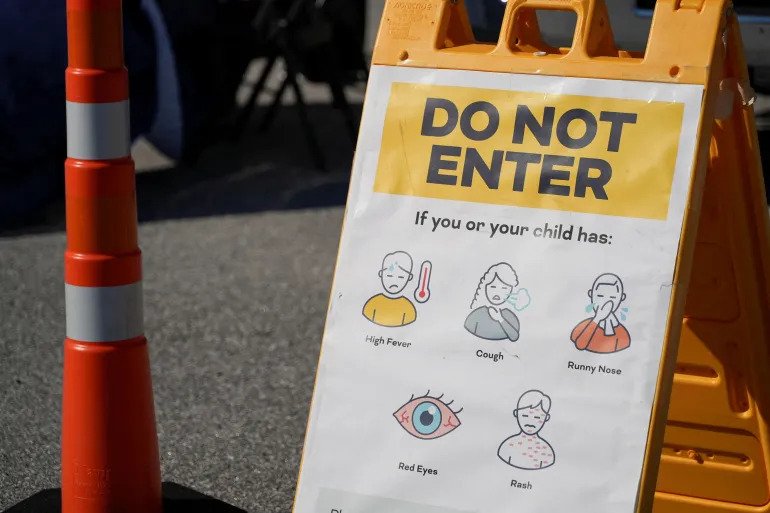
If a school or health department tells you that you or your child may have been exposed, the CDC advises calling a healthcare provider right away. If you can find your vaccination record, have it ready for the call. A clinician can use it, together with the timing of the exposure, to advise you. Call before entering a clinic or hospital so staff can arrange care and protect people in the waiting room.
Measles often begins with a fever, cough, runny nose and red eyes. The rash comes later. Complications can include pneumonia, and some people need hospital care. For routine protection, the CDC recommends a first MMR dose at 12 to 15 months and a second at ages four to six. Two doses are about 97% effective at preventing measles. Parents who are unsure whether a child missed a dose can ask their healthcare provider to review the record.
Can the US regain measles elimination status?
Yes. The US will need to interrupt sustained transmission and provide evidence that the interruption has lasted at least a year. Canada offers an example of what progress looks like. It lost its status in 2025, then stopped the chain of infections behind that decision. As of PAHO’s November 2026 review, Canada was still working towards formal recognition of elimination.
For US health departments, that work starts close to home. It means finding out which schools have gaps in coverage, making missed vaccinations easier to get and contacting families quickly when a case is confirmed. The CDC has pledged support for those efforts. The earliest sign of recovery will come well before another formal announcement: a local outbreak will end, and fewer families will receive a call telling them they may have been exposed.
Also Read | India and Japan to review defence ties during Rajnath Singh and S. Jaishankar’s Tokyo visit












Leave a comment