

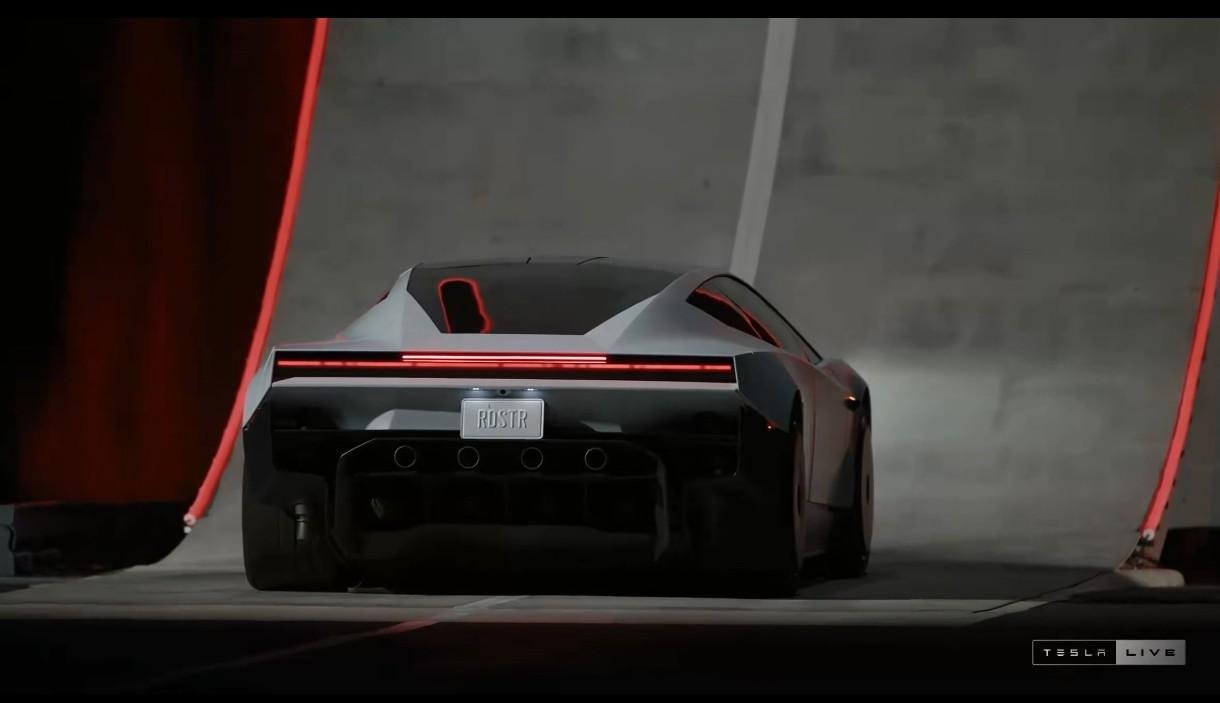

Tesla CEO Elon Musk has unveiled a redesigned electric sports car that can briefly lift itself off the ground, bringing his long-discussed flying car ambitions closer to reality.
The new Tesla Roadster was demonstrated on Thursday, October 15, 2026, at a SpaceX testing facility near Waco, Texas.
During the presentation, the vehicle used powerful air thrusters to perform unusual manoeuvres, including travelling upside down, flipping through the air and jumping over other Tesla vehicles.
Video Link : Tesla Roadster concept representing Elon Musk’s proposed flying car technology
The demonstration immediately attracted attention because it showed capabilities rarely associated with conventional passenger cars.
However, the Roadster is still an experimental vehicle, and its short airborne movements should not be confused with sustained flight like an aircraft.
What Did Elon Musk Reveal on Thursday?
Elon Musk introduced Tesla’s long-awaited second-generation Roadster, a high-performance electric sports car developed with technology from SpaceX.
The vehicle was first announced in 2017, but its production timeline has been delayed repeatedly.
At the October 15 event, Tesla demonstrated a redesigned version featuring an unconventional propulsion system.
The car accelerated rapidly, climbed an inverted ramp and briefly became airborne.
It also used thrusters to control its movement and return to the ground.
The demonstration was conducted without a driver, reflecting the experimental nature of the technology.
Musk presented the vehicle as an example of how far automotive engineering could move beyond traditional designs.
How Does Tesla’s Flying Roadster Work?
The Roadster combines electric vehicle technology with equipment designed to produce additional thrust.
According to reports, its system uses compressed gas and powerful air jets to help lift and move the vehicle.
The car also demonstrated a suction system that allowed it to travel along an inverted ramp.
This is different from the way ordinary cars operate.
Traditional electric vehicles use battery-powered motors to turn their wheels.
The new Roadster adds technology that can temporarily generate forces capable of lifting or repositioning the vehicle.
However, the demonstration did not establish that the car can travel long distances through the air.
Its airborne movements were brief and took place under carefully controlled conditions.
Can the Tesla Roadster Really Fly?
The answer depends on what is meant by flying.
During the demonstration, the Roadster visibly left the ground and performed aerial movements.
In that limited sense, Tesla showed that the vehicle could become airborne using its propulsion system.
But it is not a conventional flying car capable of taking off and travelling between cities like an aircraft.
There is no confirmed evidence that the demonstrated Roadster can perform sustained, practical flight.
Questions also remain about passenger safety, flight control, energy requirements and regulatory approval.
For now, it is more accurate to describe the vehicle as an experimental electric sports car with limited airborne capabilities.
Tesla Roadster Shows Extraordinary Acceleration
Flying was not the only feature highlighted during the launch.
Tesla also demonstrated extremely rapid acceleration.
The company claimed that the new Roadster could reach 60 miles per hour, approximately 97 kilometres per hour, in less than one second.
Such performance would be extraordinary for a road vehicle.
However, the result was demonstrated under specialised conditions with additional propulsion technology.
Independent testing will be important before the claimed performance can be compared fairly with other production sports cars.
The demonstration nevertheless showed Tesla’s ambition to push electric vehicle performance beyond familiar limits.
Why Is SpaceX Technology Important?
SpaceX, another company led by Elon Musk, develops rockets and spacecraft.
Tesla has drawn on engineering concepts associated with rocket propulsion to develop the Roadster’s unusual capabilities.
Musk first discussed the possibility of adding small rocket-style thrusters to the Roadster several years ago.
The idea was to improve acceleration, braking and handling, with the possibility of lifting the vehicle off the ground.
The October 15 demonstration showed how some of those ideas could work in practice.
However, adapting experimental propulsion systems for everyday passenger vehicles presents major engineering and safety challenges.
When Will the New Tesla Roadster Be Available?
Tesla has indicated that production could begin in 2028.
However, this timeline should be treated cautiously.
The second-generation Roadster was originally unveiled in 2017 and has experienced several delays.
The latest demonstration does not mean customer deliveries have begun.
Pricing, production numbers and availability may vary depending on the final version.
Potential buyers will need to wait for confirmed specifications and delivery information from Tesla.
Is Tesla’s Flying Car Legal on Public Roads?
One of the biggest questions concerns road safety and government approval.
The demonstrated Roadster uses technology that is very different from standard passenger vehicles.
A car capable of lifting off the ground raises additional questions about public safety, vehicle certification and responsibility in the event of an accident.
The experimental version shown at the event has not been established as approved for normal public-road use.
If Tesla eventually sells a version with airborne capabilities, it may face additional regulatory requirements.
The company will need to demonstrate that the technology can operate safely outside a controlled testing environment.
Why Is the Flying Roadster Important for Tesla?
The Roadster is not expected to become a mass-market vehicle like Tesla’s Model 3 or Model Y.
Instead, it represents an opportunity for the company to demonstrate advanced engineering.
Tesla has increasingly focused on autonomous driving, robotics and artificial intelligence.
The Roadster’s dramatic launch offers another way to attract attention to its technology.
However, an impressive demonstration does not automatically guarantee commercial success.
Manufacturing costs, reliability, customer demand and regulatory approval will all influence the vehicle’s future.
Could Flying Cars Become Common in the Future?
The idea of flying cars has fascinated people for generations.
Several companies are developing aircraft and vehicles intended to provide new forms of personal or urban transport.
Tesla’s approach is different because it begins with a high-performance sports car and adds technology for brief airborne movement.
Whether this concept can develop into practical transportation remains uncertain.
For everyday use, flying vehicles would need reliable safety systems, clear operating rules and suitable infrastructure.
The Roadster demonstration is an engineering milestone, but it is not yet a solution for ordinary road traffic.
Conclusion
Elon Musk’s October 15 reveal has given the world a dramatic look at Tesla’s experimental flying Roadster.
The vehicle demonstrated rapid acceleration, upside-down movement and brief airborne manoeuvres using specialised propulsion technology.
Yet important questions remain about sustained flight, production, safety and road approval.
For now, Tesla has shown an extraordinary prototype rather than a flying car ready for everyday
Also Read | Budhi Gandaki River Flood: Powerful Torrents














Leave a comment