

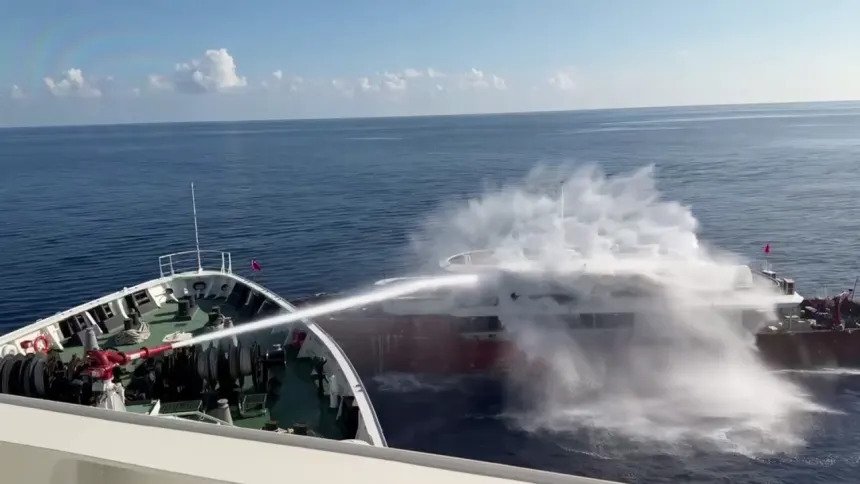

Taiwan Uses Water Cannon Against Chinese Fishing Boat
Taiwan’s coast guard used a water cannon on a Chinese fishing boat after the vessel refused repeated orders to leave waters that Taiwan controls and designated as restricted near Dongsha Island, also known as the Pratas Islands, in the South China Sea.
The incident took place on October 1, 2026, when Taiwan’s Coast Guard Administration (CGA) detected two Chinese fishing boats operating east of Dongsha Island. Officials said one boat complied with instructions to leave, while the second vessel, named Jin Sha, refused to move despite repeated warnings.
The incident is the latest example of maritime friction between Taiwan and China, particularly around Taiwan-controlled outlying islands in the South China Sea.
Two Chinese Fishing Boats Entered the Area
According to Taiwan’s Coast Guard Administration, a suspicious vessel was first detected around 15.5 nautical miles northeast of Dongsha Island. A 4,000-tonne patrol vessel, Yunlin, was then sent to investigate. Later, coast guard personnel found two Chinese fishing boats about 27 nautical miles east of the island, which Taiwan said placed them about eight nautical miles inside its restricted waters.
The two vessels were identified as Yue Hui Dong Yu 75066 and Jin Sha.
Taiwanese officers repeatedly instructed both boats to leave the area. The first vessel raised anchor and departed. The Jin Sha, however, stayed in place and did not follow the order.
Water Cannon Used After Three Warnings
Taiwan said the coast guard made three unsuccessful radio attempts to persuade the Jin Sha to leave.
After those warnings failed, the Yunlin patrol vessel used its water cannon for around 30 seconds from a distance of about 200 metres. Taiwan’s Coast Guard Administration said the initial spray was not effective, so the patrol vessel moved closer and directed the water at the Chinese boat for another 90 seconds.
The coast guard described the action as the use of a low-lethal enforcement measure under its standard operating procedures. The goal was to make the vessel leave the area rather than to carry out a military attack.
This distinction is important because the incident involved a coast guard patrol and a fishing vessel, rather than a direct confrontation between naval warships.
Chinese Boat Later Lost Power
The confrontation did not end immediately after the vessel began moving.
Taiwan’s coast guard said the Jin Sha later experienced engine or power trouble while leaving the area. The Yunlin then helped tow the fishing boat out of the restricted waters. The disabled vessel was eventually handed over to another Chinese work vessel early the following morning.
In an unusual development, the Taiwanese patrol crew also provided 35 hot meals to the Chinese fishing boat’s crew after the crew requested assistance.
The Coast Guard Administration said the episode reflected two parts of its mission: enforcing Taiwan’s maritime rules and providing humanitarian assistance when people at sea require help.
What Are Restricted Waters?
The terminology surrounding the incident is important.
Taiwan’s Coast Guard Administration distinguishes between prohibited waters and restricted waters. According to the agency, prohibited waters refer to territorial waters, while restricted waters are a wider zone outside territorial waters where authorities can strengthen maritime law enforcement.
Around Dongsha Island, those boundaries can be measured from nearby reefs, meaning the areas described by Taiwan do not necessarily follow a simple circle based only on the island itself.
Taiwan administers Dongsha, while China also claims the island. Taiwan maintains a coast guard presence there, and the island is located roughly 450 kilometres southwest of Kaohsiung.
Why Dongsha Matters
Dongsha is strategically important because of its location in the northern part of the South China Sea.
Although the island is small, the surrounding waters are important for fishing, maritime security and regional access. Taiwan has also designated the surrounding area as a protected marine environment, making illegal fishing another concern for local authorities.
Taiwan’s coast guard has previously reported repeated encounters with Chinese fishing boats around Dongsha. In 2025, for example, Taiwanese authorities used water cannons to drive away a Chinese fishing vessel they said had entered Taiwan’s waters illegally.
The latest episode therefore follows a wider pattern of maritime enforcement in the area.
A Sign of Wider Taiwan-China Maritime Pressure
The incident also comes during a period of increased maritime pressure around Taiwan.
China continues to claim sovereignty over Taiwan, while Taiwan maintains its own government, armed forces and maritime authorities. The two sides frequently disagree over the status and jurisdiction of waters surrounding Taiwan-controlled islands.
In recent months, Taiwan has continued strengthening coordination between its navy and coast guard. Reuters reported on October 1 that Taiwan had reassigned a senior naval officer to a leadership role in the coast guard, reflecting efforts to improve coordination and deterrence amid increased Chinese maritime activity.
The coast guard is becoming increasingly important because many encounters involve civilian or law-enforcement vessels rather than traditional military forces.
Avoiding a Bigger Confrontation
Despite the dramatic images of a water cannon being used against a fishing boat, the October 1 incident ended without reported serious injuries or a military exchange.
That may be significant for regional stability.
Maritime confrontations can quickly become dangerous when vessels operate close together, especially in disputed or politically sensitive waters. Clear communication and established procedures can help prevent smaller incidents from turning into broader confrontations.
Taiwan’s Coast Guard Administration said it would continue to lawfully drive away fishing vessels that cross into waters under its control while maintaining its responsibility to provide assistance when necessary.
What Happens Next?
The immediate incident has been resolved, with the Jin Sha removed from the restricted area and handed over to another Chinese vessel.
However, the broader dispute is unlikely to disappear.
Taiwan has called on China to prevent further illegal fishing in the area and to protect marine resources. Continued patrols by Taiwan’s coast guard are likely, while Chinese fishing activity around Dongsha could remain a source of tension.
The incident will also be watched closely because repeated encounters between Chinese and Taiwanese vessels can increase the risk of misunderstanding or escalation.
Conclusion
Taiwan’s decision to use a water cannon on a Chinese fishing boat near Dongsha Island highlights the growing importance of coast guard forces in the region’s maritime disputes.
The Jin Sha reportedly ignored three warnings to leave restricted waters before Taiwan’s Yunlin patrol vessel used its water cannon. The boat later suffered power problems, was towed out of the area and eventually handed over to another Chinese vessel. Taiwan also provided hot meals to the crew after they requested assistance.
Also Read | Russian Attack on Kyiv’s Pivnichnyi (Northern) Bridge: What Happened?







Leave a comment