

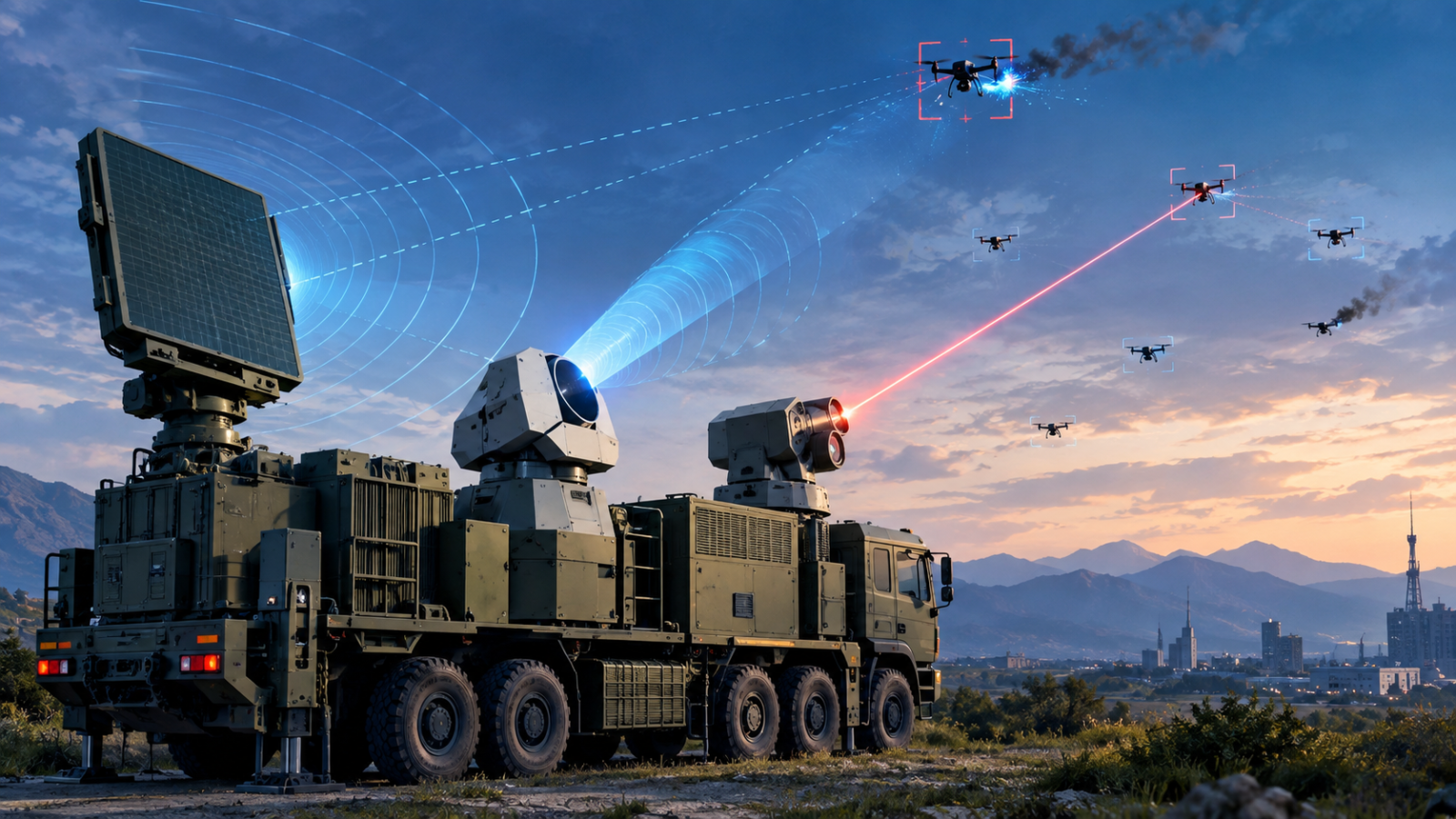

China Expands Technology to Detect and Destroy Drones
Drones have become an important part of modern security and military operations. Small unmanned aircraft can provide surveillance, carry equipment, or be used in attacks. Their low cost and ability to fly at low altitude have made them difficult for traditional air-defense systems to handle in every situation.
China is responding by developing new counter-drone technology designed to detect, track and neutralize unmanned aircraft. Recent Chinese systems include high-power microwave weapons, laser-based defenses, radar systems and other technologies that can work together against individual drones or larger groups.
A key example is the Hurricane 3000, a vehicle-mounted high-power microwave system developed by Chinese state-owned defense contractor Norinco. According to information disclosed by the developer and reported by the South China Morning Post in January 2026, the system has a reported effective interception range of more than 3 kilometers against light and small unmanned aircraft and drone swarms.
How China’s Counter-Drone Technology Works
Detecting a drone is the first step. Counter-drone systems can use several sensors to identify and track an aircraft.
A 2026 review published in IET Cyber-Systems and Robotics describes a range of detection technologies, including radar, infrared cameras, optical sensors, acoustic systems and radio-frequency detection. Combining several sensors can help create a more accurate picture of where a drone is moving and what type of target it may be.
Artificial intelligence can also assist with target classification and tracking. AI systems can process sensor data quickly and help operators distinguish potential drone threats from other low-flying objects.
Once a target has been detected, the defense system can choose a suitable countermeasure. Depending on the system, this can include electronic interference, lasers, high-power microwave energy or conventional interceptors.
Hurricane 3000 Uses High-Power Microwaves
The Hurricane 3000 is one of the most widely reported examples of China’s recent counter-drone development.
Unlike a conventional gun or missile, a high-power microwave weapon uses electromagnetic energy. Chinese developer Norinco says the Hurricane 3000 can operate against small drones and drone swarms at distances exceeding 3 kilometers. The company has also said the system can operate on its own or be combined with lasers and conventional artillery as part of a layered air-defense network.
Another report published in March 2026 described a Chinese urban anti-drone microwave system that combines radar, electro-optical and radio detection equipment. The system can reportedly use electronic jamming as a “soft kill” method or high-power microwaves as a “hard kill” method intended to damage the drone’s electronics.
This approach is particularly relevant to drone swarms, where large numbers of inexpensive aircraft may approach a protected site at the same time.
China Also Shows Laser-Based Drone Defenses
China is also developing laser systems designed to stop drones.
At a defense technology exhibition in Beijing in June 2026, Chinese supplier Harbin Xinguang Optic-Electronics Technology displayed the Lijian series of high-energy laser systems. The South China Morning Post reported that the larger systems were advertised with ranges of up to 1,200 meters, while the portable versions were designed for shorter-range use.
The Lijian systems are notable because some versions are designed to be portable. The reported systems include a laser emitter, cooling equipment and a handheld control terminal. The manufacturer said the Lijian III can burn through a drone in a matter of seconds, although such performance figures are manufacturer claims rather than results independently verified in combat conditions.
Lasers can be attractive for counter-drone missions because they do not rely on a conventional projectile for every engagement. However, they require a clear line of sight and can be affected by environmental conditions such as dust, rain, smoke and atmospheric turbulence.
Why Drone Swarms Are a Growing Challenge
The development of these technologies is closely connected to the rise of drone swarms.
A single drone may be relatively easy to identify and stop. A large number of drones approaching simultaneously creates a different challenge. A defense system must detect many targets, track them rapidly and decide how to respond without exhausting ammunition or overwhelming human operators.
High-power microwave weapons are being studied partly because one system may be able to affect multiple nearby electronic targets. Laser weapons offer another approach for precise engagement of individual drones.
China’s reported development therefore reflects a broader shift toward layered counter-UAS systems rather than relying on a single weapon.
The Role of AI and Sensor Fusion
AI is becoming another important part of counter-drone systems.
Researchers studying counter-UAV technologies say modern defenses increasingly combine information from multiple sensors. Radar can help detect an object, radio-frequency systems can identify communications signals, and optical or infrared cameras can provide additional confirmation.
AI can then help process this information and support faster decisions.
The goal is not simply to find a drone but to understand its movement, identify the threat and select an appropriate response. In a crowded environment, this can be especially important because false identification could create serious security risks.
Challenges Remain
Despite rapid technological development, no counter-drone system is effective against every possible threat.
Small drones can have low radar signatures. Some can operate without easily detectable radio signals. Bad weather can reduce the effectiveness of optical and laser systems, while sophisticated drones may use different navigation and communication methods.
There is also the question of scale. Defending a military base, airport, power plant or border area could require multiple sensors and several types of countermeasures working together.
It is also important to distinguish between technology demonstrations and proven battlefield performance. Many published range, speed and interception figures are based on manufacturer statements or exhibition material.
Conclusion
China is investing heavily in counter-drone technology that combines detection, artificial intelligence, high-power microwaves and lasers.
The Hurricane 3000 represents China’s push toward longer-range microwave-based defenses against small drones and swarms, while the Lijian series shows an effort to make laser-based counter-drone systems more flexible and portable.
As drones become more common, the ability to detect and neutralize them quickly is becoming an important area of defense research around the world. China’s work is part of that wider technological race, but the real-world effectiveness of individual systems will depend on testing, operating conditions and how well different defenses work together.
Also Read | Donald Trump Announces Plans for $15 Billion Steel Mill in Iowa












Leave a comment