

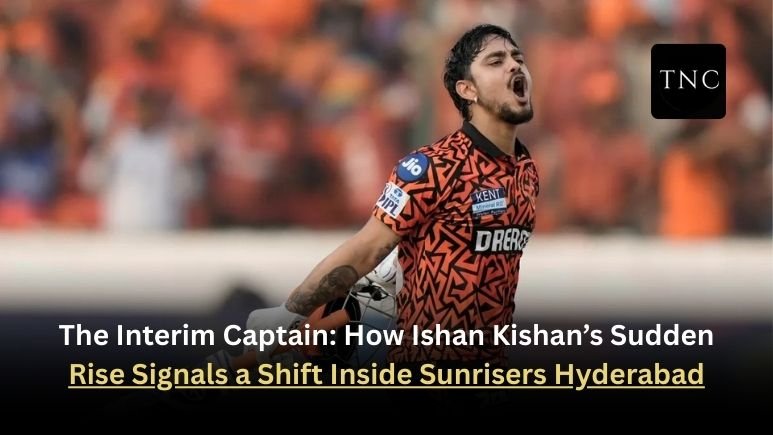

The dressing room at Hyderabad was quieter than usual. Pads leaned against lockers, half-unzipped kits scattered across the floor. In the corner, Ishan Kishan sat hunched over his gloves, tapping the leather rhythmically fast, restless, like a man rehearsing something bigger than a match.
A support staff member walked in, leaned toward him, and said just enough.
Kishan didn’t smile. He just nodded.
By the time he stepped out for practice, the whispers had already spread: the wicketkeeper-batter wasn’t just opening the innings anymore he was leading the team.
Sunrisers Hyderabad’s decision to hand Ishan Kishan the captaincy albeit temporarily after Pat Cummins was ruled out of the opening phase of IPL 2026 isn’t just a stopgap move. It reflects a deeper recalibration inside the franchise: a pivot toward youth, aggression, and Indian leadership in a league increasingly defined by adaptability.
With Cummins sidelined due to injury and recovery concerns, the franchise has entrusted Kishan with steering the side, while Abhishek Sharma steps in as his deputy.
But beneath the surface, this is less about absence and more about opportunity.
Kishan’s appointment didn’t come out of nowhere. It came from momentum.
In the months leading up to IPL 2026, he had rebuilt his career arc dominating domestic cricket, forcing his way back into India’s T20 setup, and showcasing a more composed, situational awareness to complement his natural explosiveness.
That matters. Because captaincy in the IPL is no longer about seniority alone it’s about tempo.
Kishan plays fast. He thinks fast. And crucially, as a wicketkeeper, he sees everything. Every field shift, every hesitation, every misfield it’s all in his line of sight. That tactical vantage point is something franchises increasingly value when grooming leaders.
For Sunrisers Hyderabad, the timing is strategic.
The team has spent the last two seasons searching for consistency. After finishing mid-table in 2025 despite flashes of brilliance, the franchise needed a new identity something sharper, more aggressive, less dependent on overseas leadership.
Kishan fits that mold.
His elevation also signals a subtle shift in IPL team-building philosophy. While overseas captains like Cummins bring experience and calm, they also come with availability risks, international schedules, injuries, and workload management.
Indian captains, on the other hand, offer continuity.
And continuity wins tournaments.
There’s also the Abhishek Sharma factor. By naming him vice-captain, SRH isn’t just filling a role, they’re building a leadership pipeline. A young core, groomed together, tested under pressure, and ready to take ownership beyond a single season.
This isn’t a temporary fix. It’s a trial run for the future.
Ishan Kishan’s captaincy may begin as a placeholder, but it carries the weight of a long-term audition.
If he succeeds, Sunrisers Hyderabad won’t just get through a few matches without Pat Cummins they might discover the leader they didn’t know they were already grooming.
And in the IPL, those unexpected promotions often change everything.
Also Read / When Cricket Collides With National Sentiment.










Leave a comment