

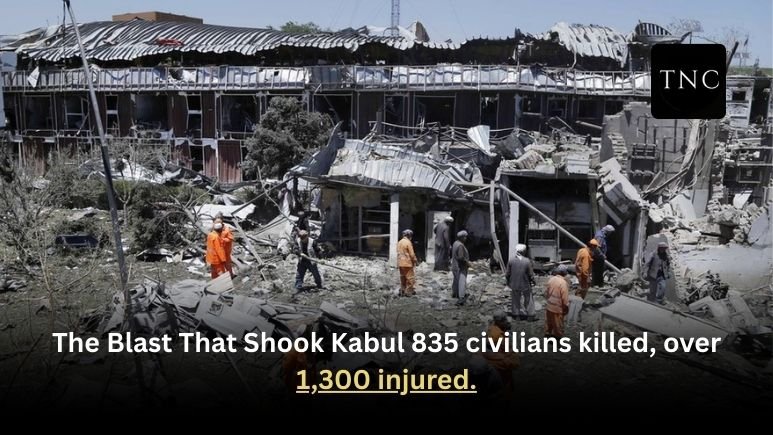

By the time the second ambulance arrived, there was nowhere left to park.
In Kabul’s District 9, a nurse named Farid had been halfway through his night shift at a drug rehabilitation center when the windows blew inward. He remembers the smell first: burnt plastic, antiseptic, something metallic. Patients, many too weak to stand on their own, stumbled into corridors thick with dust. Someone was shouting for oxygen cylinders. Someone else was calling for a doctor who was already dead.
Outside, men clawed at concrete with bare hands. Inside, beds had become coffins.
By dawn, the hospital was no longer a hospital.
The reported Pakistani airstrike on a Kabul medical facility part of a broader escalation between Afghanistan and Pakistan has become one of the deadliest flashpoints in the region in years. Afghan officials say hundreds died in that single strike and at least 835 civilians have been killed and over 1,300 injured since late February in a wave of cross-border attacks.
Pakistan denies targeting civilians, insisting its operations are aimed at militant infrastructure. But the scale and location of casualties, hospitals, homes, even mosques have triggered a deeper question: Is this still counterterrorism, or has it crossed into a widening, undeclared war with civilians caught in the middle?
Both sides tell sharply different stories.
Afghanistan calls the Kabul strike a “crime against humanity,” pointing to the destruction of a 2,000-bed rehabilitation hospital filled with patients.
Pakistan calls it a precision operation, part of a campaign against militants it says operate from Afghan soil.
This contradiction is not new. It is the defining feature of modern cross-border warfare: precision in intent, ambiguity in outcome.
The facts on the ground, however, are harder to dispute.
- Entire neighborhoods along the disputed border have been damaged or flattened.
- Families have been displaced in the thousands.
- Civilian deaths including women and children continue to mount, even as each side denies responsibility.
And then there is the hospital.
Medical facilities occupy a protected status under international law. When they are hit whether by error, faulty intelligence, or intent it signals a breakdown not just of targeting systems, but of restraint itself.
This latest escalation did not begin with a single strike.
Pakistan has long accused Afghanistan’s Taliban-led government of sheltering militants responsible for attacks inside Pakistan. Afghanistan denies it. The cycle is familiar: attack, retaliation, denial, repeat.
Since February, that cycle has accelerated.
Airstrikes have followed suicide bombings. Border skirmishes have escalated into aerial campaigns. What was once a shadow conflict has become visible loud, destructive, and increasingly urban.
Even the justifications reveal the shift. Pakistan frames its actions as defensive, “intelligence-based” strikes against groups like the Tehreek-e-Taliban Pakistan.
Afghanistan frames them as violations of sovereignty.
Both claims can be true and still produce the same outcome: civilians buried under rubble.
Numbers flatten reality. But even they tell a story.
- 835 dead
- 1,300 injured
- Hundreds of homes destroyed
- A hospital reduced to debris
Behind each number is a moment like Farid’s unfinished sentences, interrupted lives.
And perhaps the most dangerous shift is this: civilian deaths are no longer shocking headlines; they are becoming expected outcomes.
That normalization is what turns conflict into crisis.
This is no longer just a dispute over militants or borders. It is a conflict where the line between target and bystander is collapsing.
When hospitals become battlegrounds, the war has already spread further than either side admits.
Also Read / The Night the Sirens Didn’t Stop.









Leave a comment