

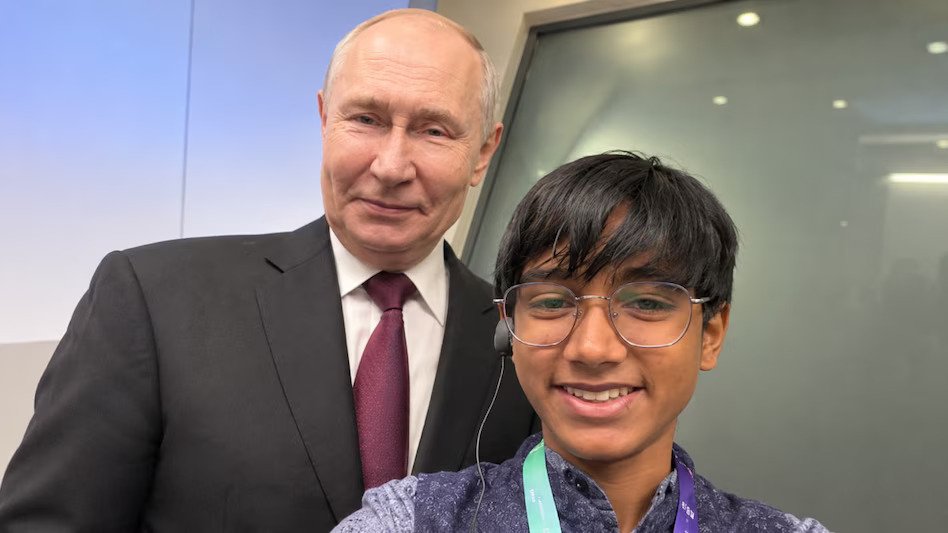

Raul John Aju has attracted fresh attention after meeting Russian President Vladimir Putin at the AI Journey 2026 conference in Moscow. The Indian teenage entrepreneur shared a selfie from the encounter, bringing his work in artificial intelligence to a wider audience.
The interaction took place on November 26, 2026. Several reports describe Aju as 16, while others identify him as 17. This article uses “teenage entrepreneur” because the available coverage does not consistently establish his current age.
What Happened at the Moscow Conference?
Aju was among the young AI participants who interacted with Putin and Kazakhstan President Kassym-Jomart Tokayev. Reporting placed the meeting after the conference’s plenary session.
Anadolu footage listed on Reuters Connect describes Putin taking a selfie with Aju and shaking his hand. The accompanying account identifies Aju as a creator of ThinkCraft, an AI education platform.
AI Journey runs from November 26 to 28 in Moscow. Its programme brings together specialists discussing how artificial intelligence affects society, business and science.
For Aju, the encounter added a memorable moment to an event focused on technology and learning.
Who Is Raul John Aju?
Aju is a young entrepreneur from Kochi, Kerala, popularly described in media reports as the “AI Kid of India”. He founded AI Realm Technologies and is associated with ThinkCraft Academy.
NDTV Profit identifies him as a Class 12 Commerce student at North Edappally Government Higher Secondary School. His story has drawn interest because he is developing technology projects while continuing his education.
In a February interview with UN News, he explained that his interest began with video editing. Access to software through his father’s work helped him explore digital tools.
He later built MeBot, a robot developed for a school science project, at the age of 12.
The Story Behind the Viral Selfie
After the meeting, Aju shared the photograph on Instagram and reflected on the distance between his early experiments and the Moscow encounter.
The Indian Express reported that he recalled making videos at nine and expressed surprise at meeting Putin. He also thanked the people who supported his journey.
The post attracted congratulatory reactions from social media users. Its appeal is easy to understand: a school student involved in technology had reached an international platform and met a prominent world leader.
His post also carried a more personal message about gratitude. The attention has introduced new readers to his background, interests and educational work.
What Does ThinkCraft Aim to Do?
ThinkCraft is described in the conference footage’s accompanying account as an education platform using short, practical lessons to explain AI concepts.
In his UN News interview, Aju described ThinkCraft Academy as a place where learners could move from studying artificial intelligence to building tools for everyday use.
That approach connects learning with experimentation. A student can understand a concept more clearly when they apply it to a small project and examine the result.
The important questions for any learning platform are practical: are its lessons clear, accurate and useful, and can students apply what they learn? Those measures provide a stronger picture of educational value over time.
Why His Father’s Experience Matters
Aju has also spoken about employing his father in the business. In the UN News interview, he explained that access to information through a phone could not replace his father’s professional experience.
He referred to his father’s work at companies including Amazon, Adobe, Wipro and IBM.
The point offers a useful business lesson. Technical curiosity and management experience can contribute different strengths to a young venture. Building a tool, organising a team and supporting customers each require attention.
Putin’s Remarks Linked to Make in India
Education Times reported that Putin connected Aju’s work with Prime Minister Narendra Modi’s Make in India initiative. The report described the Russian leader’s remarks as encouragement for young people developing and implementing their own solutions.
That exchange adds context to the photograph. It places the teenager’s work within a wider discussion about innovation and practical technology development.
The meeting’s significance lies in that opportunity to present ideas, meet experienced participants and continue learning.
What Comes After the Attention?
The Raul John Aju story offers an example of how an early interest can develop through practice, projects and public communication.
For young readers, the most accessible starting point is a manageable project that answers a real question. Testing it carefully and explaining its limits can turn curiosity into a learning experience.
His next achievements will be clearer through the tools he develops, the learning experiences he supports and the problems his work helps address.
The Moscow selfie has given him visibility. Sustained progress will depend on the work that follows: improving products, listening to users and continuing to learn from people with different skills and experience.
Also Read | Bangladesh Garment Wage Increase: Minimum Monthly Pay Set at Tk 17,000











Leave a comment