

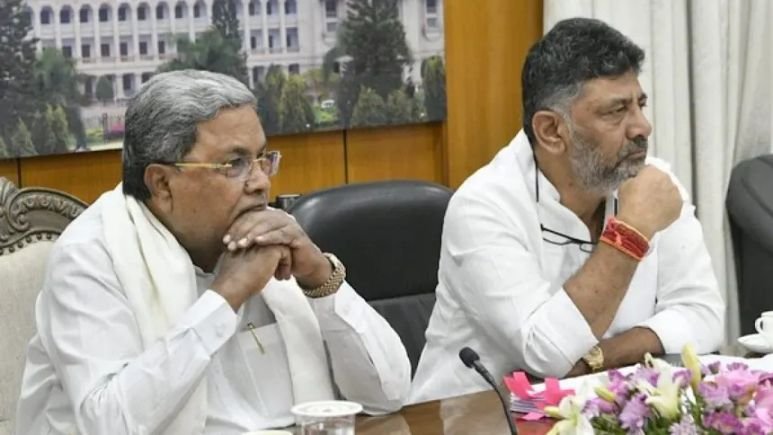

Congress president Mallikarjun Kharge will summon Karnataka’s feuding leaders to Delhi for crisis talks as the public battle over the chief minister’s post threatens party unity in one of its few major states.
Kharge said Thursday he will convene a meeting with Rahul Gandhi, Chief Minister Siddaramaiah, and Deputy Chief Minister DK Shivakumar to “put an end to the confusion” after the two Karnataka leaders engaged in an increasingly bitter war of words on social media.
“After going to Delhi, I will call three-four important leaders and discuss,” Kharge told reporters. “After the discussion, we will say how to go ahead, thereby put an end to the confusion.”
The crisis erupted after the Karnataka government crossed the 2.5-year mark on November 20, triggering speculation about an alleged power-sharing agreement under which Shivakumar would replace Siddaramaiah as chief minister.
The ‘word power’ exchange
The public clash began Wednesday when Shivakumar posted cryptically on X: “Keeping one’s word is the greatest strength in the world. Word power is world power. Be it a judge, president or anyone else including myself, everyone has to walk the talk.”
The timing was unmistakable. Shivakumar’s supporters have long maintained that the Congress high command promised him the chief minister’s post after 2.5 years when Siddaramaiah was chosen for the role following the party’s 2023 electoral victory.
Siddaramaiah responded hours later with his own pointed message using similar language. “The mandate given by the people of Karnataka is not a moment, but a responsibility that lasts five full years,” he wrote.
He added: “A word is not power unless it betters the world for the people. Our word to Karnataka is not a slogan, it means the world to us.”
The 75-year-old chief minister then listed his governance record, claiming he fulfilled 157 of 165 promises during his previous 2013-18 term and has already delivered 243 of 593 commitments this time.
The message was clear: Siddaramaiah has no intention of stepping aside.
The secret deal
Shivakumar later sought to downplay his post, claiming it was “misread” and meant in the context of Constitution Day. But the damage was done.
Speaking to reporters Wednesday, Shivakumar acknowledged the speculation but refused to confirm details. “It is a secret deal between five and six of us,” he said in Kanakapura. “I don’t want to speak publicly on this.”
He emphasized he hasn’t demanded the chief minister’s post. “I have not asked to make me the CM,” he said. “I don’t want to cause embarrassment to the party in any way and weaken it.”
Yet his carefully calibrated public statements have kept the issue alive. “I believe in my conscience. We should work with our conscience,” he told journalists.
The 63-year-old Karnataka Congress president and powerful Vokkaliga leader has been positioning himself as Siddaramaiah’s natural successor for years.
The 2023 arrangement
When Congress swept Karnataka’s assembly elections in May 2023 with 135 of 224 seats, both Siddaramaiah and Shivakumar were strong contenders for chief minister.
The high command faced a delicate balancing act. Siddaramaiah, a Kuruba leader, commanded the AHINDA coalition (minorities, backward classes, and Dalits) that Rahul Gandhi wanted to replicate nationally. Shivakumar controlled the party machinery as state president and enjoyed support from Sonia Gandhi and Priyanka Gandhi.
According to multiple party sources, the leadership resolved the standoff with a 2.5-2.5 formula under which Siddaramaiah would serve the first half of the term before handing over to Shivakumar.
The Congress has never officially confirmed this arrangement. But Shivakumar’s repeated references to a “secret deal” and the timing of the current controversy suggest many in the party believe such an understanding exists.
MLAs take sides
The power struggle has prompted legislators to pick sides publicly.
Several MLAs perceived as Shivakumar supporters traveled to Delhi this week to lobby for leadership change. They argue that agreements made in 2023 must be honored now that 2.5 years have passed.
Ministers close to Siddaramaiah, including Home Minister G Parameshwara and PWD Minister Satish Jarkiholi, have backed the chief minister completing his full term.
“We will require CM Siddaramaiah’s leadership, his service and guidance even after he retires from active politics,” Jarkiholi said Wednesday.
Siddaramaiah’s son Yathindra, a Congress MLC, stated Thursday that “there is no development regarding a leadership change in the state.”
“CM Siddaramaiah is providing good administration. There is no need for any change,” he told reporters in Mysuru. “In my opinion, I am sure that CM Siddaramaiah will complete his five-year tenure.”
A third contender emerges
Adding complexity to the situation, Deputy Chief Minister G Parameshwara suggested this week he could be in the running if leadership changes.
“I’m always in the race, it is not a big issue,” Parameshwara said. “I was the Pradesh Congress Committee President in 2013. We brought the Congress government to power.”
The 73-year-old Dalit leader’s entry into the conversation complicates any straightforward Siddaramaiah-to-Shivakumar transition.
BJP seizes opportunity
Opposition parties have gleefully exploited the Congress infighting.
“Words and worlds are revolving around the chair in Karnataka as the Congress fights internally over power instead of governance,” BJP leaders mocked.
They’ve portrayed the episode as proof that the state government is driven by personal ambitions and secret deals rather than the welfare guarantees promised to voters.
High command’s dilemma
The crisis places the Congress high command in an impossible position.
Honoring an alleged power-sharing commitment to Shivakumar risks destabilizing a government that has won praise for its welfare schemes. It would also set a precedent that could complicate leadership decisions in other states.
But ignoring Shivakumar’s claims risks alienating a powerful regional leader who controls the state party machinery and commands significant Vokkaliga support. His faction’s discontent could weaken Congress ahead of 2028 state elections.
Kharge’s decision to summon both leaders to Delhi suggests the high command recognizes it can no longer avoid taking a stand.
“We should certainly call them and discuss,” Kharge said when asked if the CM and deputy CM would come to Delhi. “We will call them, discuss with them and settle the issue.”
“Rahul Gandhi will be part of it, also other members including CM and Deputy CM. After discussing with everyone, a decision will be made.”
The cabinet reshuffle angle
Another dimension involves a pending cabinet reshuffle. Two of Karnataka’s 34 ministerial posts remain vacant.
Siddaramaiah reportedly wants to proceed with the reshuffle to reward loyalists. Shivakumar’s camp believes a reshuffle without addressing the chief minister question would effectively signal Siddaramaiah serving the full term.
“A reshuffle approved by the high command would effectively signal Siddaramaiah finishing the full five-year term, sidelining Shivakumar’s chances of taking over,” one Congress insider explained.
Congress MP Randeep Singh Surjewala acknowledged Thursday that both leaders have agreed to await the high command’s decision on both the reshuffle and the larger leadership question.
He criticized the BJP for “running a maligning campaign” and warned Congress leaders against making “needless statements” that undermine party unity.
What happens in Delhi
The Delhi meeting, likely scheduled for Friday, will force the high command to choose between several difficult options.
They could honor the alleged 2.5-year commitment and install Shivakumar as chief minister. This would satisfy his supporters but create enormous resentment in the Siddaramaiah camp.
They could ask Siddaramaiah to continue for the full term, potentially offering Shivakumar some compensation package. This preserves stability but risks breaking the party’s word to a key leader.
They could propose a middle path, perhaps having Siddaramaiah serve another six months before transitioning to Shivakumar. This satisfies neither faction fully but allows face-saving on both sides.
Or they could postpone any decision, asking both leaders to focus on governance while the high command considers the matter further. This kicks the can down the road but doesn’t resolve underlying tensions.
The stakes for Congress
The Karnataka crisis matters beyond state politics.
Congress governs just three states: Karnataka, Telangana, and Himachal Pradesh. Karnataka is by far the most significant, both in terms of size and as a showcase for Congress’s welfare model.
The state’s five guarantee schemes including free bus travel for women and monthly cash assistance to women heads of households have won national attention. Congress hopes to replicate this model in upcoming state elections.
Internal feuding threatens to undermine that narrative. It also risks destabilizing a government that needs to deliver ahead of 2028 state polls.
For Rahul Gandhi, the crisis tests his leadership. His preference for Siddaramaiah’s AHINDA model conflicts with family loyalty to Shivakumar, who stood by the party during difficult times.
How he navigates this could set precedents for handling similar disputes in other states.
The coming days will reveal whether Kharge can broker a compromise that preserves party unity or whether Karnataka becomes Congress’s latest self-inflicted wound. For Siddaramaiah and Shivakumar, the Delhi meeting will determine who leads Karnataka and who waits for another chance.
Whatever the outcome, the public nature of their clash has already damaged Congress in a state where it can ill afford internal warfare.










Leave a comment