

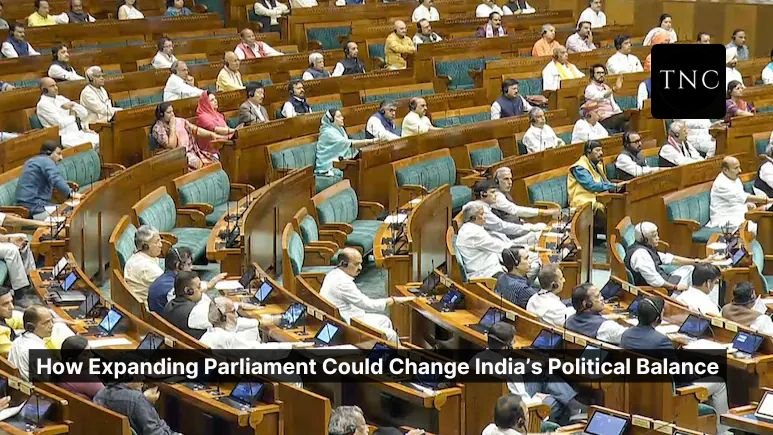

At a tea stall outside a district collector’s office in Telangana, a local party worker scrolls through his phone, pausing at a headline about Parliament expanding. He squints, then laughs half disbelief, half calculation. “More seats means more tickets,” he says, tapping the screen. But then he stops. “Or maybe… less power for us.”
Around him, the conversation shifts quickly from opportunity to anxiety. Because in Indian politics, numbers are never just numbers. They redraw power.
The Union government’s proposal to increase the size of the Lok Sabha by roughly 50% from 543 to around 850 seats has triggered one of the most consequential political debates in years.
On paper, the plan promises greater representation, smoother implementation of women’s reservation, and a modernized Parliament. But beneath that promise lies a deeper question: who gains political power in a larger India and who risks losing it?
The logic behind the expansion is straightforward. India’s population has grown dramatically since the last delimitation freeze in the 1970s. More people should mean more representatives. The proposed increase would also help accommodate a 33% reservation for women, potentially bringing over 270 women into Parliament.
But representation in India is not evenly distributed; it is tied to population. And that is where the tension begins.
Northern states like Uttar Pradesh and Bihar, with higher population growth, stand to gain the most seats in a population-based redistribution. Southern states, which successfully controlled population growth over decades, risk seeing their relative influence shrink even if their absolute number of seats rises.
The Centre has attempted to address this fear by suggesting a uniform increase of roughly 50% more seats for every state arguing it would preserve the current balance. Yet critics remain unconvinced.
Political leaders in the South warn that even a proportional increase could subtly tilt long-term power dynamics, especially once fresh delimitation based on updated census data kicks in.
Some have proposed hybrid models splitting new seats between population and economic contribution to prevent what they see as a structural penalty for states that invested in education, healthcare, and family planning.
The debate has quickly escalated beyond policy into politics. Opposition parties argue the move could consolidate power in already dominant regions, while the government frames it as overdue democratic expansion.
Even outside formal politics, the reaction is visceral. Online discussions reveal sharp divides; some users welcome better representation, while others call it a “numbers game” that could centralize power further.
And then there is timing. With delimitation expected after the next Census and changes likely to take effect around the 2029 elections, this isn’t just about governance it’s about shaping India’s political map for decades.
Expanding Parliament sounds like a technical reform. It isn’t. It’s a reset of political power.More seats will mean more voices but not necessarily equal influence. And in a country as diverse as India, how those seats are distributed may matter far more than how many are added.









Leave a comment