

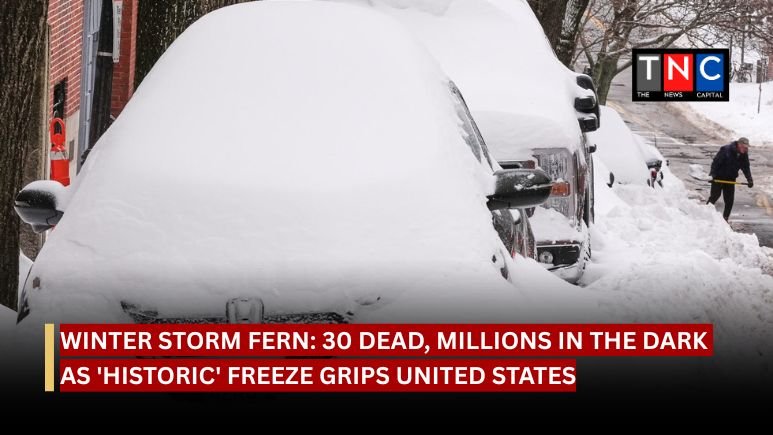

A colossal storm system stretching 2,000 miles from the Southern Plains to New England has paralyzed the United States, leaving a trail of record-breaking flight cancellations, widespread blackouts, and a rising death toll. The United States is grappling with the catastrophic aftermath of Winter Storm Fern, a “historic” weather event that has claimed at least 30 lives and left over 670,000 customers shivering without electricity as of Tuesday, January 27, 2026, prompting President Donald Trump to approve federal emergency disaster declarations for more than a dozen states across the South and Mid-Atlantic.
While the Northeast is buried under more than a foot of snow, the South has been crippled by a “catastrophic” glaze of ice that has snapped power lines and utility poles like toothpicks, creating conditions regions unaccustomed to winter weather are ill-equipped to handle.
- Hardest Hit Regions: Tennessee remains the epicentre of the blackout crisis, with utility providers in Nashville warning that restoration could take weeks due to the extent of infrastructure damage and difficulty accessing affected areas.
- Persistent Outages: Significant outages also persist in Mississippi, Louisiana, and Texas, with some rural communities facing the prospect of being without power for extended periods as crews work systematically through damaged grid infrastructure.
- The ‘Ice Storm of a Generation’: Officials in Mississippi described the event as the state’s worst ice storm since 1994, with ice accumulations reaching three-quarters of an inch in some areas enough weight to collapse trees and power lines.
- University Closures: At the University of Mississippi, classes have been cancelled for the entire week as the campus remains encased in a thick layer of ice, with buildings and walkways rendered hazardous and power supply unreliable.
As temperatures plunge to dangerous levels, authorities are racing to provide shelter and warmth to vulnerable populations while the death toll continues to climb.
- Warming Centres: Authorities are rushing to supply cots, blankets, and generators to temporary shelters as temperatures in parts of Texas and the Deep South plunge to a bone-chilling -20°C (-4°F), levels rarely experienced in these regions.
- New York Deaths: In New York City, where eight people were found dead outdoors over the weekend, officials have urged residents to stay inside as “flash freezing” continues to turn treated roads into skating rinks.
- Hypothermia Risk: Many of the 30 confirmed deaths are linked to hypothermia, with homeless populations and those in homes without power facing particular vulnerability to the extreme cold.
- Vehicle Accidents: Additional fatalities resulted from ice-related traffic crashes, with black ice creating treacherous conditions on highways and local roads throughout affected regions.
Air travel across North America has faced its most significant disruption since the 2020 pandemic, with “total paralysis” reported at several major hubs creating cascading delays throughout the global aviation network.
- The Sunday Surge: On Sunday alone, more than 12,500 flights were cancelled nationwide the highest single-day figure in six years. By Tuesday morning, total cancellations for the weekend surpassed 16,000 flights.
- Airport Groundings: Washington’s Ronald Reagan National Airport and New York’s LaGuardia were forced to halt almost all operations due to ice accumulation on runways and taxiways that overwhelmed de-icing capabilities.
- International Impact: Major international carriers, including Air India, Emirates, and Etihad, were forced to cancel or reschedule services to the U.S. East Coast, affecting thousands of international passengers and cargo operations.
- Recovery Timeline: The Federal Aviation Administration (FAA) has advised that while they hope to “get back to normal” by Wednesday, hundreds of flights remain delayed as de-icing crews struggle against refreezing runways and backlogged aircraft repositioning.
Winter Storm Fern by the Numbers
| Metric | Reported Figures (as of Jan 27, 2026) |
| Confirmed Deaths | 30 (linked to hypothermia, crashes, and ice-related incidents) |
| Current Power Outages | 670,000+ customers |
| People Under Cold Alerts | 230 Million (over half the US population) |
| Flight Cancellations | 16,000+ (weekend total) |
| Economic Loss (Estimated) | $105 Billion – $115 Billion |
| Storm System Length | 2,000 miles (Southern Plains to New England) |
| Ice Accumulation (Maximum) | 0.75 inches in parts of Mississippi |
The National Weather Service (NWS) has warned that the “colossal” system is not finished, with additional Arctic air threatening to prolong the crisis and delay recovery efforts.
- Continued Cold: While the heaviest snowfall has moved out of the Northeast, a secondary pulse of Arctic air is expected to keep temperatures well below freezing through the weekend, preventing ice melt and complicating restoration efforts.
- Flash Freezing: Even treated roads are experiencing “flash freezing” as temperatures remain so low that salt and chemical treatments lose effectiveness, creating dangerous conditions for emergency responders and utility crews.
- Weekend Extension: The prolonged duration of subfreezing temperatures potentially lasting through the upcoming weekend means communities will remain in crisis mode for days longer than typical winter storms.
- Infrastructure Stress: Extended cold places enormous stress on already-damaged power grids, water systems (frozen pipes), and heating infrastructure operating at maximum capacity.
The widespread blackouts have revived memories of the February 2021 Texas grid collapse and raised questions about whether infrastructure improvements have been sufficient.
- Tennessee Epicentre: While Texas faced the 2021 crisis, Tennessee has emerged as the epicentre of Winter Storm Fern’s blackout emergency, with Nashville utilities warning restoration could take weeks.
- Week-Long Outages: The prospect of week-long power outages in subfreezing temperatures creates life-threatening conditions for vulnerable populations including elderly residents, families with young children, and those with medical needs requiring electricity.
- Grid Reliability Questions: The administration is facing scrutiny about whether “bolstering grid reliability” efforts since 2021 have been adequate, particularly in southern states less accustomed to extreme winter weather.
- Winterization Gaps: The extensive damage suggests that infrastructure winterization insulating equipment, protecting transformers, preparing for ice loading remains inadequate in regions that historically experienced mild winters.
President Trump has approved federal emergency disaster declarations for more than a dozen states, triggering federal assistance and resources for affected regions.
- Disaster Declaration States: Federal emergency status enables affected states to access FEMA resources, federal emergency funds, and coordinated multi-state response capabilities.
- National Guard Deployment: Multiple states have activated National Guard units to assist with welfare checks, emergency transportation, and supply distribution to isolated communities.
- FEMA Coordination: The Federal Emergency Management Agency is coordinating shelter operations, generator distribution, and emergency supply chains to support state and local authorities.
- Recovery Funding: Emergency declarations unlock federal funding for infrastructure repair, debris removal, and long-term recovery efforts that will extend well beyond the immediate crisis.
The storm’s economic toll is staggering, with preliminary estimates placing total losses between $105 billion and $115 billion across multiple sectors.
- Business Interruption: Widespread closures of businesses, schools, and government offices create massive productivity losses and economic disruption.
- Infrastructure Damage: Repair costs for damaged power grids, roads, bridges, and other public infrastructure will run into tens of billions of dollars.
- Agricultural Losses: Livestock losses, crop damage, and agricultural infrastructure destruction add billions to the economic toll, particularly in southern states.
- Travel Industry: The 16,000+ cancelled flights represent hundreds of millions in lost airline revenue, plus cascading economic effects on hotels, rental cars, and destination economies.
Meteorologists are viewing Winter Storm Fern as evidence of increasing volatility in seasonal weather patterns, though the administration focuses on infrastructure rather than climate factors.
- Polar Vortex Disruption: The extreme Arctic intrusion reflects disruptions to the polar vortex that allow frigid air masses to plunge southward into regions unprepared for such conditions.
- Frequency Questions: Whether such extreme events are becoming more frequent remains subject to scientific debate, though recent years have seen multiple “historic” winter storms affecting the U.S.
- Infrastructure Planning: Regardless of causation, the storm demonstrates that infrastructure planning must account for worst-case scenarios that historically occurred rarely but may be increasing in frequency.
- Policy Implications: The emphasis on “bolstering grid reliability” suggests focus on adaptation and resilience rather than addressing underlying climate drivers of weather volatility.
As the U.S. moves from a “rescue” to a “recovery” phase, multiple challenges will extend the crisis’s impacts well beyond the storm’s meteorological conclusion.
- Power Restoration: Week-long restoration timelines in Tennessee and other affected areas mean some communities will spend days in subfreezing darkness before electricity returns.
- Infrastructure Assessment: Full damage assessment cannot begin until ice melts and crews can safely access affected areas, delaying the start of comprehensive repairs.
- Economic Recovery: Businesses face not just immediate closure losses but delayed reopening as power is restored gradually, supply chains are re-established, and consumer confidence returns.
- Vulnerable Populations: The elderly, disabled, homeless, and medically fragile populations will require sustained support services throughout the recovery period and face elevated mortality risk until normal conditions return.
Winter Storm Fern has paralyzed a 2,000-mile swath of the United States with a catastrophic combination of ice, snow, and Arctic cold that has killed 30 people, left 670,000 without power, cancelled 16,000 flights, and caused $105-115 billion in economic losses the “historic” event demonstrates that southern states remain dangerously vulnerable to extreme winter weather despite infrastructure improvements since the 2021 Texas grid collapse, with Tennessee utilities warning restoration could take weeks as 230 million Americans remain under cold weather alerts and a secondary Arctic pulse threatens to prolong the crisis through the weekend.
Also Read / Desert turns white: Rare snowfall transforms Saudi Arabia into ‘Winter Wonderland’.














Leave a comment