

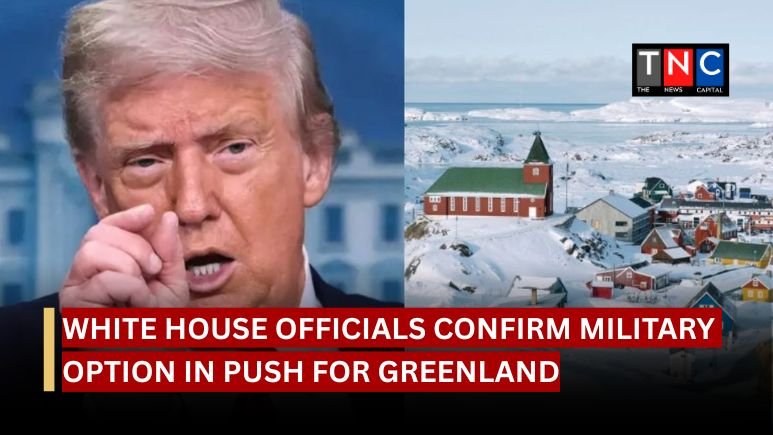

The words were spoken matter-of-factly, as if discussing routine policy options rather than threatening military action against an allied democracy’s territory. But make no mistake: when a White House spokesperson confirms that using force remains “on the table” to acquire Greenland, it represents one of the most extraordinary diplomatic ruptures in modern transatlantic history and a moment when America’s closest allies are confronting the reality that the rules-based international order they helped build may no longer constrain Washington.
At a press briefing Tuesday, White House spokesperson Karoline Leavitt stated that President Donald Trump has made clear that acquiring Greenland is a “national security priority” and that U.S. military power is “always an option” in pursuing that goal. She described internal administration discussions as ranging from diplomatic negotiations with the Kingdom of Denmark to exploring “broader strategic arrangements” carefully vague language that could mean anything from economic incentives to outright coercion but stopped short of outlining any specific operational plan or timeline.
Greenland, a semi-autonomous Danish territory with a population of roughly 56,000 people most of them Indigenous Inuit sits at the edge of the Arctic Circle in a position of extraordinary strategic importance. For decades, U.S. military strategists have viewed the massive island as a crucial bulwark against Russian and Chinese influence in the rapidly warming and increasingly contested Arctic region. Washington has maintained military facilities there for generations, most notably the Pituffik Space Base (formerly Thule Air Base), under longstanding agreements with Copenhagen that both sides have historically treated as mutually beneficial arrangements between NATO allies.
The suggestion that this relationship could now be enforced through military means rather than mutual agreement represents a fundamental break with how alliances are supposed to function.
European allies respond with rare unanimity:
European governments, which often struggle to present unified positions on controversial issues, responded with unusual coordination and clarity. Leaders from France, Germany, Britain, and other major European nations issued a joint statement explicitly backing Danish sovereignty over Greenland and insisting that “Greenland belongs to its people” a pointed reminder that the territory’s 56,000 residents are actual human beings with rights, not simply strategic real estate to be acquired.
The statement warned in unusually direct language that any coercive attempt to seize control of Greenland would fundamentally undermine NATO’s coherence and violate the basic principles of international law that the alliance was supposedly created to defend. Denmark’s Prime Minister Mette Frederiksen called the U.S. rhetoric “completely unacceptable” and emphasized Greenland’s inherent right to self-determination the principle that peoples have the right to freely determine their political status without external coercion.
Canada, which shares Arctic waters and strategic interests with Greenland, announced it was initiating diplomatic engagement directly with Greenlandic authorities, effectively treating the territory as a separate entity worthy of direct consultation rather than simply deferring to Copenhagen. Canadian officials affirmed that any decisions about Greenland’s future must rest exclusively with its residents and the Danish state, not be imposed by external powers regardless of their military capabilities.
“We are witnessing something unprecedented: the United States openly threatening military action against the territory of a NATO ally. This isn’t how alliances work. This is how empires behave,” stated a senior European diplomat speaking on condition of anonymity due to the sensitivity of transatlantic relations.
“Greenland is not for sale. Greenland’s people are not property to be transferred. This should not need to be stated in 2026, but apparently it does,” Danish Foreign Minister Lars Løkke Rasmussen declared in a televised address, his frustration barely concealed.
The renewed push to bring Greenland under American control follows a pattern of increasingly assertive critics would say aggressive moves by the Trump administration on multiple global strategic fronts. Most notably, the recent military operation in Venezuela that resulted in the capture and extraction of President Nicolás Maduro demonstrated Washington’s willingness to use force unilaterally against governments it views as hostile or illegitimate, regardless of international legal frameworks or allied concerns.
Leavitt framed Greenland’s strategic location positioned between North America and Europe, controlling access to Arctic shipping routes, and sitting atop potentially vast untapped mineral resources including rare earth elements crucial for modern technology as central to deterring geopolitical rivals, particularly Russia and China, both of which have expanded their Arctic presence dramatically in recent years.
But critics across the political spectrum argue that invoking the prospect of U.S. military action against the territory of a democratic ally sets a catastrophically dangerous precedent that undermines the very alliance structures America helped create and has benefited from for over 75 years.
“If the United States can threaten military seizure of Danish territory today, what stops China from claiming the same right over Taiwan tomorrow? What stops Russia from justifying its actions in Ukraine by pointing to American precedent? This destroys the moral authority that has been America’s greatest strategic asset,” warned Dr. Emma Ashford, a senior fellow at the Stimson Center specializing in transatlantic security.
Danish and Greenlandic leaders have made their position unambiguously clear through multiple statements over recent weeks: the island is categorically not for sale, not open to negotiation regarding sovereignty transfer, and the people of Greenland who gained expanded self-governance in 2009 and are on a gradual path toward potential full independence vehemently oppose any suggestion of forced annexation or transfer to U.S. control.
Greenland’s Premier Múte Egede has been particularly vocal, stating that Greenland’s future will be determined by Greenlanders themselves, not by great powers negotiating over their heads as if they were colonial subjects rather than citizens with democratic rights. He emphasized that while Greenland values its security relationship with the United States, this does not extend to surrendering sovereignty.
European leaders have warned in increasingly stark terms that even entertaining military options let alone actually pursuing them could fracture NATO’s cohesion irreparably. The alliance has weathered numerous internal disputes over its 76-year history, from Suez to Iraq, but never before has one member openly threatened to use force to seize another member’s territory. That this threat comes from the alliance’s founding member and dominant military power makes it exponentially more destabilizing.
The broader Arctic strategic context:
The timing of this confrontation reflects genuine strategic tensions in the Arctic, a region undergoing dramatic transformation due to climate change. As ice sheets melt and new shipping routes open, competition for resources and strategic positioning has intensified dramatically:
- Russian Arctic Expansion: Moscow has invested heavily in Arctic military infrastructure, reopening Soviet-era bases and deploying advanced weapons systems along its northern coastline.
- Chinese Arctic Ambitions: Beijing, despite being geographically distant from the Arctic, has declared itself a “near-Arctic state” and invested billions in infrastructure projects across the region, including in Greenland itself.
- Resource Competition: Greenland sits atop potentially vast deposits of rare earth minerals, uranium, and other resources critical for modern technology and defense systems—resources currently dominated by Chinese production.
- Strategic Geography: Control of Greenland would give the U.S. unprecedented ability to monitor and control access between the Atlantic and Arctic Oceans, positioning military assets closer to both Russia and emerging northern shipping routes.
These are legitimate strategic concerns. What’s unprecedented isn’t America’s interest in Greenland that dates back to the 1860s when the U.S. first explored purchasing it but rather the willingness to openly threaten military force against an allied democratic territory as a policy option.
For now, the confrontation remains largely in the realm of rhetoric and diplomatic positioning. U.S. officials continue to insist that diplomacy and negotiation remain the “preferred” approach, but the very inclusion of military force in official White House statements has fundamentally changed the nature of the discussion transforming what might have been a somewhat uncomfortable diplomatic conversation into an existential question about whether the United States still respects the sovereignty of allied democracies.
How far the Trump administration intends to push this issue, whether it plans to translate inflammatory rhetoric into concrete policy actions, and what such actions might actually look like remain deeply unclear. What is crystal clear is that Greenland’s sovereignty has emerged as an unexpected flashpoint in the broader geopolitical competition playing out in the Arctic and that America’s traditional allies are drawing a hard line against what they view as unacceptable threats against one of their own.
The diplomatic standoff continues, with European capitals coordinating responses, Danish officials consulting with Greenlandic leaders about enhanced security arrangements that might not depend on U.S. cooperation, and NATO officials privately expressing alarm about fractures that could weaken the alliance at precisely the moment when unity matters most.
And in Greenland itself, 56,000 people who probably never imagined their remote island would become the center of a geopolitical crisis are watching nervously as great powers debate their future, hoping that in 2026, the principle that people have the right to determine their own destiny still means something even when a superpower decides it wants what you have.
The question isn’t whether Greenland is strategically important. The question is whether that importance gives anyone the right to take it by force. And the fact that question is even being asked tells you everything about how much has changed.
Also Read / Transition Under Shadow: 55 dead as Venezuela enters ‘Phase Two’ of post-Maduro era.








Leave a comment