

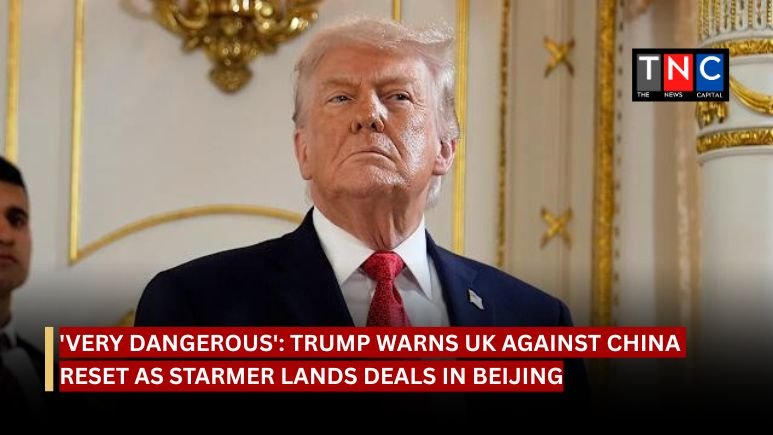

The timing couldn’t have been more pointed. As Keir Starmer stood beside Xi Jinping celebrating a “new era” in UK-China relations and announcing billions in trade deals, Donald Trump was 6,000 miles away telling reporters that Britain was making a “very dangerous” mistake the same language he used about Canada just before threatening to economically destroy them. The message was unmistakable: you can have a special relationship with Washington or you can have one with Beijing, but in Trump’s world, you cannot have both.
Speaking from the red carpet at the Kennedy Centre on Thursday evening (January 29, 2026) during the premiere of the documentary film Melania, President Donald Trump issued a stark and public warning that the United Kingdom is entering “very dangerous territory” by pursuing what his administration views as an overly ambitious economic reset with China. The blunt intervention came just hours after Prime Minister Keir Starmer concluded a three-hour summit with President Xi Jinping in Beijing’s Great Hall of the People, where the two leaders enthusiastically hailed the beginning of a “comprehensive strategic partnership” and announced significant commercial victories for British businesses, including major concessions for Scotch whisky exporters and landmark investment commitments from pharmaceutical giants.
The President’s unusually direct public critique of a close ally’s sovereign foreign policy decisions has reignited fears of a serious transatlantic trade rift and raised the specter of potential retaliatory tariffs that could devastate Britain’s already-fragile post-Brexit economy.
The President’s critique was delivered casually to assembled reporters at what was supposed to be a cultural event, but the substance was anything but casual. When specifically asked about the United Kingdom’s active pursuit of Chinese investment and expanded trade relationships, Trump did not equivocate or offer diplomatic pleasantries:
- The “Very Dangerous” Characterization: “It’s very dangerous for them to do that,” Trump stated flatly when asked about the UK’s China engagement, his tone suggesting genuine concern rather than mere disapproval. He immediately expanded the criticism beyond Britain: “It’s even more dangerous for Canada to get into extensive business relationships with China,” pointedly noting that Canada under Prime Minister Mark Carney is currently “doing very poorly economically” a claim that conveniently ignores that much of Canada’s economic struggles stem from Trump’s own threatened tariffs and trade disruptions.
- The Implicit Tariff Threat: While Trump conspicuously did not explicitly threaten the United Kingdom with the punishing 100% tariffs he has openly proposed for Canada tariffs that would essentially end normal trade between the countries his rhetoric deliberately mirrored the “America First, everyone else distant second” posture that has systematically rattled NATO allies and upended traditional security partnerships throughout early 2026. The omission of a specific tariff threat was notable primarily because it suggested the threat remains on the table, not that it’s been ruled out.
- The “Friend” Who’s a Problem: In characteristically contradictory fashion, Trump referred to President Xi Jinping as a “friend” language he’s used inconsistently depending on whether he’s threatening China with tariffs or praising Xi’s authoritarian governing style but simultaneously characterized any Western nation’s strategic pivot toward deeper Beijing engagement as representing a “big hurdle” that fundamentally undermines U.S.-led security architecture and American economic interests globally.
Despite the threatening noises emanating from Washington, Downing Street has aggressively framed the four-day China visit the first by a British Prime Minister in eight years, reflecting how severely the relationship had deteriorated under previous Conservative governments as an exercise in essential “economic pragmatism” that Britain can no longer afford to avoid:
- Scotch Whisky Breakthrough: Starmer successfully negotiated a significant reduction in Chinese tariffs on premium Scotch whisky imports a major win for Scotland’s economically crucial distilling industry that generates billions in export revenue and supports tens of thousands of jobs in economically depressed rural areas. The tariff reduction could increase UK whisky exports to China by an estimated 30-40% over the next three years.
- Visa-Free Travel Access: The UK secured an agreement for 30-day visa-free travel for British tourists and business visitors to China a reciprocal arrangement that dramatically reduces bureaucratic barriers and costs for the growing number of UK citizens seeking to do business in or visit China. This puts Britain on par with several EU nations that already enjoy similar arrangements.
- AstraZeneca’s Massive Commitment: In perhaps the most significant commercial announcement, British-Swedish pharmaceutical giant AstraZeneca revealed plans to invest an staggering $15 billion (£11.8 billion) in China between now and 2030 to dramatically expand its research and development facilities and manufacturing footprint in the Chinese market. This represents one of the largest foreign direct investment commitments ever made by a UK-headquartered company in China and provides significant validation for Starmer’s engagement strategy.
- The “Mega-Embassy” Quid Pro Quo: The diplomatic and commercial thaw was made possible in large part by Starmer’s controversial decision last week to finally approve China’s long-delayed plans to construct a massive new “mega-embassy” in London a facility significantly larger than China’s current diplomatic presence that would include expanded commercial, cultural, and consular facilities. The project had been blocked for years by previous UK governments citing legitimate espionage and surveillance concerns raised by MI5, but Starmer greenlit it over security service objections, clearing a major diplomatic “stuck point” that had poisoned bilateral relations.
Starmer’s impossible balancing act:
Prime Minister Starmer publicly maintains that the United Kingdom does not face a binary choice between maintaining its security partnership with Washington and pursuing economic opportunities with Beijing, pointing to substantial evidence that both relationships can theoretically coexist:
- The American Investment Counterpoint: Starmer’s team repeatedly emphasizes the £150 billion ($190 billion) in American investment commitments into Britain that were announced during Trump’s state visit to the UK in September 2025—investments that significantly exceed anything China has offered and demonstrate that courting Beijing hasn’t (yet) triggered American economic retaliation or corporate withdrawal.
- The “Pragmatic” Defense: “Ignoring China when it represents the second-biggest economy in the world, when there are substantial business opportunities that could benefit British workers and companies, and when cooperation is needed on global challenges like climate change simply wouldn’t be sensible or responsible,” Starmer stated during a joint press conference with Chinese Premier Li Qiang, his language carefully crafted to portray China engagement as economically necessary rather than geopolitically preferential.
The strategic tensions underlying the disagreement:
| Strategic Dimension | UK Objective in China | Washington’s Fundamental Concern |
| Market Access & Trade | Launch feasibility study for comprehensive new services trade agreement; expand financial sector access to Shanghai markets | Fear that UK becomes “back door” for Chinese goods and capital to enter Western markets, circumventing U.S. restrictions and sanctions |
| Security Dialogue | Maintain “respectful but candid” dialogue on human rights issues; press for release of Jimmy Lai; address Xinjiang concerns | Deep concern that economic dependencies will weaken UK’s willingness to support NATO positions against Beijing; “respectful dialogue” seen as capitulation |
| Economic Growth | Boost trade with UK’s third-largest trading partner to avoid technical recession; create jobs in struggling regions | Fundamental conflict with U.S. “de-risking” strategy and Trump’s aggressive tariff-based economic warfare aimed at decoupling from China |
| Technology & Investment | Attract Chinese investment in green technology, AI research, infrastructure modernization | Acute fears about technology transfer, intellectual property theft, and Chinese infiltration of sensitive sectors |
The Canadian warning that haunts British calculations:
Trump’s warning to the UK carries extraordinary weight precisely because of his recent brutal treatment of Canada, which pursued a nearly identical “we can engage both superpowers” strategy just weeks earlier:
After Canadian Prime Minister Mark Carney pursued what he termed a necessary “China Pivot” earlier this month signing a trade framework agreement with Beijing that included provisions for increased Chinese investment in Canadian infrastructure and expanded market access Trump’s response was swift, public, and economically devastating:
- Immediately rescinded Canada’s invitation to participate in the “Board of Peace” (Trump’s proposed new international security architecture meant to replace or supplement existing multilateral institutions)
- Threatened to “eat Canada alive economically” with comprehensive trade penalties
- Publicly questioned whether Canada deserves to remain in revised North American trade arrangements
- Imposed preliminary 25% tariffs on select Canadian goods as “warning shot”
The message to other allies was unmistakable: choosing economic engagement with China over exclusive alignment with Washington will trigger severe economic retaliation, regardless of historic alliances or security partnerships.
“Trump sees this in zero-sum terms. If you’re doing business with China, you’re undermining America. If you’re not completely aligned with his confrontational approach to Beijing, you’re the problem. There’s no middle ground in his worldview,” explained Dr. Leslie Vinjamuri, director of the U.S. and Americas Programme at Chatham House.
“The UK is trying to have it both ways maintain the special relationship while also accessing Chinese markets. That worked during the Obama and even Trump 1.0 years. But Trump 2.0 with his ‘absolute loyalty or total opposition’ mentality makes that impossible,” noted Sir Peter Westmacott, former British Ambassador to the United States.
As Starmer prepares to travel to Shanghai for the final leg of his China visit where additional commercial agreements are expected to be announced his government faces an extraordinarily delicate task: celebrating what they’re characterizing as a “consistent, stable, and mutually beneficial” relationship with the world’s second-largest economy without triggering a fundamental “rupture” in the special relationship with a newly assertive, increasingly erratic, and demonstrably vindictive White House.
The economic stakes for Britain could hardly be higher. The country desperately needs growth to avoid recession, requires investment to modernize infrastructure, and depends on export markets to generate employment. China offers all of these but potentially at the cost of American retaliation that could prove even more economically damaging than the benefits Beijing provides.
Starmer is gambling that he can thread this needle that Britain’s unique position as a nuclear power, permanent Security Council member, NATO cornerstone, and global financial center gives it leverage and importance that smaller countries like Canada lack, making Trump unwilling to follow through on threats that would damage American interests as much as British ones.
Whether that gamble pays off depends entirely on whether Donald Trump views the UK-China relationship as Starmer frames it pragmatic economic engagement that doesn’t compromise security commitments or as Trump appears to view it: a dangerous betrayal that demands punishment to discourage other allies from similar “disloyalty.”
The answer will determine whether Starmer returns from Beijing having secured Britain’s economic future, or having triggered a transatlantic crisis that destroys it.
The deals are signed. The warnings have been issued. And the Prime Minister is about to discover whether “very dangerous” was a caution or a promise.
Also Read / The Great Balancing Act: Starmer Lands in Beijing to Thaw Ties Without Freezing Out Washington.







Leave a comment