

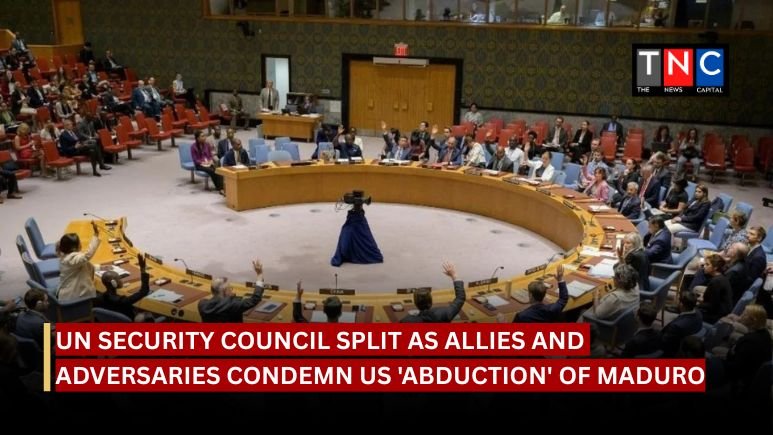

The emergency session was supposed to be about upholding international law and defending sovereignty. Instead, it became a window into just how isolated the United States has become even among its closest allies as the Trump administration’s willingness to use military force unilaterally pushes the boundaries of what the post-World War II international order considers acceptable behavior.
The United Nations Security Council convened in a high-stakes emergency session on Monday (January 5, 2026) following the dramatic U.S. military extraction of Venezuelan President Nicolás Maduro from Caracas over the weekend. While the United States defended the operation as a “surgical law enforcement action” targeting a wanted criminal, a remarkable chorus of world leaders including several of Washington’s closest traditional security partners accused the Trump administration of abandoning multilateralism and dragging the world back to an “era of lawlessness” where might makes right.
The meeting, which marked the Security Council’s first formal session of 2026, exposed a chasm between American unilateralism and international consensus on sovereignty that hasn’t been this visible since the 2003 Iraq invasion and this time, even longstanding allies aren’t standing with Washington.
The stunning breadth of international criticism:
- The Secretary-General’s Rebuke: UN Secretary-General António Guterres opened the session with an unusually pointed warning, stating he was “deeply concerned” that fundamental rules of international law had been disregarded. He cautioned that this “grave” action could establish a “dangerous precedent” for how nations interact, essentially giving any powerful country license to invade weaker neighbors under the pretext of law enforcement.
- Allies Break Ranks:
- France: Deputy Ambassador Jay Dharmadhikari delivered a surprisingly sharp rebuke from a country that has been America’s ally for over two centuries, stating that the operation “chips away at the very foundation of international order” and directly contradicts the UN Charter’s prohibition on the use of force except in self-defense or with Security Council authorization.
- Denmark: Ambassador Christina Markus Lassen emphasized that “the inviolability of borders is not up for negotiation” a pointed comment that took on additional meaning given President Trump’s renewed threats over the weekend to pursue annexation of Greenland, a Danish territory. The implication was clear: if America can violate Venezuela’s borders today, whose borders might be next?
- Adversaries Unite in Fury:
- Russia: Ambassador Vasily Nebenzya, representing a country that has itself been accused of violating sovereignty in Ukraine, seized the moment to accuse the United States of proclaiming itself a “supreme judge” above international law and described the intervention as “a turn back to the era of lawlessness” the same accusation the West has leveled at Moscow.
- China: Representative Fu Cong demanded the U.S. “cease its bullying behavior” and return to dialogue, stating bluntly that no single country should act as the “world’s police.” The irony of China defending sovereignty principles while occupying disputed territories in the South China Sea was apparently lost on no one but went unmentioned.
- Colombia: Ambassador Leonor Zalabata Torres delivered perhaps the most emotional condemnation, calling the raid reminiscent of “the worst interference” in Latin American history a reference to decades of U.S. interventions, from Guatemala to Chile to Nicaragua, that remain open wounds across the region.
“This operation violates the most basic principles of international law. Venezuela is a sovereign nation. You cannot simply send military forces to kidnap a head of state because you disagree with their policies or accuse them of crimes,” stated the French ambassador, his words carrying extra weight coming from a NATO ally.
“If this becomes acceptable, what stops any powerful nation from invading its weaker neighbors under the guise of law enforcement? This is precisely the kind of behavior the UN was created to prevent,” added the Danish representative.
U.S. Ambassador Mike Waltz remained entirely undeterred by the international condemnation, mounting a vigorous defense that invoked Cold War-era precedents and rejected characterizations of the operation as an act of war or occupation.
America’s legal justification:
- Law Enforcement, Not War: Waltz argued the action was a “surgical law enforcement operation” carried out specifically to fulfill long-standing criminal indictments against individuals he characterized as “narco-terrorists” who happen to also be government officials. In the U.S. framing, this wasn’t regime change it was serving an arrest warrant with military backup.
- The Noriega Precedent: Waltz explicitly invoked the 1989 U.S. invasion of Panama to capture dictator Manuel Noriega, who was similarly wanted on drug trafficking charges. “We are not occupying Venezuela. We are not installing a government. This was a law-enforcement operation in furtherance of lawful indictments issued by U.S. courts,” he stated, as if the parallel would be reassuring rather than alarming to an international community that remembers Panama quite differently.
“Nicolás Maduro is not a head of state engaged in legitimate governance. He is a criminal enterprise masquerading as a government. The United States has every right to enforce its laws against narco-terrorists, regardless of what title they claim,” Waltz declared, his words met with visible discomfort from even friendly delegations.
As diplomats debated the legality of the operation in New York, the crisis was unfolding in real-time across multiple locations, each development adding new layers of complexity:
The multi-venue crisis:
- Manhattan Federal Court: Just miles from the United Nations building, Nicolás Maduro and his wife Cilia Flores appeared in shackles before a federal judge, both pleading not guilty to charges of narco-terrorism, weapons trafficking, and money laundering. The surreal image of a sitting head of state (or former head of state, depending on perspective) in an American courtroom crystallized just how extraordinary the situation has become.
- Caracas Power Transition: In Venezuela’s capital, Delcy Rodríguez was hastily sworn in as interim president in a ceremony attended by remaining government officials and military commanders. While her brother, Assembly President Jorge Rodríguez, initially condemned Maduro’s “kidnapping” in fiery rhetoric, the new administration has since signaled a more cautious “agenda of cooperation” with Washington likely recognizing that defiance could bring additional U.S. military strikes.
- Regional Escalation Threats: The Security Council meeting was further complicated by President Trump’s weekend statements threatening to expand military operations into Colombia and Mexico to directly target drug cartels, raising the horrifying prospect that Venezuela might be just the beginning of a broader military campaign across Latin America.
The Security Council ended the emergency session without issuing any collective statement or resolution paralyzed by the same fundamental divisions that have rendered the body increasingly ineffective since the conflicts in Ukraine and the Middle East exposed the limits of its authority. Russia and China would obviously veto any resolution condemning their own actions, just as the U.S. would veto anything critical of the Venezuela operation, leaving the Council capable of debate but incapable of action.
With the United States maintaining a 15,000-strong military force in the Caribbean and President Trump vowing to “run” Venezuela until a stable, friendly transition government is in place, the international community confronts a 2026 where the “law of the strongest” may increasingly trump (no pun intended) the established rules enshrined in UN charters and international treaties.
The Venezuela intervention represents a test case: Can a powerful nation simply decide that another country’s leadership is criminal, send in military forces to extract them, and face no meaningful consequences beyond diplomatic condemnation? Based on Monday’s Security Council session, the answer appears to be yes as long as you’re powerful enough to ignore the criticism.
For smaller nations watching this unfold, the message is chilling. Sovereignty, it turns out, is not an absolute principle but rather something that exists only as long as more powerful nations choose to respect it. And when they don’t, the United Nations can convene emergency sessions, ambassadors can deliver eloquent speeches about international law, and none of it will matter if there’s no enforcement mechanism beyond moral suasion.
The emergency session ended. Diplomats returned to their offices. Maduro remains in American custody. And the precedent has been set, regardless of what international law technically says about it.
The question now isn’t whether this violated sovereignty clearly it did. The question is whether anyone can or will do anything about it, and what it means for a world order where the rules apparently apply only to those without the military power to ignore them.
Also Read / Operation Absolute Resolve: U.S. forces capture Nicolás Maduro in lightning strike.





Leave a comment