

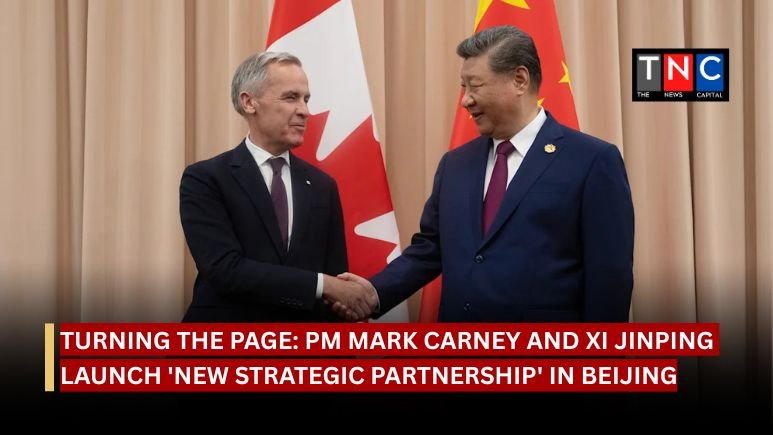

In the first visit by a Canadian leader in nearly a decade, Prime Minister Mark Carney and President Xi Jinping formally reset relations Friday with a landmark agreement to slash tariffs, restore visa-free travel, and coordinate on global energy security. The meeting at the Great Hall of the People marked a decisive shift in Ottawa’s foreign policy as it seeks to diversify trade away from an increasingly protectionist United States, with the leaders announcing a “New Strategic Partnership” built on five foundational pillars aimed at long-term cooperation.
The centerpiece of the summit was a joint statement outlining a comprehensive roadmap for cooperation, with both leaders committing to “mutual respect and equality” across strategic sectors.
- Energy & Clean Tech: Collaboration on conventional oil and gas as well as massive scaling of investments in batteries, solar, and wind technology, leveraging both nations’ positions as “energy superpowers.”
- Economic & Trade: Reinvigorating the High-Level Economic and Financial Strategic Dialogue (EFSD) and resolving long-standing market access issues that have hampered bilateral commerce for years.
- Public Safety: Launching a senior-level dialogue on narcotics trafficking, specifically targeting fentanyl flows, and addressing cybercrime concerns that have strained relations.
- Multilateralism: Coordinating on UN reform and international financial systems, positioning both nations as advocates for reforming global governance structures.
- People-to-People Ties: Restarting the Joint Committee on Culture and facilitating easier travel through visa reforms, aimed at rebuilding connections severed during years of diplomatic tension.
In a significant breakthrough for Canadian industry, the leaders announced a preliminary deal to remove trade barriers that have plagued the relationship for years, potentially unlocking billions in new commerce.
- The EV Compromise: To resolve the tariff war that erupted over electric vehicles, Canada will allow 49,000 Chinese EVs into the market at a preferential tariff rate of 6.1%, a return to the levels seen in 2023 before protective measures were imposed.
- Agricultural Relief: Beijing has committed to resolving market access challenges for Canadian canola, seafood, and agri-food products, potentially unlocking nearly $3 billion in new export orders for sectors that have been effectively shut out of the Chinese market.
- Visa-Free Access: In a major boost for tourism and business, President Xi confirmed that China will grant visa-free access for Canadian visitors, eliminating a significant barrier to bilateral exchanges and commerce.
- Trade Volume Potential: The agreements position China to play a central role in Carney’s goal of doubling non-U.S. exports over the next decade, reducing Canada’s 75% trade dependence on America.
The visit comes at a time of global trade disruption, fueled largely by the “America First” policies and 50% tariffs imposed by the Trump administration on Canadian exports, making diversification an economic necessity rather than a strategic choice.
- The Carney Doctrine: The Prime Minister, who took office 10 months ago following Justin Trudeau’s resignation, has set a target to double non-U.S. exports over the next decade. “At a time of global trade disruption, Canada is building a stronger, more independent, and more resilient economy,” Carney told reporters.
- Energy Superpowers Alliance: The leaders emphasized that both nations are “energy superpowers” that stand to make “historic gains” by leveraging each other’s strengths in energy storage, transition technologies, and resource development.
- Strategic Timing: The reset comes as Trump has mused about Canada becoming the “51st state” and imposed punitive tariffs, creating political space for Carney to pursue what would have been unthinkable partnerships under previous administrations.
- Economic Leverage: By securing Chinese market access, Canada gains negotiating leverage with Washington, demonstrating it has alternatives if American trade relationships continue deteriorating.
While the focus was overwhelmingly economic, Canadian officials maintained that the “pragmatic” engagement does not mean a retreat from values or security concerns, attempting to navigate between commerce and principles.
- National Security Dialogue: Carney welcomed plans to deepen engagement on security issues, including addressing “transnational repression” the targeting of critics abroad a phenomenon that has affected Chinese dissidents living in Canada.
- Human Rights Ambiguity: Notably absent from public statements were explicit commitments on human rights issues like Xinjiang, Hong Kong, or detained Canadians, suggesting these contentious topics were either addressed privately or deliberately avoided.
- Fentanyl Focus: The public safety pillar’s emphasis on fentanyl trafficking represents a rare area of overlapping concern, with both nations facing domestic political pressure to address the crisis.
- Xi’s Framing: President Xi characterized the visit as a “moment of transition,” noting that the healthy development of ties serves the common interests of both nations and contributes to global stability, framing cooperation as mutually beneficial rather than one-sided concessions.
| Area | Canadian Gain | Chinese Gain |
| Trade | Market access for $3B+ in agriculture, reduced dependence on US | EV market entry, legitimacy boost amid Western isolation |
| Energy | Investment partnerships, technology transfer in clean tech | Access to Canadian resources, energy security diversification |
| Geopolitical | Leverage against US pressure, diversified partnerships | Wedge between Five Eyes allies, expanded influence |
| Domestic Politics | Economic wins to show voters, alternative to US dependence | Demonstration of global influence despite Western criticism |
Carney’s “Beijing Reset” represents more than bilateral trade adjustments it signals a potential realignment in global partnerships and challenges to traditional Western alliance structures.
- Five Eyes Tensions: The warming with China could strain Canada’s intelligence-sharing relationships within the Five Eyes alliance (US, UK, Australia, New Zealand), particularly as other members maintain harder lines on Beijing.
- European Reactions: The agreement may influence European nations considering similar balancing acts between economic interests with China and security alignment with the United States.
- USMCA Questions: The reset raises questions about Canada’s commitments under the United States-Mexico-Canada Agreement, which contains provisions designed to limit members’ economic integration with non-market economies like China.
- Australian Comparison: Canada’s approach contrasts sharply with Australia, which has faced Chinese economic coercion but maintained harder security positions, offering a different model for middle powers caught between superpowers.
Carney’s mission marks the end of nearly a decade of frosty relations that began with the 2018 arrest of Huawei executive Meng Wanzhou and subsequent Chinese detention of Canadians Michael Kovrig and Michael Spavor. For Canada, the “Beijing Reset” is a high-stakes bet that economic diversification can shield the nation from the volatility of its southern neighbor.
- The Gamble: Carney is betting that China will honor market access commitments and that deeper economic ties won’t create new vulnerabilities through Chinese leverage over Canadian policy.
- Domestic Politics: The reset will face scrutiny from opposition parties and security hawks who argue economic benefits don’t justify closer ties with an authoritarian regime accused of human rights abuses and transnational repression.
- The Timeline: With significant trade deals requiring months or years to fully implement, Carney needs to deliver tangible economic wins before the next election to justify the strategic pivot.
- Point of No Return: The visa-free travel and EV market access represent concrete, visible changes that will be difficult to reverse, suggesting Carney views this reset as a fundamental reorientation rather than tactical maneuvering.
The Friday summit represents a defining moment for Canadian foreign policy a conscious decision to reduce dependence on an unpredictable American partner by embracing closer ties with an authoritarian superpower. Whether the “New Strategic Partnership” delivers the promised economic benefits without compromising Canadian sovereignty and values will determine if Carney’s Beijing gambit is remembered as visionary statecraft or a dangerous miscalculation that traded one form of dependence for another.
Also Read / Breaking the North American Orbit: PM Mark Carney Embarks on Historic China Visit.











Leave a comment