

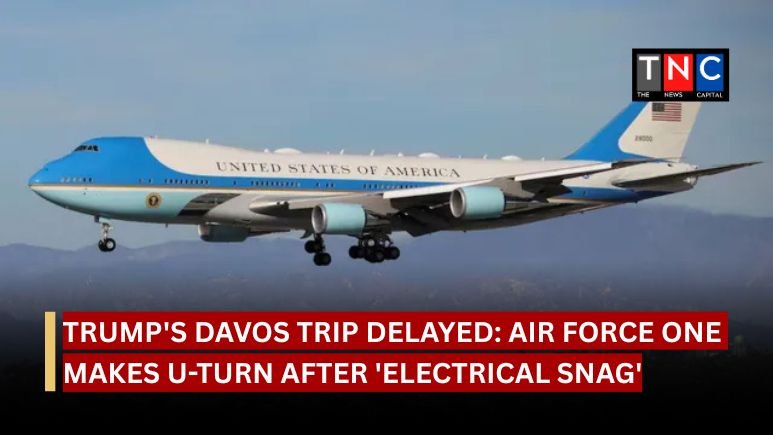

President Donald Trump’s high-stakes journey to the World Economic Forum was briefly interrupted late Tuesday night when a technical glitch forced his aircraft to abort its Atlantic crossing, requiring a swift transfer to a backup jet before resuming the trip toward a “volatile” Davos summit. Shortly after taking off from Joint Base Andrews on Tuesday night, January 20, 2026, Air Force One’s crew identified a “minor electrical issue,” prompting an immediate return to Maryland “out of an abundance of caution” before the President could resume his journey on a smaller backup aircraft.
The technical snag occurred approximately 30 to 60 minutes into the flight as the Boeing 747-200B headed toward Switzerland, forcing an immediate abort of the transatlantic crossing.
- The Incident: Reporters traveling with the President noted that the lights in the press cabin flickered off briefly shortly after the aircraft became airborne. While no immediate explanation was provided to those on board, the flight crew opted to head back to base rather than risk a trans-Atlantic crossing with a faulty electrical system.
- Safety Protocol: The decision to return demonstrates standard aviation safety protocols where even minor electrical issues on long overwater flights warrant conservative action, particularly for the presidential aircraft carrying the commander-in-chief.
- Communication Blackout: The White House initially provided limited information about the nature of the problem, with traveling reporters learning details gradually as the aircraft turned back toward the U.S. East Coast.
- No Immediate Danger: Officials emphasized that the President was never in danger and that the return was purely precautionary, though any Air Force One malfunction inevitably raises security concerns.
The incident has reignited debates over the aging presidential fleet, with the current aircraft having served far beyond their originally intended service life.
- Four Decades of Service: The two current VC-25A aircraft have been in service for nearly four decades, well beyond the typical operational lifespan for commercial Boeing 747 aircraft of the same vintage.
- Replacement Delays: Although Boeing is working on replacements designated VC-25B based on the newer 747-8 airframe, the program has faced significant delays due to cost overruns, technical challenges, and pandemic-related disruptions.
- Maintenance Burden: The aging fleet requires increasingly intensive maintenance to keep the highly modified aircraft operational, with unique presidential communications and defensive systems adding complexity.
- The Qatari Alternative: Press Secretary Karoline Leavitt reportedly quipped to the press pool that the luxury Boeing 747-8 gifted to Trump by Qatar in 2025 was sounding “much better” at that moment. That plane is currently undergoing security retrofitting to meet presidential aircraft standards.
The Midnight Transfer: Swift Pivot to Backup Aircraft
Upon landing safely at Joint Base Andrews at approximately 11:00 PM, the President and his entourage wasted little time executing a transfer to backup aircraft to minimize delays to the carefully choreographed Davos schedule.
| Flight Metric | Details (January 20–21, 2026) |
| Initial Departure | Tuesday Evening (from Joint Base Andrews, Maryland) |
| Return Arrival | 11:07 PM EST |
| Backup Aircraft | Air Force C-32 (Modified Boeing 757) |
| Final Takeoff | Shortly after Midnight, Wednesday |
| Mission Status | On track for Wednesday keynote address |
| Flight Duration | Approximately 8-9 hours to Zurich/Switzerland |
- The C-32 Alternative: The C-32, often used as “Air Force Two” for the Vice President or for domestic trips to smaller airports, was utilized to ensure the President reached Davos in time for his scheduled keynote address.
- Capacity Constraints: The smaller Boeing 757-based aircraft has significantly less space than the 747, potentially requiring some staff and press to travel on separate aircraft or remain behind.
- Rushed Logistics: The midnight transfer required rapid coordination to move luggage, communications equipment, and classified materials from the disabled 747 to the backup aircraft.
- Schedule Pressure: With the keynote address scheduled for Wednesday afternoon Swiss time, the delay left little margin for error, putting pressure on advance teams to adjust ground transportation and security arrangements.
Despite the mechanical delay, the geopolitical friction awaiting Trump in Switzerland remains at a boiling point, with European leaders preparing confrontational messages on multiple fronts.
- The Greenland Standoff: Trump is expected to face a cold reception from European leaders over his recent threats to impose a 10-25% tariffs on nations opposing the U.S. acquisition of Greenland, with eight EU member states directly targeted.
- Italian Mediation Efforts: Italian PM Giorgia Meloni’s public criticism of the tariff threats as a “mistake” signals even Trump’s closest European ally is concerned about the Greenland crisis fracturing NATO.
- Trade War Warnings: European business leaders at Davos are expected to press the administration on tariff policies that threaten billions in transatlantic commerce.
- Democratic Values Questions: The acquisition push against a fellow democracy (Denmark) has raised uncomfortable questions about American commitment to sovereignty principles.
On Thursday, Trump is slated to announce the “Board of Peace Charter,” inviting nations to join a multi-billion dollar Gaza redevelopment body that has already seen pushback from traditional allies.
- $1 Billion Price Tag: Permanent membership on the Board requires a $1 billion commitment, effectively limiting participation to wealthy nations and potentially excluding regional stakeholders with direct interests.
- Bypassing the UN: The framework operates outside UN structures, raising questions about international legitimacy and whether reconstruction serves Palestinian interests or donor priorities.
- Canadian Hesitation: Canada, traditionally a strong U.S. ally, is among nations expressing skepticism about the governance structure and financial requirements.
- Indian Consideration: India is analyzing whether the Board membership offers sufficient strategic benefits to justify the billion-dollar commitment amid competing domestic priorities.
Before departing Washington, Trump signaled he remains undeterred by the diplomatic challenges awaiting him in Switzerland, framing the trip as an opportunity rather than an obstacle course.
- “Very Interesting” Preview: Trump told reporters the trip would be “very interesting,” signaling that he welcomes rather than fears the diplomatic “showdown” scheduled for Wednesday afternoon.
- Confrontational Approach: The President’s rhetoric suggests he views European pushback as weakness rather than legitimate concern, potentially setting up confrontational encounters rather than productive dialogue.
- Economic Leverage: Trump appears confident that America’s economic power gives him leverage over European partners, even when demanding territorial concessions or billion-dollar commitments.
- Domestic Audience: The defiant posture plays well with Trump’s domestic base, which views European criticism as validation that the President is prioritizing American interests over international niceties.
The electrical malfunction, while resolved without incident, highlights the intersection of presidential power projection and practical vulnerabilities.
- Global Symbol: Air Force One serves as a flying symbol of American power and presidential authority, making any malfunction a potential propaganda opportunity for adversaries.
- Operational Necessity: The President’s ability to travel securely and maintain command and control from the air is essential to modern presidential operations, particularly during international crises.
- Modernization Urgency: The incident underscores the urgency of the VC-25B replacement program, even as cost overruns and delays have made it politically controversial.
- Contingency Planning: The swift execution of backup plans demonstrates the depth of presidential travel contingency planning, though the incident reveals constraints when primary systems fail.
Trump’s delayed arrival sets the stage for a Davos appearance that could reshape transatlantic relations and global economic partnerships.
- Keynote Message: The Wednesday address provides Trump a platform to defend his Greenland position, tariff threats, and “America First” approach before global business and political elites.
- Bilateral Meetings: Scheduled meetings with European leaders will test whether personal diplomacy can defuse tariff tensions or whether positions have hardened beyond compromise.
- Business Community: American CEOs at Davos may pressure Trump to moderate trade policies that threaten their European operations and supply chains.
- Contrast with Predecessors: Trump’s confrontational approach contrasts sharply with previous presidents who used Davos to emphasize American leadership of the liberal international order.
The Air Force One electrical malfunction that forced a midnight aircraft swap is ultimately a minor footnote to Trump’s Davos journey, resolved through backup systems and contingency planning without endangering the President or significantly delaying the trip. But the incident serves as an apt metaphor for the administration’s broader approach pressing forward with ambitious and controversial policies (Greenland acquisition, Gaza Board of Peace, sweeping tariffs) despite warning lights flashing and systems showing strain. Just as the aging Boeing 747 required an emergency return and transfer to backup aircraft, Trump’s aggressive international agenda is triggering emergency responses from allies forced to develop contingencies for American policies that threaten longstanding partnerships. The President arrives in Davos on a smaller plane than intended but undeterred in ambitions, ready to demand European acquiescence on Greenland, billion-dollar commitments for Gaza reconstruction, and acceptance of tariff threats as normal tools of alliance management. European leaders waiting in the Swiss Alps have their own messages prepared red lines on sovereignty, activation of trade retaliation mechanisms, and warnings that NATO cannot survive if its leading member treats territorial acquisition of member territory as legitimate policy. Whether Trump’s delayed arrival provides any time for reflection on the diplomatic turbulence ahead remains to be seen, but his “very interesting” preview suggests he welcomes confrontation in Davos just as confidently as Air Force One’s backup systems executed the midnight aircraft transfer that got him there.
Also Read / Gaza Reconstruction: Trump Invites India to Join ‘Most Consequential’ Board of Peace.













Leave a comment