

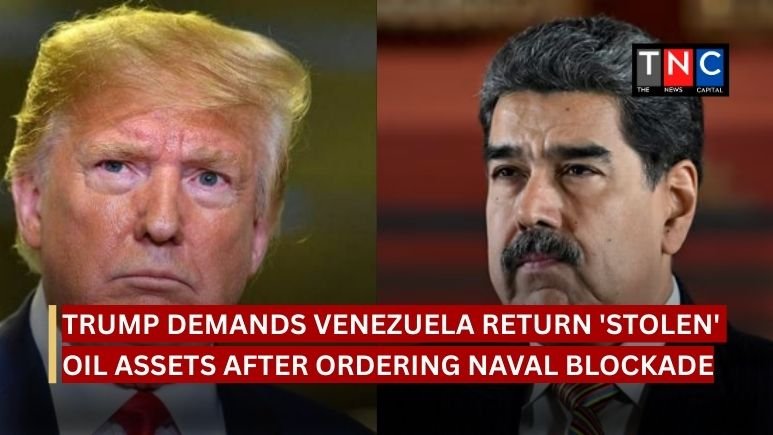

The US President has justified his order for a “total and complete blockade” of sanctioned tankers by demanding Caracas pay for American energy assets seized decades ago, significantly raising the stakes in the Caribbean standoff.
President Donald Trump has demanded that Venezuela immediately return oil assets seized from US companies, using that claim to justify his new blockade against the South American nation. Speaking to reporters Wednesday (17 December), Trump said his administration’s aggressive new tactics, including a naval blockade announced just 24 hours earlier, were motivated by a desire to reclaim “energy rights” he says were “illegally” taken by the socialist government.
The demand follows a dramatic escalation Tuesday night when Trump posted on Truth Social that he was ordering a “total and complete blockade of all sanctioned oil tankers” entering or leaving Venezuela. He also declared the government of Nicolás Maduro a “Foreign Terrorist Organization,” accusing it of using oil revenue to fund drug trafficking and human smuggling.
“You remember they took all of our energy rights. They took all of our oil not that long ago. And we want it back,” Trump told reporters, referencing the wave of nationalizations under former leader Hugo Chávez and his successor, Maduro. He added that the US naval armada in the region, described as the largest ever assembled in South American history, would “only get bigger” until these assets were returned.
The blockade appears to already be having an effect. Shipping data shows several tankers have diverted away from Venezuelan waters to avoid the fate of a vessel seized by US forces last week. That seizure, which Caracas called “piracy,” marked the first direct confiscation of a tanker in this renewed pressure campaign.
“They took it they illegally took it… They took it away because we had a president that maybe wasn’t watching. But they’re not going to do that again,” Trump said, specifically citing the uncompensated seizure of projects belonging to firms like ExxonMobil.
Venezuela fired back with a defiant response, issuing a statement condemning the blockade as a “grotesque threat” and a violation of international maritime law. “The President of the United States intends to impose, in an utterly irrational manner, a supposed naval blockade… with the aim of stealing the riches that belong to our homeland,” the statement read.
The dispute over “stolen” assets goes back to 2007, when Venezuela nationalized multi-billion dollar projects in the Orinoco Belt. International arbitration panels have ordered Venezuela to pay compensation before, but payments have been spotty or nonexistent because of the country’s economic collapse.
The situation has gone downhill fast since September, when the US started a campaign of airstrikes against alleged “drug boats” in the Caribbean. Officials say those strikes have killed nearly 100 people. Analysts are warning that a full naval blockade could cut off Venezuela’s remaining cash flow, potentially triggering a humanitarian crisis or a wider military conflict.
With the blockade now in force, the US Navy and Coast Guard are expected to ramp up interdictions of “dark fleet” vessels carrying Venezuelan crude. Venezuela has vowed to take the matter to the United Nations, but with no diplomatic off-ramp in sight, the risk of a direct military clash between US forces and the Venezuelan military is at its highest point in decades.
Also Read / US sanctions six more ships as Venezuela slams tanker seizure as ‘piracy’.








Leave a comment