

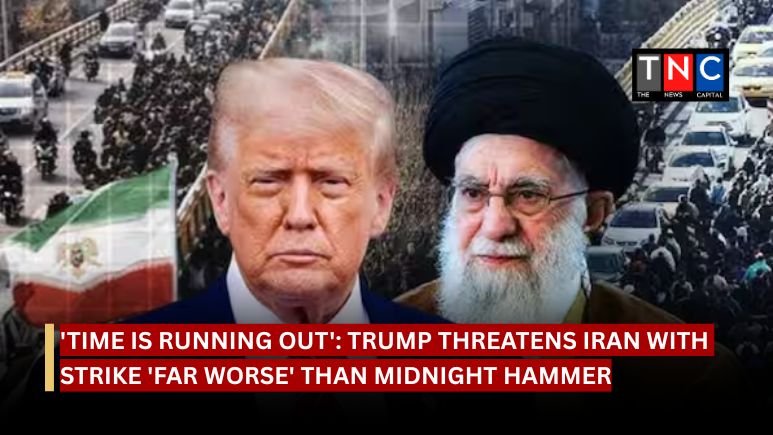

The ultimatum couldn’t be more stark or the deadline more immediate. Twenty-four hours to choose between total capitulation on nuclear ambitions and a military strike that would make last year’s devastating attack look like a warning shot. As a massive American naval armada steams toward the Persian Gulf and Iran’s Supreme Leader reportedly retreats to a fortified underground bunker, the world is holding its breath, watching the clock tick down toward what could become the most consequential military confrontation of the decade.
President Donald Trump on Wednesday (January 28, 2026) warned Iran’s leadership in the most explicit and threatening terms yet that “time is truly of the essence,” threatening a devastating military intervention that would dwarf last year’s strikes if the regime continues its brutal suppression of protesters and refuses to permanently abandon its nuclear weapons program. Writing on his Truth Social platform in characteristically blunt language, the President directly referenced Operation Midnight Hammer the June 2025 coordinated strikes that crippled three major Iranian nuclear facilities stating with chilling clarity: “The next attack will be far worse! Don’t make that happen again.”
The threat arrives as human rights organizations report that the death toll from Iran’s violent crackdown on the ongoing “Rial Rebellion” has climbed to a staggering 6,221 people killed by security forces, with activists expressing grave fears that thousands more have simply vanished into the regime’s notorious prison system where torture, forced confessions, and summary executions occur beyond any international oversight or documentation.
The President laid down two absolute red lines that he characterized as non-negotiable conditions for avoiding immediate military action:
- Stop Killing Protesters: Trump demanded an immediate halt to the “barbaric and unconscionable” killing of peaceful demonstrators by Iranian security forces. Specifically, he warned against the reported plan to execute 837 detainees currently held in high-security facilities across Iran who were arrested during recent protests and face charges of “moharebeh” (waging war against God) a capital offense under Iranian law that has historically been used to execute political dissidents.
- The ‘Rescue’ Doctrine: Trump explicitly reiterated what’s being called the “Trump Rescue Doctrine” following the Venezuela intervention: “If Iran shoots and violently kills peaceful protesters demanding their basic rights and freedoms, the United States of America will come to their rescue.” He described the U.S. military as being “locked and loaded” and positioned for immediate intervention, deliberately echoing language he’s used before authorizing military operations.
- Failed Restraint Narrative: The President claimed he had previously demonstrated restraint and diplomatic patience after receiving what he characterized as “direct assurances” from intermediaries that mass executions would be halted and that Iran would engage in good-faith negotiations. However, Trump stated that “horrific stories and verified reports” of continued systematic brutality, torture, and killings have since emerged, forcing what he termed a “necessary strategic pivot” from diplomacy to threatened force.
“I tried. I gave them time. I offered a path to peace and prosperity. They chose violence against their own people and continued pursuit of nuclear weapons. That choice has consequences,” Trump wrote, framing his threatened military action as reluctant but necessary response to Iranian intransigence.
While Trump included obligatory references to seeking a “fair and equitable deal” that would address all parties’ security concerns, his diplomatic language was fundamentally undermined by the simultaneous deployment of overwhelming military force to the region:
- Carrier Strike Group Deployment: The USS Abraham Lincoln aircraft carrier strike group, accompanied by several Aegis-equipped guided-missile destroyers and a nuclear-powered attack submarine, has officially entered the Persian Gulf region the largest concentration of offensive U.S. naval power in Middle Eastern waters in over a decade. Trump personally characterized the deployment as a “massive armada moving quickly and decisively, with great power and terrible purpose” language deliberately designed to evoke both inevitability and overwhelming force.
- Beyond Surgical Strikes: Operation Midnight Hammer in June 2025 consisted of carefully targeted, surgical strikes against specific nuclear enrichment facilities, designed to set back Iran’s nuclear program while minimizing casualties and avoiding broader escalation. The current threatened operation, according to Pentagon sources speaking on background, would involve “major destruction” of a far wider array of military infrastructure, command and control facilities, missile sites, naval bases, and institutional targets including Revolutionary Guard headquarters essentially a campaign designed to cripple Iran’s ability to project power regionally rather than simply delay its nuclear timeline.
- Air Defense Preparations: Military sources indicate that additional Patriot missile batteries, along with the more advanced THAAD (Terminal High Altitude Area Defense) systems, are being rapidly deployed to U.S. bases in Kuwait, Qatar, UAE, and potentially Saudi Arabia in anticipation of Iranian retaliatory strikes using ballistic missiles or drone swarms against American forces and allied nations.
The nuclear deal demands:
The White House has fundamentally shifted its strategic objectives, moving beyond humanitarian concerns about protester deaths to articulating a comprehensive nuclear framework that Iran would be required to accept to avoid military action:
| Pillar of Required Agreement | Specific U.S. Demands |
| Permanent Nuclear Status | Iran must formally accept perpetual “NO NUCLEAR WEAPONS” status and provide unrestricted access to all facilities for international inspectors indefinitely |
| Existing Stockpile Disposal | Complete handover of all highly enriched uranium to a third-party custodian (Russia has been mentioned, though that raises obvious concerns) |
| Missile Program Restrictions | Strict, verifiable caps on long-range ballistic missile development and elimination of support for regional proxy forces |
| Economic Enforcement | Immediate 25% tariff on any country continuing trade with Iran—explicitly targeting India, China, Turkey, and others maintaining economic relationships |
“These aren’t negotiating positions. These are requirements. Iran can accept them and rejoin the civilized world with lifted sanctions and economic opportunity, or they can reject them and face consequences that will set their country back decades,” stated National Security Advisor Mike Waltz during a White House briefing.
Tehran has remained outwardly undeterred by the threatening presence of American naval power and ultimatum-style diplomacy, with senior officials rejecting what they characterize as “blackmail and coercion masquerading as diplomacy”:
“Iran stands ready for dialogue based on mutual respect and recognition of our sovereign rights. BUT IF PUSHED TO THE BRINK, IT WILL DEFEND ITSELF WITH ALL AVAILABLE MEANS AND RESPOND LIKE NEVER BEFORE!” the Iranian mission to the United Nations posted on X (formerly Twitter), the all-caps emphasis clearly intended to convey Iran’s own threat of massive retaliation.
Iranian Foreign Minister Abbas Araghchi stated more formally that Iran categorically rejects “diplomacy conducted through military threat and ultimatums” and insisted that any negotiations must occur between equals rather than with one party holding a gun to the other’s head.
However, behind the public defiance, there are indications that Iran’s leadership is taking the threats extremely seriously:
- Khamenei’s Reported Relocation: Multiple intelligence sources suggest that Supreme Leader Ayatollah Ali Khamenei Iran’s ultimate decision-maker who holds authority above even the elected president has relocated from his normal Tehran residence to a high-security underground command bunker built deep into mountains outside the capital. This facility, constructed with assistance from North Korean engineers experienced in creating hardened leadership protection sites, is designed to survive direct hits from bunker-buster munitions and maintain command and control capabilities even during sustained American airstrikes.
- Military Dispersal: Satellite imagery analysed by independent defence analysts shows that Iranian military assets particularly mobile missile launchers, naval vessels, and aircraft have been dispersed from their normal bases to harder-to-target locations, suggesting Iranian military planners are preparing for the possibility of imminent American strikes.
- Civil Defence Preparations: Reports from inside Iran indicate that authorities in major cities have begun activating civil defence protocols, including testing air raid sirens, conducting blackout drills, and positioning emergency medical supplies measures that haven’t been implemented since the Iran-Iraq War of the 1980s.
“The Supreme Leader doesn’t hide in a bunker because he thinks Trump is bluffing. He hides because he knows Trump has already authorized similar strikes before and might well do so again,” noted Dr. Sanam Vakil, deputy director of the Middle East and North Africa Programme at Chatham House.
The confrontation is sending shockwaves far beyond Iran and the United States:
- Oil Markets Panic: Global oil prices have spiked by over 15% in the past 48 hours as traders factor in the possibility that a major U.S.-Iran conflict could disrupt shipping through the Strait of Hormuz the narrow waterway through which approximately 21% of the world’s petroleum passes daily. A closure or significant disruption would create immediate global energy crisis.
- Israeli Coordination: Intelligence suggests extensive coordination between U.S. and Israeli military planners, with Israel likely to participate in any strikes against Iranian nuclear facilities given its own existential concerns about an Iranian nuclear weapon. Israeli Prime Minister Benjamin Netanyahu has been conspicuously silent on the ultimatum, which diplomatic observers interpret as tacit support for Trump’s approach.
- European Alarm: European allies, while sharing concerns about Iran’s nuclear program and treatment of protesters, have expressed deep anxiety about the prospect of a major Middle East war that could trigger refugee crises, economic disruption, and potential terrorist attacks in Europe. However, unlike previous U.S.-Iran crises, European governments have been notably restrained in their criticism, possibly because the brutality of Iran’s crackdown has eliminated sympathy even among traditionally dovish voices.
- China and Russia’s Calculations: Both nations maintain significant economic and strategic relationships with Iran but have been notably quiet about the current crisis. Neither appears willing to provide Iran with the kind of explicit security guarantees that might deter American action, suggesting they may have concluded that defending Iran isn’t worth confrontation with the United States though both would certainly exploit any American military failure for propaganda purposes.
As Wednesday evening approaches in Washington and early Thursday morning in Tehran the world is watching the clock on Trump’s implicit 24-hour deadline for Iran to signal acceptance of his terms. The lack of clear diplomatic channels, the inflammatory rhetoric from both sides, and the presence of overwhelming military force create dangerous conditions for miscalculation, accident, or deliberate escalation.
“We’re in the most dangerous 24 hours of U.S.-Iran relations since the 1979 hostage crisis. Both sides have boxed themselves into positions where backing down looks like weakness, but going forward could mean war,” stated Richard Haass, president emeritus of the Council on Foreign Relations.
Six thousand two hundred twenty-one Iranians are already dead from their government’s brutal crackdown. Hundreds more face imminent execution. And now the threat of American military intervention adds the possibility of thousands more casualties—Iranian military personnel, civilians caught in strikes, and potentially American service members if Iran retaliates against U.S. forces in the region.
The clock is ticking. The armada is positioned. The Supreme Leader is in his bunker. And President Trump has drawn a red line and dared Iran to cross it.
Within 24 hours, the world will know whether this was successful coercive diplomacy that forced Iran to capitulate, or the opening act of a war that could reshape the Middle East and send shockwaves through the global economy.
Also Read / Diplomatic Brinkmanship: Trump Deploys Second ‘Beautiful Armada’ to Gulf, Demands Iran Deal.








Leave a comment