

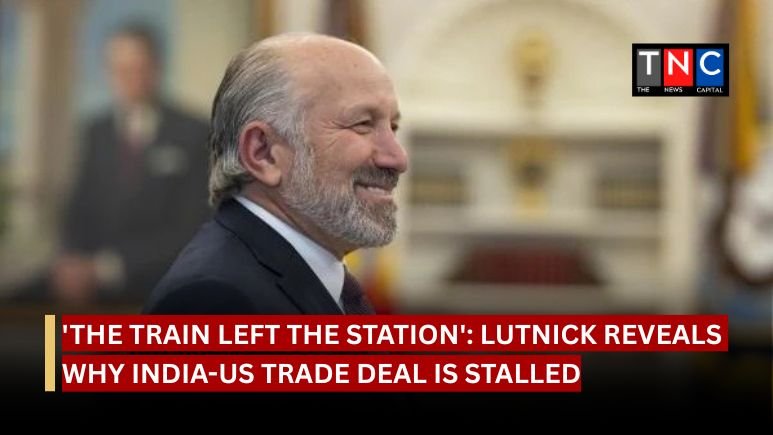

In a candid revelation that has stunned the diplomatic community, U.S. Commerce Secretary Howard Lutnick has claimed that a landmark trade deal between New Delhi and Washington failed to materialize because Prime Minister Narendra Modi did not personally call President Donald Trump to “close” the agreement.
The much-anticipated India-U.S. trade pact, designed to ease the crippling 50% tariffs on Indian goods, hit a “deadly” diplomatic wall over a missed phone call. Speaking on the All-In Podcast Thursday (January 8, 2026), U.S. Commerce Secretary Howard Lutnick revealed that while a framework was ready, the deal stalled because the Indian leadership was “uncomfortable” with President Trump’s demand for a direct, leader-level closing call.
Lutnick detailed the Trump administration’s “staircase” approach to international trade, where countries that move the fastest secure the most favorable terms. After the U.S. finalized a deal with the United Kingdom in May 2025, India was reportedly put on a “short clock.”
- The Three-Friday Ultimatum: Lutnick claimed India was given a window of “three Fridays” to finalize the deal. “I negotiated the contracts and set the whole deal up, but let’s be clear it’s his [Trump’s] deal. He is the closer,” Lutnick said.
- The Reluctance: Despite the deal being “all set up,” Lutnick claimed PM Modi didn’t make the required call. “They [India] were uncomfortable doing it, so Modi didn’t call. That Friday left,” he added.
- The Consequence: Because the window was missed, the U.S. moved ahead with trade agreements for Indonesia, the Philippines, and Vietnam. These deals were reportedly negotiated at higher tariff rates because the U.S. had reserved the “best stair” for India.
The trade deadlock comes at a time of extreme economic friction. India is currently battling a 50% tariff on its exports, a punitive measure doubled in August 2025 because of New Delhi’s continued purchase of Russian crude oil.
- The 500% Threat: The tension has only gotten worse with the recent “greenlighting” of the Sanctioning Russia Act of 2025. The bill could authorize the President to impose tariffs of at least 500% on countries like India, China, and Brazil if they keep buying Russian petroleum.
- Negotiation Reset: When Indian officials reportedly reached out three weeks after the missed deadline to say they were “ready,” Lutnick’s response was blunt: “Ready for what? The train left the station three weeks ago.”
The news has triggered a wave of concern among Indian exporters and stock market analysts.
- Export Slump: India’s merchandise exports to the U.S. have already fallen for two consecutive months, dropping 8.58% to $6.3 billion in October 2025 because of the existing 50% duties.
- Political Interpretation: While Lutnick framed the issue as a matter of negotiation protocol, some analysts in New Delhi suggest the “closer” requirement was less about trade and more about a display of diplomatic loyalty.
“He [Trump] names India a couple of times publicly… but you had to have Modi call President Trump. They were uncomfortable doing it. So Modi didn’t call.” Howard Lutnick, U.S. Commerce Secretary.
“India is going to be at the table and they’re going to say they’re sorry and they’re going to try to make a deal with Donald Trump.” Howard Lutnick, speaking to Bloomberg TV.
As the 90-day tariff exemptions previously granted to India approach their expiration, the stakes for a personal intervention between the two leaders have never been higher. With Asian peers like Vietnam and Indonesia now holding more favorable trade terms, India may find itself at the “back of the line” unless a diplomatic breakthrough happens before the next round of sanctions takes effect.
Also Read / Mexico slaps steep tariffs on Asian imports in bid to shield trade ties.









Leave a comment