

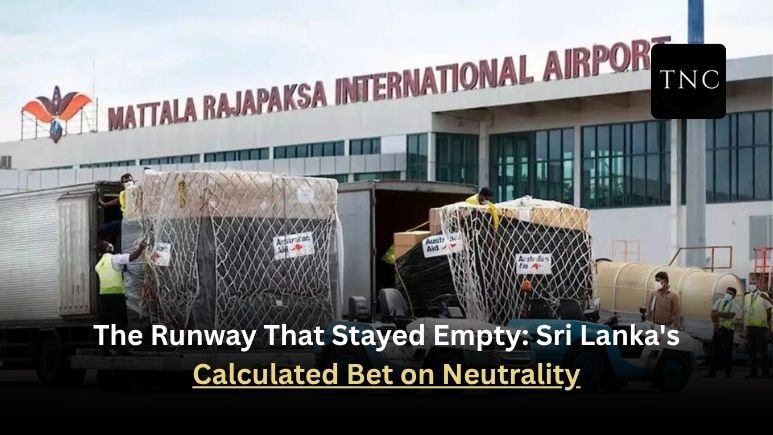

The runway at Mattala Rajapaksa International Airport lay still under the afternoon heat, a stretch of tarmac better known for stray elephants than strategic drama. Inside Colombo’s संसद chamber, President Anura Kumara Dissanayake leaned into the microphone and delivered a line that cut through the noise of a widening war: the planes would not land.
Somewhere over the Indian Ocean days earlier, two American warplanes armed, officials later said, with anti-ship missiles had sought permission to touch down on that quiet runway. The answer, after deliberation, came back simple and final: no.
Sri Lanka’s refusal to host U.S. military aircraft is more than a diplomatic footnote. It is a signal small nations, especially those sitting along strategic maritime routes, are increasingly unwilling to be drawn into great-power conflicts. As tensions in the Middle East spill into the Indian Ocean, Colombo’s decision reflects a broader question: can neutrality survive in a world where geography makes you unavoidable?
The request itself was not routine. The United States wanted to temporarily station two warplanes, reportedly carrying advanced anti-ship weaponry, at a civilian airport in southern Sri Lanka.
Timing made it more sensitive. Just days earlier, a U.S. submarine had torpedoed the Iranian frigate IRIS Dena off Sri Lanka’s coast, killing dozens of sailors and pulling the island into the periphery of a distant war.
That incident changed everything.
Granting access to American aircraft would not have been a neutral logistical favor it would have been interpreted as alignment. And Sri Lanka knew the cost. Its ports, its airspace, even its economic lifelines could become targets or leverage points in a conflict it never chose.
So Colombo drew a line. It rejected not just the U.S. request, but also a separate Iranian naval request, an intentional balancing act designed to reinforce credibility.
This is neutrality in its most pragmatic form: not ideological, but survival-driven.
There is also a deeper geopolitical layer. Sri Lanka sits along some of the busiest sea lanes in the world, routes critical to global oil shipments and trade. Any military foothold there carries disproportionate strategic weight. By denying access, Sri Lanka signaled it would not allow its geography to be weaponized even under pressure from powerful partners.
Yet neutrality is becoming harder to maintain. The same decision that protects sovereignty can strain alliances. The United States remains a key economic partner, while Iran has long been important for Sri Lankan tea exports.
Colombo is not choosing sides but it is constantly being forced to explain why it isn’t.
On a quiet runway built for commerce, Sri Lanka made a decision about war.
It chose distance over alignment, risk over entanglement.
In a world where power often demands participation, Sri Lanka’s message was blunt: neutrality is not passive, it is a choice, and sometimes, a refusal.
Also Read / Silencing the Story: Why the U.S.-Israel Alliance Targeted Iran’s Voice, Not Just Its Missiles.







Leave a comment