


Forty-eight hours. That’s what analysts are saying the world has before this either ends in negotiation or explodes into regional war. The USS Abraham Lincoln carrier group is within striking distance of the Iranian coast. President Pezeshkian is ordering diplomats to pursue “fair and equitable” talks. Trump is warning the next strike will be “far worse” than last June’s devastating attack. And somewhere between Ankara, Muscat, and Istanbul, diplomats are frantically trying to arrange a face-to-face meeting before Trump’s ultimatum expires and the missiles start flying. This isn’t just another Middle East crisis. This is the moment when either diplomacy pulls off a miracle or the entire region goes up in flames.
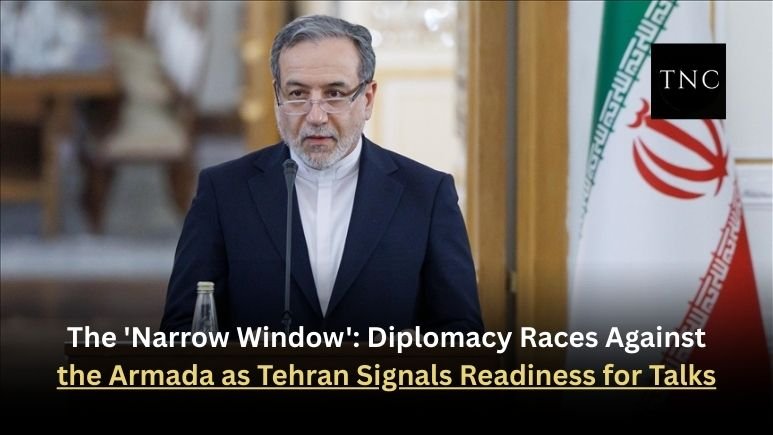
TEHRAN / WASHINGTON — On Wednesday (February 4, 2026), Iranian President Masoud Pezeshkian instructed his diplomatic corps to pursue “fair and equitable” negotiations with Washington, marking the most significant softening of Tehran’s stance since this crisis began. The timing is no coincidence. A massive U.S. naval armada just entered the Persian Gulf, bringing enough firepower to devastate Iran’s infrastructure in hours, and Trump has made clear he’s willing to use it unless Iran permanently abandons its nuclear program and stops what he calls the “bloody crackdown” on protesters.
This is the moment both sides have been maneuvering toward: Iran signaling readiness to talk while demonstrating it won’t be intimidated, America positioning overwhelming force while leaving diplomatic channels barely open. The question is whether the narrow window for negotiation closes before someone miscalculates and turns threats into action.
The diplomatic scramble
Diplomats from Turkey, Qatar, and Oman are working frantically to organize a face-to-face meeting between U.S. Special Envoy Steve Witkoff and senior Iranian officials, potentially as early as Friday, February 6. That’s two days away. Two days to arrange a meeting that could prevent a war that would reshape the Middle East.
Turkey’s proposed framework: President Recep Tayyip Erdoğan has suggested a trilateral video setup allowing Trump and Pezeshkian to speak directly, bypassing the “bloc logic” that’s stalled previous attempts. The idea is that direct leader-to-leader contact might break through the posturing and positioning that characterizes envoy-level talks.
The Araghchi mission: Foreign Minister Abbas Araghchi concluded a high-stakes visit to Istanbul on January 30, meeting with Turkish FM Hakan Fidan. His message was carefully calibrated: Iran is “ready for war” if attacked, but the door for a deal remains open if it’s based on “mutual dignity” rather than “military dictation.” Translation: we’ll negotiate, but not with a gun to our heads, even though there’s literally a carrier group pointing guns at us right now.
Potential venue shift to Oman: Sources suggest Friday’s summit might happen in Muscat instead of Istanbul or Ankara, providing what diplomats consider more neutral ground for what could be the most consequential U.S.-Iran meeting since 1979. Oman has historically played the mediator role between Washington and Tehran, facilitating the secret talks that led to the 2015 nuclear deal. If serious negotiation is happening, Muscat makes sense.
The armada that’s concentrating minds
Despite the diplomatic activity, the White House maintains its “locked and loaded” posture, and the military pressure is impossible to ignore.
The USS Abraham Lincoln is currently leading a fleet Trump described as “larger than the one sent to Venezuela.” That’s not hyperbole. This is one of the most powerful naval strike groups assembled in recent years, positioned within range of every significant Iranian military and nuclear facility.
Operation Midnight Hammer II threats: Trump has repeatedly referenced last June’s strikes on Iranian enrichment sites, warning: “The next attack will be far worse! Don’t make that happen again.” Those strikes crippled Iran’s nuclear program for months. The implication is clear: the next round would be more extensive, more devastating, potentially targeting not just nuclear facilities but Iranian Revolutionary Guard command centers, leadership infrastructure, and the entire apparatus that maintains regime control.
The protester ultimatum: A primary U.S. red line is the ongoing repression of internal dissent. Rights groups report that since December 2025, over 6,159 people have been killed in clashes with the IRGC, with 42,000 more detained. Trump is explicitly tying potential military action to Iran’s domestic crackdown, not just nuclear activity. This expands the justification for strikes beyond traditional non-proliferation concerns into humanitarian intervention territory.
Regional allies backing away: Saudi Arabia and the UAE have officially notified Washington that their airspace and territory cannot be used for offensive strikes against Iran. This is huge. America’s closest Arab allies are refusing to support military action because they believe Iran’s threats of regional retaliation are credible and they don’t want their cities becoming targets. The military option still exists through carrier-based strikes, but losing regional basing and overflight rights significantly complicates operations.
The negotiations that might save or doom the region
If talks actually happen Friday, here’s what both sides are bringing to the table, and why the gaps remain enormous:
| Issue | U.S./Board of Peace Demands | Iranian Red Lines |
| Nuclear program | “NO NUCLEAR WEAPONS”; all IAEA inspectors return, full access | Preservation of “peaceful” enrichment rights as sovereign capability |
| Regional activities | End proxy funding, stop supporting Hamas/Houthis, withdraw from Syria/Iraq/Yemen | Strategic depth non-negotiable; regional influence is defensive necessity |
| Internal repression | Stop executions, release political prisoners, end crackdown on protesters | Domestic security is sovereign “internal affair,” no external interference |
| Economic integration | Join “Pax Silica” framework via 10-year trade deal, integrate into U.S.-led economy | All “Maximum Pressure” sanctions must be lifted first, no preconditions |
Look at those positions. They’re not close. They’re fundamentally incompatible on almost every major point.
The U.S. wants Iran to surrender its nuclear program, abandon regional influence networks built over decades, stop domestic repression, and integrate into American-led economic frameworks. In exchange: sanctions relief and trade opportunities.
Iran wants to maintain peaceful nuclear capability, preserve regional strategic depth, reject interference in domestic affairs, and get sanctions lifted before making any concessions.
Those aren’t negotiating positions with room for compromise. Those are mutually exclusive visions of what an acceptable outcome looks like.
The “Board of Peace” framework
Trump’s transactional “Board of Peace” mechanism offers Iran a potential economic lifeline, but the structure reveals the fundamental problem. Countries pay $1 billion for seats at the negotiating table. Russia offered $1 billion from frozen assets. The framework is explicitly designed around economic transactions rather than strategic compromises.
For Trump, this is business. Make a deal, lift sanctions, integrate Iran into global trade, everyone profits. The nuclear program and regional influence are just obstacles to economic opportunity.
For Iran, this is survival. The nuclear program represents deterrence against regime change. Regional influence provides strategic depth against enemies on all sides. Domestic repression maintains control against internal threats and foreign-backed destabilization. These aren’t bargaining chips to be traded for economic benefits that could be revoked by executive order whenever a future president decides the deal isn’t working.
The Supreme Leader’s warning
Ayatollah Khamenei’s recent statement about “total regional war” isn’t empty rhetoric. It’s a specific threat backed by specific capabilities:
- Missile strikes on U.S. bases throughout the Gulf
- Closure or mining of the Strait of Hormuz, disrupting 20% of global oil supply
- Activation of Hezbollah in Lebanon, militias in Iraq and Syria, Houthis in Yemen
- Cyber attacks on Gulf states’ critical infrastructure
- Potential strikes on Saudi oil facilities
This wouldn’t be a contained U.S.-Iran conflict. This would be region-wide chaos affecting global energy markets, international shipping, and millions of civilians across multiple countries. And America’s Gulf allies know it, which is why they’re refusing to provide basing for strikes.
The next 48 hours
Al Jazeera analysts are calling this a “narrow window” between “reciprocal trade” and “regional catastrophe,” and the framing is accurate. The next two days determine whether diplomacy can produce even a preliminary framework for de-escalation or whether positions remain so far apart that military confrontation becomes inevitable.
Trump stated: “We seek a deal that ensures no nuclear weapons, one that is good for all parties. Time is running out; it is truly of the essence.”
The problem with “good for all parties” is that Trump’s definition requires Iran to surrender essentially everything that makes it a regional power, while Iran’s definition requires the U.S. to accept Iranian capabilities and influence that Washington considers unacceptable threats.
What Friday might bring
If the meeting happens in Muscat on Friday, several scenarios are possible:
Breakthrough: Both sides present face-saving formulas allowing retreat from maximalist positions. Temporary agreements on energy infrastructure targeting, preliminary frameworks for nuclear inspections, enough progress to justify continued talks and military de-escalation.
Partial progress: Narrow agreements on peripheral issues (prisoner exchanges, humanitarian access) while core disputes remain frozen. Enough to claim diplomatic success without actually resolving anything.
Productive stalemate: Both sides restate positions, but do so in ways that leave room for continued negotiation. No agreements, but no breakdown either. The carrier group stays in position, talks continue, crisis remains unresolved but not escalating.
Complete failure: Positions prove irreconcilable, one side or both walks away, diplomatic track collapses, military option moves from threat to implementation.
The civilians nobody’s consulting
Lost in the diplomatic manoeuvring and military posturing are millions of ordinary people across Iran and the Gulf whose futures are being decided by leaders they didn’t elect and negotiations they can’t influence.
Iranians suffering under sanctions and domestic repression, hoping diplomacy brings relief. Gulf residents fearing their cities could become targets if war breaks out. Iraqi, Syrian, Lebanese, and Yemeni populations who would see their countries become battlefields again if Iran activates proxy forces.
None of them get votes. None of them can stop this. They just wait and hope the people making decisions in Washington, Tehran, Ankara, and Muscat actually care about consequences beyond their own political calculations.
The USS Abraham Lincoln keeps its position. Diplomats keep working their phones between capitals. Trump keeps posting ultimatums on Truth Social. Pezeshkian keeps ordering his diplomatic corps to pursue talks while Khamenei warns of regional war.
And somewhere in this chaos, a narrow window exists where the right words, the right concessions, the right face-saving formulas might prevent catastrophe. But that window is measured in hours now, not days, and nobody knows if either side is actually willing to climb through it before it slams shut.
Forty-eight hours. Maybe less. That’s what the world has to find out if threats are just posturing or if the Middle East is about to explode.
Also Read / “They Do Want to Talk”: Trump Claims Iran is Ready for a Deal as Armada Nears Gulf.










Leave a comment