

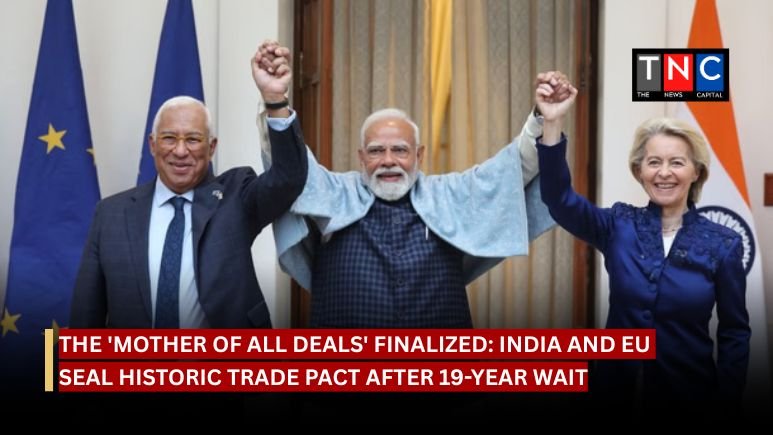

In a monumental shift for global commerce, India and the European Union have successfully concluded negotiations for a Free Trade Agreement that creates a combined market of two billion people, with the deal nearly two decades in the making serving as a strategic fortress for both powers amid escalating trade volatility from Washington and Beijing. Ending an eighteen-year diplomatic marathon that began in 2007, Prime Minister Narendra Modi and European Commission President Ursula von der Leyen formally announced the conclusion of the India-EU Free Trade Agreement on Tuesday, January 27, 2026, with the pact eliminating or reducing tariffs on over 96% of traded goods, signalling a new era of economic integration between the world’s fastest-growing major economy and the €22.5 trillion European market.
The agreement arrives at a critical geopolitical juncture, with both New Delhi and Brussels fast-tracking negotiations to hedge against the “Trump Tariff” era and reduce dependence on Chinese supply chains.
- Trump Tariff Pressure: Both powers have faced 50% levies or threats thereof on several export categories from the Trump administration, making alternative trade partnerships strategically essential rather than merely economically beneficial.
- De-risking Strategy: The deal is a cornerstone of the EU’s “de-risking” strategy, reducing collective reliance on Chinese supply chains and providing a stable alternative to the increasingly protectionist policies of the United States.
- Energy and Climate Cooperation: As part of the pact, the EU has committed €500 million over the next two years to support India’s green transition, including technical cooperation on the Carbon Border Adjustment Mechanism (CBAM) that could otherwise penalize Indian exports.
- Democratic Partnership: The agreement between two large democracies creates an implicit contrast with authoritarian economic models, positioning the partnership as values-aligned rather than purely transactional.
Parallel to the trade deal, the two powers signed complementary agreements that extend cooperation into security and human capital domains.
- Security and Defence Partnership (SDP): A framework for enhanced military-to-military cooperation, defense industrial collaboration, and intelligence sharing that strengthens the EU’s Indo-Pacific strategy.
- Mobility Pact: Facilitates the legal migration of Indian tech talent and healthcare professionals to the EU, addressing Europe’s demographic challenges and labor shortages while providing opportunities for skilled Indian workers.
- Talent Circulation: The mobility agreement creates pathways for Indian professionals to gain European experience and potentially return with enhanced skills, supporting India’s development while filling European labor gaps.
- Strategic Depth: The security and mobility dimensions transform the relationship from purely commercial to comprehensive strategic partnership, deepening interdependence beyond trade flows.
The negotiations were famously stalled over “sensitive sectors” like dairy and automobiles, with the final text utilizing a system of quotas and phased reductions to protect domestic industries while enabling market access.
European Luxury to India:
- Automotive Access: India will slash the massive 110% tariff on cars to just 10% for a quota of 250,000 European vehicles annually, opening India’s growing luxury car market to BMW, Mercedes-Benz, Audi, and other European manufacturers.
- Wine and Spirits: Premium wines and spirits will see their 150% duties fall immediately to 75%, eventually reaching as low as 20% in phased reductions, making European luxury beverages more accessible to India’s affluent consumers.
- Machinery and Chemicals: European industrial equipment and specialty chemicals gain improved access to support India’s manufacturing expansion and infrastructure development.
Indian Exports to Europe:
- Near-Complete Liberalization: The EU will eliminate tariffs on 99.5% of Indian goods by value, providing a massive boost to labor-intensive sectors such as textiles, leather, marine products, and gems and jewelry, which will now enter Europe duty-free.
- Textile Advantage: India’s massive textile industry gains preferential access over competitors, potentially capturing market share from Chinese and other Asian suppliers facing continued tariffs.
- Services Access: Indian IT companies, healthcare providers, and professional services gain access to 144 EU subsectors, formalizing and expanding opportunities that already see significant Indian participation.
Sensitive Exclusions:
- Dairy Protection: To protect rural livelihoods and small farmers, dairy remains excluded from the deal on the Indian side, shielding the sector from European competition.
- EU Agricultural Safeguards: The EU has maintained protections for beef, rice, and sugar sectors where Indian producers could potentially compete effectively but where European farmers have significant political influence.
Sector-by-Sector Impact
| Sector | Impact for India | Impact for the EU |
| Manufacturing | Zero duty on textiles, leather, and gems | Duty-free access for machinery and chemicals |
| Automotive | Phased access to high-end car parts | 110% to 10% tariff cut on luxury cars (250,000 quota) |
| Services | Access to 144 EU subsectors (IT, healthcare) | Access to 102 Indian subsectors (Finance, Maritime) |
| Agriculture | Boost for tea, coffee, and spices | Cheaper exports of olive oil, wine, and spirits |
| Pharmaceuticals | Generic drug access to European markets | IP protection improvements in India |
| Digital Economy | Data flow provisions supporting IT services | E-commerce framework for European platforms |
While the negotiations are complete, the legal text must now undergo “scrubbing” and ratification by the European Parliament and the Indian Cabinet before entering into force.
- Legal Scrubbing: Technical teams will review the agreed text for legal consistency, translation accuracy across EU languages, and elimination of any ambiguities before formal signature.
- European Parliament: Ratification requires approval from the European Parliament and potentially all 27 EU member state parliaments depending on the agreement’s scope, a process that could take 12-18 months.
- Indian Cabinet: India’s Cabinet must approve the agreement, followed by any necessary legislative changes to implement tariff reductions and regulatory harmonization.
- Implementation Timeline: Officials expect the deal to be fully operational by early 2027, with some provisions potentially entering force earlier through provisional application.
PM Modi highlighted that the pact would save exporters roughly €4 billion ($4.7 billion) annually in duties, reinforcing India’s position as a global manufacturing and services hub.
- Tariff Elimination Value: The €4 billion figure represents duties that Indian exporters currently pay to access European markets, money that will either increase profit margins or allow price reductions to gain market share.
- Competitiveness Boost: Eliminating tariffs makes Indian products more price-competitive against suppliers from other regions, potentially triggering manufacturing investment to serve the European market.
- European Savings: European exporters will similarly save on duties currently paid to access Indian markets, though the total may be smaller given lower current export volumes.
- GDP Impact: Economic modeling suggests the agreement could add 0.5-1.0% to India’s GDP growth over time as trade and investment flows increase, with similar though smaller percentage impacts on EU economies.
Both leaders emphasized the historic and strategic significance of the agreement beyond its immediate commercial provisions.
“We have created a free trade zone of two billion people. This is not just a trade agreement; it is a blueprint for shared prosperity in an increasingly volatile world.” PM Narendra Modi
- Von der Leyen’s Framing: The European Commission President has characterized the deal as part of Europe’s strategy to partner with “growth centres of today and economic powerhouses of this century,” positioning India as central to EU’s future prosperity.
- Strategic Autonomy: For both leaders, the agreement represents strategic autonomy the ability to pursue economic interests independent of U.S. or Chinese pressures or preferences.
- Multilateral Alternative: The pact demonstrates that major trade agreements remain possible even as the WTO struggles, offering a model for plurilateral cooperation when multilateral progress stalls.
The India-EU FTA carries implications that extend well beyond the bilateral relationship, potentially reshaping global trade patterns and alliance structures.
- China Competition: The agreement accelerates efforts to build supply chains independent of Chinese control, with European companies potentially shifting sourcing from China to India.
- U.S. Isolation Risk: As the EU and India cement their partnership while both face U.S. tariff threats, Washington risks self-imposed isolation from major economies seeking alternatives to American unpredictability.
- RCEP Alternative: The deal provides India which declined to join the China-dominated Regional Comprehensive Economic Partnership with major market access through European rather than Asian integration.
- Other FTAs: Success of the India-EU negotiation may accelerate other pending FTA discussions, including India-UK, India-Canada, and various EU deals with other Asian partners.
Despite the celebratory rhetoric, significant challenges remain in translating the legal text into actual trade flows and investment.
- Non-Tariff Barriers: Regulatory differences, standards recognition, customs procedures, and other non-tariff barriers will require years of technical work to fully harmonize.
- Domestic Opposition: Protected industries in both Europe and India will lobby against implementation or seek safeguards, potentially delaying or limiting liberalization.
- Customs Capacity: Indian customs infrastructure will require significant upgrading to handle the complexity of rules of origin verification and preference administration.
- Business Awareness: Many small and medium enterprises remain unaware of FTA provisions and how to utilize them, requiring extensive outreach and capacity building.
The early 2027 implementation timeline represents an ambitious but achievable goal if political will remains strong and technical work proceeds efficiently.
- Provisional Application: Some provisions, particularly tariff reductions, may enter force through provisional application before full ratification is complete.
- Phased Implementation: Many tariff reductions will be phased over 5-10 years, meaning full benefits won’t materialize immediately even after the agreement enters force.
- Business Preparation: The 12-18 month ratification period provides businesses time to understand provisions, adjust supply chains, and prepare to capitalize on new market access.
- Monitoring Mechanisms: Joint committees will monitor implementation and resolve disputes, with early years critical for establishing precedents and building trust.
The India-EU FTA eighteen years in the making and finalized amid unprecedented trade volatility from Trump’s America creates a two-billion-person free trade zone that eliminates tariffs on 96%+ of goods, provides Indian textiles and IT services preferential European access while opening India’s luxury car market to European manufacturers, and represents both powers’ strategic bet that democratic partnerships can deliver prosperity and autonomy in a world where the U.S.-led order has experienced what Canadian PM Carney called a permanent “rupture” the €4 billion in annual duty savings is tangible, but the real value lies in forging an alternative to dependence on either American whims or Chinese supply chains as both India and Europe navigate the multipolar reality of 2026.
Also Read / The ‘Mother of All Deals’: EU and India Near Historic Trade Breakthrough.





Leave a comment