


At 5:30 a.m., the queue had already wrapped around the block outside a small LPG distributor in western India. Steel cylinders clanged against one another as delivery workers unloaded a fresh truck.
Inside the cramped office, a manager refreshed his phone again and again, waiting for confirmation of the next shipment. Customers had started arriving before sunrise. Some wanted refills early. Others just wanted reassurance.
“Sir, will there be gas next week?” one customer asked.
The manager paused before answering. “We’ll manage,” he said quietly.
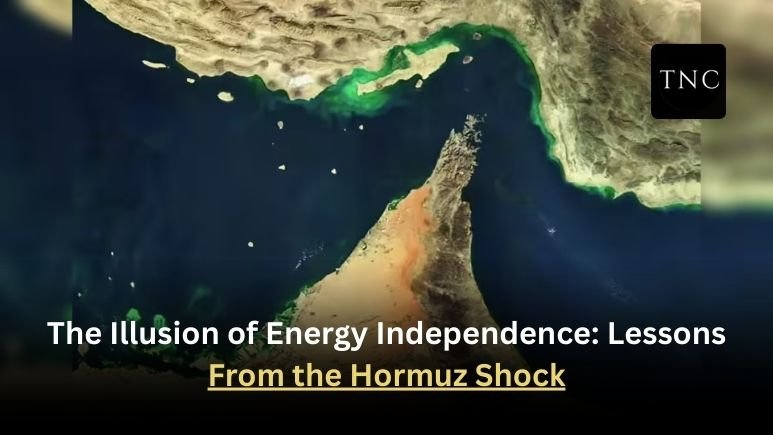
But outside that storefront, a geopolitical storm was unfolding thousands of kilometres away in the narrow waters of the Strait of Hormuz, one of the most critical arteries of the global energy system.
The recent squeeze on energy shipments through the Strait of Hormuz has exposed a harsh reality: energy independence in the modern world is rarely absolute; it is conditional.
When tensions in West Asia disrupted shipping through the corridor, countries that believed they had diversified supply chains quickly discovered the limits of their autonomy. The strait carries roughly 20 million barrels of oil per day, about one-fifth of global petroleum consumption, making it one of the world’s most strategically important choke points.
For countries like India, which import large portions of their oil and natural gas, even a temporary disruption in this narrow passage can ripple across households, factories, and financial markets.
The Hormuz disruption has forced governments and energy companies to confront a fundamental truth about global energy markets: diversification reduces risk, but it does not eliminate it.
India offers a telling example. Nearly 59.5 percent of its LNG imports come from the Middle East, leaving it particularly vulnerable to instability in the Persian Gulf.
When shipments slowed through Hormuz, policymakers scrambled to reroute cargoes from alternative suppliers such as the United States, Australia, and West Africa. But these substitutes come with a catch: distance.
- LNG cargoes from the Gulf reach India in 4–6 days.
- Australian shipments take 9–17 days.
- Cargoes from Nigeria may require 18–24 days.
- Supplies from the United States can take 30–35 days.
Longer journeys mean higher shipping costs, tighter supply chains, and rising fuel prices. What looked like diversification on paper quickly became a logistical bottleneck.
The effects are already visible.
Governments have begun reallocating gas supplies to priority sectors such as households and power plants. India meets about half of its daily gas consumption through imports, and disruptions have forced authorities to prioritize essential users.
At the same time, consumer anxiety has triggered surges in LPG bookings and pushed authorities to adjust distribution policies to prevent shortages.
The pattern reveals something deeper about the energy economy. Oil and gas may be traded globally, but the infrastructure that moves them pipelines, shipping lanes, ports, and insurance networks is geographically fragile.
A single chokepoint can rattle the entire system.
This vulnerability is why countries maintain strategic petroleum reserves, negotiate long-term contracts, and increasingly invest in renewable energy. Each strategy aims to reduce exposure to geopolitical shocks. Yet none can fully sever the ties that bind the world’s energy markets together.
In practice, energy independence has become less about isolation and more about resilience, the ability to absorb disruptions without collapsing.
The Hormuz crisis has delivered a blunt reminder: energy security is not simply about where fuel comes from, it is about how easily it can stop flowing.
Nations can diversify suppliers, build reserves, and sign new contracts. But as long as the world depends on a handful of strategic shipping routes, true energy autonomy will remain an illusion.
The real goal is not independence.
It is survival in an interconnected energy system where a conflict in one narrow strait can echo across the entire global economy.
Also Read / A War in the Gulf and a Strategic Test for China.











Leave a comment