

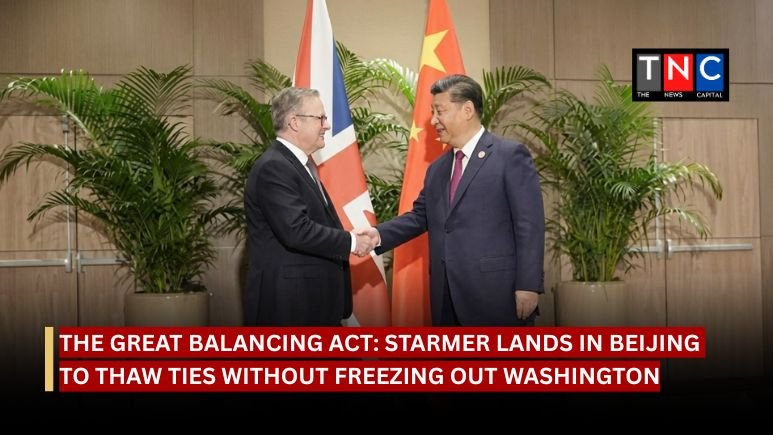

Walking the tightrope between superpowers has never been more treacherous. One misstep to the left and you face “100% tariffs” and exclusion from Washington’s inner circle. One lean to the right and you miss out on the world’s second-largest economy and future growth markets. Britain’s Prime Minister is attempting something that Canada just tried and paid dearly for: engaging with China without enraging America. The question isn’t whether it’s possible it’s whether Keir Starmer can pull off what Mark Carney couldn’t.
Prime Minister Keir Starmer arrived in the Chinese capital on Wednesday (January 28, 2026), marking the first visit by a British Prime Minister to China in eight years and signalling a deliberate “reset” of the UK’s relationship with the world’s second-largest economy after years of deteriorating ties, mutual suspicion, and diplomatic freeze. Meeting with President Xi Jinping at the Great Hall of the People on Thursday, Starmer framed the visit as essential for British economic prosperity, even as he navigates a dangerous diplomatic pincer movement: intense domestic pressure to confront Beijing on human rights abuses and surveillance, and the looming threat of a trade war sparked by President Trump’s increasingly aggressive “America First” resurgence that punishes allies perceived as getting too cozy with China.
With a 50-strong business delegation of corporate heavyweights in tow, Starmer is attempting to chart a narrow path between desperately needed economic growth for a struggling post-Brexit Britain and the very real “100% tariff” threats currently emanating from the Trump White House toward any ally that appears to be choosing Beijing over Washington.
Starmer’s arrival in Beijing comes just days after President Trump effectively punished Canada for pursuing its own “China Pivot,” creating a cautionary tale that the British Prime Minister is acutely aware of and desperately trying to avoid replicating:
- The Carney Catastrophe: After Canadian Prime Minister Mark Carney signed a comprehensive trade framework agreement with Beijing earlier this month including provisions for increased Chinese investment in Canadian infrastructure and expanded market access for Chinese goods Trump’s response was swift and brutal. He immediately rescinded Canada’s invitation to participate in the “Board of Peace” (Trump’s proposed new international security architecture), threatened to “eat them alive economically” with punitive duties, and publicly mused about whether Canada deserved to remain in revised North American trade arrangements.
- Starmer’s Delicate Dance: The British Prime Minister is working overtime to signal that London isn’t “choosing sides” in the emerging U.S.-China cold war, but rather pursuing what he characterizes as a mature, balanced approach that recognizes geopolitical reality. “I’m a British pragmatist,” Starmer told reporters aboard his flight to Beijing, carefully calibrating his message. “We have extraordinarily close relations with the United States our most important security partner and a vital trading relationship. But ignoring China when it represents the second-biggest economy in the world and a crucial player on climate, global health, and countless other issues simply wouldn’t be sensible or responsible.”
- The Broader Strategic Context: With the United States currently consumed by the “Golden Dome” missile defence expansion project, the escalating Greenland sovereignty dispute that’s straining NATO cohesion, and Trump’s threatened military intervention in Iran, Starmer is positioning the United Kingdom as a “mature, stabilizing” player capable of maintaining productive relationships with multiple superpowers simultaneously without compromising core security commitments essentially arguing that engaging China is compatible with the Western alliance rather than a betrayal of it.
The Prime Minister isn’t making this politically risky journey alone or for purely diplomatic reasons. He’s accompanied by over 50 corporate executives representing Britain’s most powerful companies, signaling unmistakably that the multi-year “Ice Age” in UK-China commercial relations is officially thawing, driven by hard economic necessity:
- Blue-Chip Participation: The delegation includes senior leadership from HSBC (seeking expanded operations in Chinese financial markets), Jaguar Land Rover (wanting better access for luxury vehicle sales to China’s wealthy consumers), pharmaceutical giant GSK (pursuing clinical trial cooperation and market access), and British Airways (seeking additional flight routes and landing rights). The presence of these household-name corporations demonstrates that this isn’t merely symbolic diplomacy but serious commercial engagement with billions of pounds in potential deals at stake.
- Strategic Priorities: Specific objectives include expanding UK financial services operations in Shanghai and other Chinese financial centers (where London’s expertise in banking, insurance, and asset management could generate substantial revenue), boosting exports of high-end British manufacturing (aerospace components, precision machinery, luxury goods), and perhaps surprisingly but importantly to rural Scottish constituencies increasing sales of premium Scotch whisky to China’s growing middle class.
- The Mega-Embassy Breakthrough: The visit was made possible in part by Starmer’s controversial decision last week to approve China’s construction of a massive new “mega-embassy” in London a facility that would be significantly larger than China’s current diplomatic presence and include expanded commercial, cultural, and consular facilities. Starmer greenlit the project despite significant espionage concerns raised by MI5 and despite opposition from Conservative Party members who view it as a surveillance threat. However, approving the embassy cleared a major diplomatic “stuck point” that had poisoned UK-China relations for years and opened the door for this visit.
- Security Guardrails Promised: Downing Street maintains publicly that increased trade will not come at the expense of British national security or fundamental values. Starmer’s team insists he raised sensitive issues during private sessions with President Xi, including the case of jailed British-Hong Kong citizen and pro-democracy activist Jimmy Lai (who faces life imprisonment on national security charges), human rights violations against Uyghur Muslims in Xinjiang province, and concerns about Chinese surveillance technology potentially being deployed in UK infrastructure.
The complex negotiating landscape:
| Area of Discussion | UK Objectives | Potential Friction Points |
| Trade & Investment | Achieve surplus in services sector; secure market access for Scotch whisky, luxury vehicles, and financial services | Trump’s explicit threats of retaliatory tariffs against allies trading with China; potential restrictions on Chinese investment in sensitive sectors |
| Security Cooperation | Establish “stable and consistent” dialogue channels to manage disagreements and avoid escalation | Deep concerns over Chinese espionage operations in UK, surveillance of diaspora communities, and approved “mega-embassy” creating intelligence gathering platform |
| Human Rights | Secure release of Jimmy Lai; press for protections for Uyghurs and Tibetans; address Hong Kong crackdown | Beijing’s firm view that these constitute “unacceptable interference in China’s internal affairs” with no room for foreign pressure |
| Migration & Organized Crime | Cooperation to dismantle human trafficking networks and illegal immigration operations | Divergent legal frameworks, China’s reluctance to extradite nationals, and mutual distrust on law enforcement cooperation |
| Climate & Technology | Joint initiatives on renewable energy, green technology transfer, and climate finance | Technology transfer concerns, intellectual property protection, and competition in green tech markets |
President Xi Jinping, speaking at the formal welcoming ceremony, acknowledged that UK-China relations had experienced significant “twists and turns” over recent years diplomatic understatement for a relationship that had deteriorated to near-hostility under previous British governments. He noted that these tensions had “served neither country’s interests” and suggested both nations bore responsibility for allowing the relationship to decay.
More significantly, Xi described the current international order as “turbulent and fluid” language that reflects Chinese analysis that American global dominance is declining and that opportunities exist for alternative power centers to emerge. He explicitly called on the United Kingdom to help maintain “world peace and stability” through developing a “long-term strategic partnership” with China essentially inviting Britain to position itself as a bridge between competing power blocs rather than as a unequivocal member of an anti-China coalition.
“Working together on issues like climate change, pandemic preparedness, and global stability during these challenging times is precisely what mature, responsible nations should be doing,” Prime Minister Starmer stated during the talks with President Xi, his language carefully chosen to emphasize pragmatism over ideology.
For Starmer, this visit represents an extraordinarily delicate balancing act with profound implications for Britain’s post-Brexit economic future and its role in an increasingly polarized international system:
If he succeeds in securing meaningful trade agreements, expanded market access for British companies, and demonstrates that engaging China doesn’t require abandoning Western security partnerships or fundamental values, he’ll have charted a “third way” that other middle powers might emulate proving that countries don’t have to choose absolute alignment with either Washington or Beijing but can maintain productive relationships with both based on clear-eyed national interest.
If he fails to adequately balance Beijing’s embrace with Washington’s mounting suspicion if Trump perceives Starmer as having chosen China over America, or if the domestic British public views him as having sold out human rights and security concerns for commercial gain he risks finding the United Kingdom isolated and caught in the crossfire of a 21st-century superpower “rupture” that could inflict severe economic and strategic damage on a Britain that desperately needs both markets.
“Starmer is trying to do what every middle power wishes it could do: have its cake and eat it too. Maintain the special relationship with America while accessing Chinese markets. The problem is Trump doesn’t accept that middle ground exists anymore. You’re either with us or against us,” noted Dr. Rana Mitter, director of the China Centre at Oxford University.
“Britain isn’t Canada. We’re a nuclear power, a permanent Security Council member, a financial center that China needs access to. We have leverage Canada doesn’t. But that only matters if we’re willing to use it, and if we’re prepared for Trump’s reaction,” commented Tom Tugendhat, the Conservative shadow foreign secretary, crystallizing the domestic political debate.
The coming days will reveal whether Starmer’s “pragmatic” approach represents skillful 21st-century statecraft that acknowledges multipolar reality, or dangerous naivety about a new cold war where neutrality isn’t an option and fence-sitting gets you crushed between competing giants.
For now, the business deals are being negotiated, the toasts are being raised, and Britain’s Prime Minister is walking his tightrope hoping that when he returns to London, he’s secured economic opportunity without sacrificing security partnerships, and that when Trump sees the news, he’ll understand the difference between engagement and betrayal.
Also Read / Breaking the North American Orbit: PM Mark Carney Embarks on Historic China Visit.








Leave a comment