

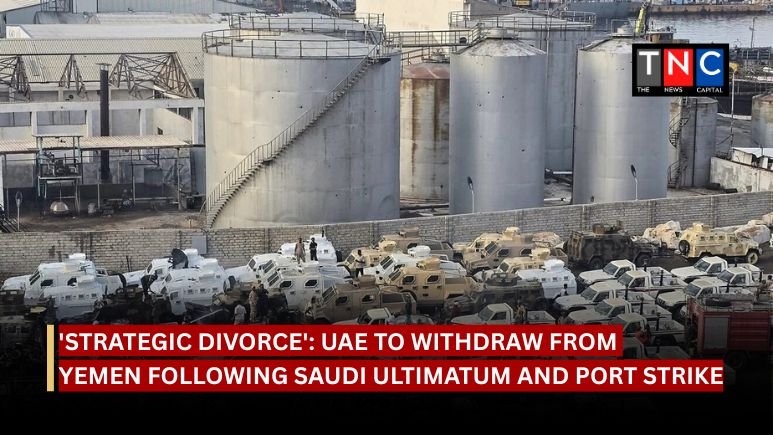

The decade-long Saudi-UAE alliance in Yemen has reached a dramatic collapse as Abu Dhabi announced the total withdrawal of its remaining counter-terrorism units, citing a “comprehensive assessment” after Saudi warplanes bombed an Emirati-linked shipment.
The United Arab Emirates announced Wednesday (December 31, 2025) that it’s ending all remaining military and counter-terrorism operations in Yemen, effective immediately. The decision follows a high-stakes ultimatum from Riyadh and a direct Saudi airstrike on the port of Mukalla, which targeted what Saudi officials claimed was an illegal weapons shipment for separatist forces. The move signals a final, public rupture between the two Gulf powers and leaves the future of the anti-Houthi coalition in total disarray.
The withdrawal marks the end of a presence that had been significantly reduced in 2019 but maintained through specialized “counter-terrorism” teams.
- The Ultimatum: Following Tuesday’s (Dec 30) strike on Mukalla, Yemen’s Presidential Leadership Council, backed by Riyadh, canceled a joint defense agreement with the UAE and ordered all Emirati personnel to leave within 24 hours.
- The Airstrike: Saudi Arabia justified bombing the Mukalla dock by claiming it was preventing the delivery of armored vehicles and weapons to the Southern Transitional Council. The UAE has flatly denied these claims, saying the shipment contained only humanitarian and logistical supplies for its own forces.
- Safety Concerns: The UAE Ministry of Defence said the withdrawal was a “voluntary” measure to ensure the safety of its personnel, especially after a separate December 28 missile attack on its Mukalla base killed 12 Emirati soldiers.
The Geopolitical Fallout
The rift centers on competing visions for Yemen’s future. While Saudi Arabia is committed to a unified Yemen under the PLC, the UAE has spent years cultivating the STC, which successfully seized control of the Hadramout and Al-Mahra provinces earlier this month in a lightning offensive.
- National Security “Red Line”: Riyadh views the STC’s presence on its southern border as an existential threat, accusing Abu Dhabi of “pressuring” the separatists to expand their territory.
- Economic Blockade: In addition to the military ultimatum, the PLC has declared a 90-day state of emergency and a 72-hour total blockade of all land, sea, and air ports to prevent further UAE-linked shipments.
“In light of recent developments and their potential implications for the safety and effectiveness of missions, the Ministry of Defence announces the termination of the remaining counterterrorism personnel in Yemen of its own volition,” the UAE Ministry of Defence stated.
“The Kingdom stresses that any threat to its national security is a red line… and will not hesitate to take all necessary steps to confront such threats,” a Saudi state spokesperson declared, emphasizing the ultimatum was necessary to preserve “good neighborliness.”
While the UAE will likely maintain “indirect” influence through funding and political support for the STC, its formal ground presence is over. Analysts warn this “strategic divorce” may empower the Houthi rebels and Al-Qaeda in the Arabian Peninsula, as the two most powerful members of the anti-Houthi coalition are now openly hostile to one another. The diplomatic freeze is expected to spill over into other regional arenas, including OPEC+ oil policy and infrastructure competition in the Horn of Africa.
Also Read / ‘Limited Operation’: Saudi Arabia bombs Yemeni port over UAE weapons shipment








Leave a comment