

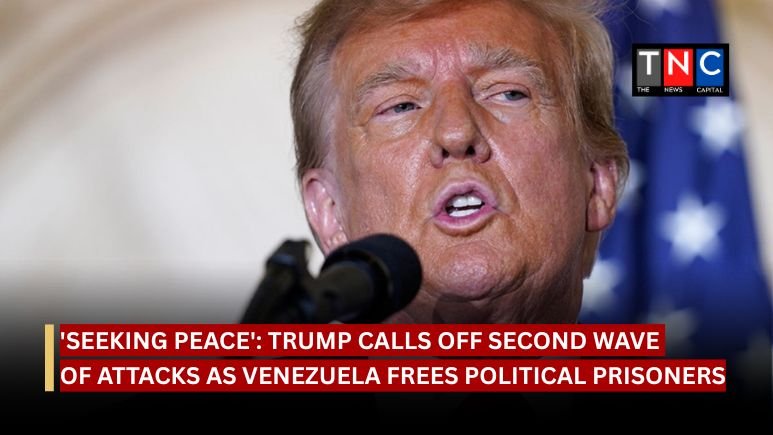

In a major de-escalation of the week-long crisis, President Donald Trump has canceled further military strikes against Caracas, citing a “smart gesture” by the interim government to release hundreds of detainees, including high-profile opposition leaders and foreign nationals.
President Donald Trump announced Friday (January 9, 2026) that he has “cancelled the previously expected second Wave of Attacks” on Venezuela, signaling a shift from military intervention to economic reconstruction. The decision follows a massive release of political prisoners by the interim administration of Delcy Rodríguez, a move the White House characterized as a sign of “seeking peace.” While the U.S. naval blockade remains in place, Trump said Washington and Caracas are now “working well together” to modernize the nation’s crippled oil infrastructure.
The release process, which began late Thursday, has seen some of the most prominent faces of the Venezuelan opposition return home after years behind bars.
- Key Figures Freed: Among those released is Enrique Márquez, a former presidential candidate, and Biagio Pilieri, a journalist and former National Assembly member. Both were seen embracing families in viral videos shortly after leaving detention.
- Foreign Nationals: Five Spanish citizens, including the renowned human rights activist Rocío San Miguel, were among the first to be freed. San Miguel, a dual citizen, had been held since February 2024 on charges of treason allegations she and international rights groups have long denied.
- Reconciliation Gesture: National Assembly President Jorge Rodríguez described the move as a “unilateral gesture” to foster “peaceful coexistence.” Rights group Foro Penal estimates that while over 800 political prisoners remain, this initial wave is a significant step toward national reconciliation.
With the immediate threat of airstrikes lifted, the focus has shifted to the “re-pumping” of Venezuela’s energy sector. Trump is scheduled to meet with CEOs of major U.S. oil firms at the White House at 2:30 PM today to finalize an investment roadmap.
- The Vision: Trump projected “big oil” companies would invest at least $100 billion to rebuild the “dilapidated” industry. “They have an unbelievable quality of oil and amount of oil,” Trump said, noting the reconstruction would be “bigger, better, and more modern.”
- Continued Oversight: Despite the thaw, Trump warned American oversight of Venezuela could last “for years.” He stressed “all ships will stay in place” to ensure security and that the U.S. retains control over the flow of crude.
The President’s “war powers” have faced a rare challenge at home even as he claims victory abroad.
- Senate Rebuke: In a surprising move, the U.S. Senate voted to advance a resolution to limit future strikes on Venezuela. Five Republicans joined Democrats in a rebuke of the President’s decision to conduct the January 3 raid without express Congressional approval.
- The ‘Machado’ Meeting: Trump confirmed he’ll meet with opposition icon María Corina Machado next week. While Machado hailed the prisoner release as a victory for “truth,” she remains a critical voice in making sure the transition leads to a fully democratic election.
“Venezuela is releasing large numbers of political prisoners as a sign of ‘Seeking Peace.’ It’s a very important and smart gesture… However, all ships will stay in place for safety and security purposes.” President Donald Trump, Truth Social.
“This is a positive step in the new phase Venezuela is entering. Injustice will not last forever.” María Corina Machado, Opposition Leader.
As the first group of freed prisoners prepares to travel including the Spanish nationals heading to Madrid the focus turns to the White House oil summit. If the promised $100 billion in private capital starts to flow, Venezuela could see its production rise to 2.5 million barrels per day by 2028. However, with the U.S. naval armada still “poised in position,” the peace in Caracas remains entirely dependent on the interim government’s continued compliance with Washington’s demands.
Also Read / Transition Under Shadow: 55 dead as Venezuela enters ‘Phase Two’ of post-Maduro era.







Leave a comment