

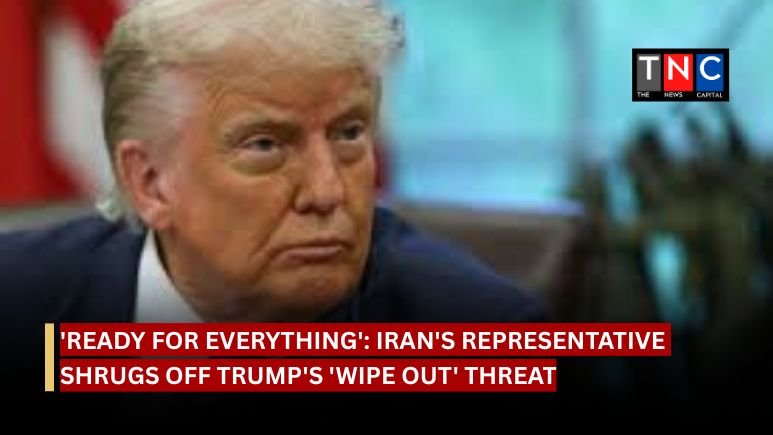

In a defiant response to escalating rhetoric from Washington, the representative of Iran’s Supreme Leader has dismissed President Donald Trump’s warnings of total destruction, citing religious decrees against nuclear weapons while claiming the Islamic Republic is prepared for any outcome. Amid spiraling tensions that have seen U.S. carrier strike groups diverted to the Middle East, Abdul Majid Hakeem Ilahi, the representative of Iran’s Supreme Leader in India, stated on Saturday, January 24, 2026, that his country is “ready for everything,” responding to President Trump’s recent warning that Iran could be “wiped off the face of the earth” if it targeted U.S. interests.
Despite reports of uranium enrichment nearing weapons-grade levels, Ilahi utilized a high-profile interview in New Delhi to reiterate that the development of atomic bombs remains strictly forbidden under Islamic law.
- The Fatwa Citation: Ilahi cited the long-standing religious decree by Ayatollah Seyyed Ali Khamenei, which classifies the possession and use of nuclear weapons as haram (forbidden). “Iran never wanted to have nuclear weapons because it is haram,” he stated, invoking religious authority to counter Western intelligence assessments.
- Double Standards Accusation: The envoy alleged a global “double standard,” arguing that international organizations are controlled by a few select countries. He questioned why Iran faces crippling sanctions while other nuclear-capable nations implicitly referencing Israel, Pakistan, and India operate without similar scrutiny.
- Peaceful Mandate: Tehran maintains that its nuclear activities are focused exclusively on medical treatment (radioisotopes for cancer therapy), humanitarian needs, and domestic energy production to reduce dependence on fossil fuel exports.
- Credibility Gap: Western intelligence agencies dispute the “peaceful purposes” narrative, citing uranium enrichment levels (reportedly at 60% purity, near the 90% weapons-grade threshold) that exceed any civilian energy requirements.
The Protest Narrative: Two Competing Realities
Addressing the civil unrest that has gripped Iran leaving an estimated 3,117 people dead according to state media Ilahi presented a starkly different narrative than that seen on global social media and independent reporting.
| Category | The Envoy’s Claim (The “Fact”) | The External Narrative (The “Imagination”) |
| Origin | Protesters were “educated from abroad” via social media | Organic grassroots movement against economic hardship and rial collapse |
| Tactics | Demonstrators “burnt hospitals, mosques, and libraries” like ISIS | Peaceful protests met with lethal state force; snipers on rooftops |
| Internet Shutdown | Cut to “bring peace” and restore social calm | A tool used to hide state-sponsored violence from the world |
| Death Toll | 3,117 (state media figure) | 3,117+ with reports suggesting higher unreported casualties |
| Foreign Role | Western intelligence orchestrating regime change | Spontaneous reaction to currency collapse and economic mismanagement |
- The Gap Acknowledgment: “There is a very deep gap between these two realities,” Ilahi said, claiming the situation is currently “under control” despite the “imagination” fueled by foreign journalists and social media activists.
- ISIS Comparison: The characterization of protesters as ISIS-like arsonists targeting religious and medical facilities represents an attempt to delegitimize the movement by associating it with terrorism.
- Information Warfare: The framing reflects Iran’s strategy of portraying domestic unrest as foreign-orchestrated rather than acknowledging legitimate grievances about economic conditions.
The envoy’s remarks come at a perilous moment for regional stability, with his warnings suggesting that any U.S.-Iran conflict would engulf the entire Middle East.
- Economic Warfare Acknowledgment: Ilahi acknowledged “economic problems” but blamed them entirely on “unlawful sanctions” led by the United States, particularly the “maximum pressure” campaign that has devastated Iran’s oil exports and currency.
- Regional Conflagration Warning: He warned that any further U.S. or Israeli escalation would “burn the region,” affecting all Middle Eastern countries, not just Iran—a reference to Iran’s network of proxies and allies across Iraq, Syria, Lebanon, Yemen, and Palestine.
- Proxy Network: The warning implicitly threatens that Iranian retaliation would involve Hezbollah in Lebanon, Houthis in Yemen, Iraqi militias, and other aligned groups attacking U.S. and allied interests throughout the region.
- Oil Infrastructure Vulnerability: The “burn the region” language suggests potential attacks on Gulf oil infrastructure, which would spike global energy prices and create economic crises far beyond the Middle East.
Despite the friction between Tehran and Washington, Ilahi expressed confidence in bilateral India-Iran relations, particularly around strategic infrastructure projects.
- Chabahar Port Project: Ilahi expressed confidence in the Chabahar port development, noting that New Delhi has historically resisted pressure from third-party sanctions to maintain its relationship with Iran.
- Civilizational Ties: The envoy invoked the “3,000-year civilizational tie” between India and Iran, positioning the relationship as transcending contemporary geopolitical pressures from Washington.
- Strategic Hedging: India’s continued engagement with Iran through Chabahar provides Tehran with an example of a major power defying American sanctions pressure, though India has significantly reduced oil imports to comply with U.S. demands.
- Balancing Act: New Delhi faces difficult choices between maintaining strategic access to Central Asia through Chabahar and managing relationships with Washington, particularly as Trump threatens nations doing business with sanctioned regimes.
The representative’s concluding remarks emphasized Tehran’s preparation for any scenario, from continued sanctions to military confrontation.
- Stoic Defiance: The “ready for everything” formulation projects confidence and resolve, suggesting Iran will neither back down nor seek accommodation with Washington.
- Peace Seeking: Despite the confrontational tone, Ilahi maintained that Iran seeks peace, framing any potential conflict as defensive rather than aggressive.
- “Locked and Loaded”: The phrase echoes Trump’s own rhetoric back at Washington, suggesting Iranian forces are equally prepared for military confrontation if diplomacy fails.
- Forced Confrontation Narrative: Tehran’s messaging consistently frames itself as the victim of American aggression, portraying any conflict as imposed by Washington rather than chosen by Tehran.
Ilahi concluded with a broader critique of the international system that governs nuclear non-proliferation, sanctions, and conflict resolution.
- Lost Influence: The representative noted that international organizations have “lost their influence” because they serve the interests of the powerful rather than the benefit of the people.
- Selective Enforcement: The critique targets the Nuclear Non-Proliferation Treaty regime, UN Security Council, and International Atomic Energy Agency as tools of Western powers rather than neutral arbiters.
- Legitimacy Crisis: Tehran’s position reflects broader challenges to the post-World War II international order, with multiple powers now questioning whether institutions represent universal principles or great power preferences.
- Alternative Frameworks: The critique implicitly supports emerging alternatives like BRICS, Shanghai Cooperation Organization, and other non-Western institutional frameworks.
The envoy’s defiant statements come as U.S. naval forces approach the Persian Gulf in what Trump has characterized as an “armada” capable of devastating Iranian military capabilities.
- USS Abraham Lincoln: The carrier strike group diverted from South China Sea patrol is approaching the region with 60-80 combat aircraft and advanced missile defense systems.
- Potential Reinforcements: Unconfirmed reports suggest the USS George H.W. Bush strike group may also be en route, creating a massive concentration of American naval power.
- Strait of Hormuz: The approaching vessels will operate in the confined waters where Iranian anti-ship missiles, naval mines, and fast attack craft create asymmetric threats to even the most advanced warships.
- Escalation Ladder: Each side’s military posturing creates pressure to demonstrate resolve, establishing dynamics where backing down appears weak and miscalculation can trigger unintended conflict.
The defiant posture from Tehran and approaching U.S. naval forces create multiple potential trajectories for the crisis.
- Deterrence Success: Iranian restraint on executions and nuclear advancement, combined with U.S. acceptance of the status quo, allows both sides to claim victory through strength without kinetic conflict.
- Limited Strikes: U.S. surgical strikes on nuclear facilities or IRGC targets, Iranian retaliation against regional U.S. interests, followed by negotiations or further escalation depending on damage and casualties.
- Proxy Escalation: Rather than direct U.S.-Iran conflict, Tehran activates proxy forces throughout the region, creating multiple simultaneous crises that strain American capabilities without clear targets for retaliation.
- Miscalculation: Accident, misinterpretation of intent, or deliberate provocation triggers exchanges that neither leadership initially wanted but feels compelled to continue once initiated.
Iran’s Supreme Leader representative in New Delhi dismissed Trump’s “wipe off the face of the earth” threats as “not new” while claiming readiness for any scenario the defiant posture combines religious prohibition against nuclear weapons with warnings that regional conflagration would follow American strikes, reflecting Tehran’s strategy of deterring attack through asymmetric threats while maintaining the fatwa narrative undermines Western intelligence assessments of weapons-grade enrichment progress.
Also Read / ‘Armada’ En Route: Trump Dispatches Massive US Fleet as Iran Warns of ‘Finger on the Trigger’.







Leave a comment