

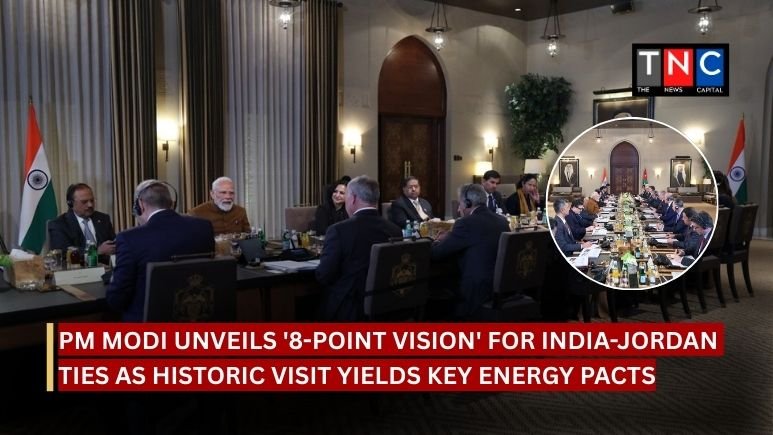

The Prime Minister has kicked off his three-nation diplomatic tour with a “meaningful expansion” of ties in Amman, signing agreements on renewable energy and water management while setting an ambitious $5 billion trade target.
Prime Minister Narendra Modi and King Abdullah II of Jordan have unveiled a comprehensive “eight-point vision” to upgrade their strategic partnership as India looks to deepen its presence in the Middle East. During high-level talks in Amman on Monday (15 December), the two leaders finalized several agreements focused on clean energy and digital infrastructure, marking the 75th anniversary of diplomatic relations between the two countries.
The visit, the first leg of Modi’s three-nation tour, resulted in a concrete “List of Outcomes” that includes Memorandums of Understanding on renewable energy, water resource management, and a unique “twinning agreement” between the historic sites of Petra and Ellora to boost tourism.
A key part of the new roadmap is an ambitious goal to nearly double bilateral trade from the current $2.8 billion to $5 billion over the next five years. The “eight-point vision” the leaders shared specifically targets cooperation in fertilizers (a crucial import for India), healthcare, critical minerals, and civil nuclear energy.
In a significant strategic move, Jordan has also expressed its intention to join three major Indian-led global initiatives: the International Solar Alliance, the Global Biofuel Alliance, and the Coalition for Disaster Resilient Infrastructure.
“These outcomes mark a meaningful expansion of the India-Jordan partnership. Our cooperation in new and renewable energy reflects a shared commitment to clean growth, energy security and climate responsibility,” Prime Minister Modi said in a statement on X (formerly Twitter).
He also praised King Abdullah II, saying, “His personal commitment towards vibrant India-Jordan relations is noteworthy. This milestone will continue to inspire us to move forward with renewed energy.”
The visit highlights India’s dual strategy of securing energy and fertilizer supply chains while positioning itself as a leader of the “Global South.” The focus on sharing “population-scale digital solutions” suggests India is eager to export its “India Stack” (digital public infrastructure like UPI) to partners in West Asia.
Having wrapped up his time in Amman, Prime Minister Modi has now left for Ethiopia (16-17 December), where he’s scheduled to meet Prime Minister Abiy Ahmed Ali. This will be the first-ever visit by an Indian PM to the African nation. The tour wraps up in Oman later this week.
Also Read / PM Modi arrives in Jordan to kick off ‘historic’ three-nation tour.











Leave a comment