

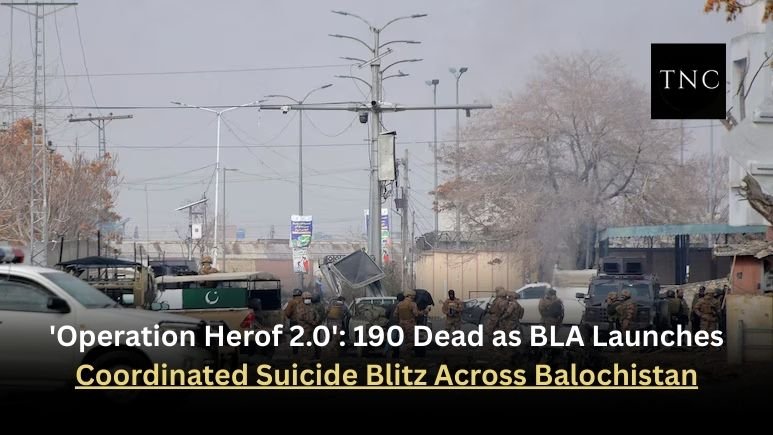

Forty hours. Twelve locations. Female suicide bombers breaching military gates with vehicle bombs while ground squads storm in behind them. Militants freeing prisoners, killing families, abducting officials. The Pakistani military claiming 145 insurgents killed while 17 soldiers and 31 civilians lie dead. And across Balochistan, a province larger than Germany, mobile networks jammed, trains stopped, hospitals overflowing, and nobody knowing when the next attack will come. This is what coordinated insurgency looks like when a separatist group decides to prove it can strike anywhere, anytime.
QUETTA / ISLAMABAD — Balochistan became a war zone this weekend as the Balochistan Liberation Army (BLA) executed what they’re calling “Operation Herof 2.0,” a massive, synchronized assault across the province that has left at least 193 people dead. Starting early Saturday morning, January 31, 2026, and continuing into Monday, the offensive hit more than 12 locations simultaneously in the deadliest 40-hour period in recent Pakistani history.
Government officials confirmed Monday that 17 security personnel and 31 civilians were killed, while the military claims its counter-offensive “eliminated” 145 militants. Those numbers tell competing stories depending on who’s speaking, but the bodies are real regardless of whose narrative you believe.
Female fighters leading the charge
The most striking element of this attack wasn’t just the scale but who carried it out. The BLA deployed female fighters from its elite Majeed Brigade in numbers never seen before.
Shortly after the attacks began, the BLA’s media wing, Hakkal, released high-definition photos and videos of female fidayeen (suicide bombers) prepared for their missions. These weren’t grainy propaganda shots. They were professionally produced images clearly designed to send a message: we have resources, we have commitment, and we have fighters willing to die for this cause.
This follows the precedent set by Mahal Baloch in 2024, but marks a massive increase in female involvement. Reports indicate these units specifically targeted high-security military gates and Frontier Corps outposts in Bela and Quetta, using Vehicle-Borne IEDs (VBIEDs) to blast through perimeters before ground squads moved in to finish the job.
The tactical sophistication is chilling. Coordinated timing across multiple districts. Vehicle bombs to breach defences. Follow-up ground assaults. Propaganda released within hours. This isn’t a ragtag insurgency anymore. This is organized warfare.
Twelve locations, one nightmare
The attacks weren’t concentrated in one area where security could respond quickly. They were deliberately spread across Balochistan’s strategic coastal and border regions, stretching security forces impossibly thin.
| Where It Happened | What Happened |
| Mastung | Militants stormed the district jail, freed 30 inmates, and seized a large weapons cache |
| Gwadar | A family of five, including women and children, killed in targeted attack near high-security zone |
| Nushki | Suicide bombers hit administrative centers; senior civil official reportedly abducted |
| Quetta | Multiple explosions throughout the provincial capital as heavy security prevented seizure of government offices |
That list doesn’t capture the terror of living through it. Imagine hearing explosions across your city for 40 hours, not knowing if your neighbourhood is next, if your family members at work are safe, if the attackers have been stopped or are still operating freely.
The prison break that changed everything
The Mastung jail assault deserves special attention because it wasn’t just about killing. It was about operational capacity. Thirty inmates freed means 30 potential fighters or supporters back in circulation. The large weapons cache seized means future attacks are already better supplied. And the symbolic victory of storming a government facility and walking away with prisoners demonstrates that BLA can strike at the heart of state authority.
For the families in Gwadar who lost five members, including women and children, the strategic calculations don’t matter. They’re just dead, caught in a conflict they likely wanted no part of but couldn’t escape because they happened to live near a “high-security zone.”
“Fitna-al-Hindustan”: Blaming India
In a sharp rhetorical escalation, Pakistan’s military media wing (ISPR) and Balochistan Chief Minister Sarfraz Bugti have started calling the BLA and its affiliates “Fitna-al-Hindustan,” terminology specifically designed to link the insurgency to alleged backing from Indian intelligence agencies.
India has consistently denied supporting Baloch separatists, but the accusation serves multiple purposes for Islamabad: it frames a domestic insurgency as foreign aggression, it appeals to Pakistani nationalism, and it potentially justifies harder crackdowns by portraying separatists as foreign agents rather than citizens with grievances.
Chief Minister Bugti stated during a Sunday press conference that 145 terrorists were killed within 40 hours. “We will not surrender even for a second. This Pakistan is not for breaking away,” he declared, framing the conflict in absolute terms with no room for negotiation or political solutions.
The iron fist response
To contain the violence, authorities have implemented measures that punish everyone in the province:
- Complete mobile network jamming across affected areas
- Suspension of all train services throughout Balochistan
- Hospitals placed on high alert, though many lack supplies for mass casualty events
- Roadblocks and checkpoints making normal movement nearly impossible
For ordinary Baloch citizens, this means being cut off from family members, unable to conduct business, trapped in their homes while the government and insurgents fight over their future without consulting them. The mobile network shutdown prevents insurgents from coordinating, but it also prevents families from checking if their loved ones are alive.
Competing narratives, uncertain reality
The Pakistani military insists the attacks were “coordinated but poorly executed” and ultimately foiled. The BLA claims it controlled certain districts for over ten hours, demonstrating state weakness. Both sides have reasons to spin the story.
What’s undeniable is that a level of tactical sophistication and intelligence penetration exists that deeply unsettles the regional security apparatus. You don’t simultaneously hit 12+ locations across a province larger than many countries without extensive planning, reliable intelligence about security force positions, and operational coordination that suggests significant organizational capacity.
The BLA’s claim of holding territory for hours, even if exaggerated, indicates security gaps that no amount of government spin can entirely dismiss. And the fact that militants successfully stormed a jail, freed prisoners, and escaped with weapons suggests vulnerabilities that future attacks will exploit.
The humanitarian cost nobody’s counting properly
As clearance operations continue in the rugged mountains of Bolan and Kalat, the people actually living in Balochistan are caught between what locals call “the force of the gun” and the state’s iron-fisted retaliation.
Civilians killed at checkpoints because they looked suspicious. Families displaced from fighting zones with nowhere to go. Young men detained for questioning who may or may not return. Businesses shuttered indefinitely. Schools closed. Normal life suspended.
The government counts security personnel killed. The BLA counts its martyrs. But the civilians who just wanted to live their lives without becoming statistics in someone else’s war? They’re barely part of the narrative, except when their deaths serve propaganda purposes for one side or another.
Clearance operations will continue. The military will claim victory, showing pictures of dead militants and captured weapons. The BLA will release more propaganda, framing their fighters as heroes resisting occupation. Politicians in Islamabad will make speeches about Pakistani unity. And absolutely none of it will address the underlying grievances that fuel this insurgency.
Balochistan has vast mineral wealth, strategic importance for China’s Belt and Road Initiative, and some of Pakistan’s poorest people. The province produces enormous revenue for the federal government while seeing minimal investment in local infrastructure, education, or economic development. Baloch people have been marginalized, disappeared by security forces, and treated as second-class citizens in their own land for decades.
Those facts don’t justify suicide bombings or killing civilian families. But they explain why the BLA can recruit fighters, why local populations sometimes provide cover, why “Operation Herof 2.0” won’t be the last coordinated assault.
Until someone in Islamabad decides that military operations alone can’t solve a political problem, this cycle continues. More attacks. More crackdowns. More bodies. More grievances. More radicalization. More violence.
The mountains of Bolan and Kalat have seen this pattern for generations. The names and tactics change, but the fundamental dynamic remains: an insurgency that can’t be militarily defeated fighting a state that refuses to politically compromise, with ordinary people dying in between.
Operation Herof 2.0 is over. The next operation is already being planned.
Also Read / Terror in the Enclave: Deadly Blast Rocks Central Kabul’s Shahr-e-Naw Area.











Leave a comment