

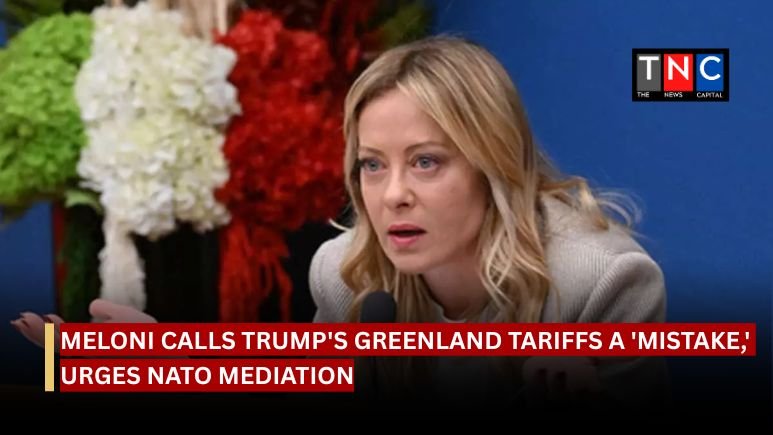

In a rare moment of friction between the two allies, Italian Prime Minister Giorgia Meloni cautioned President Donald Trump on Sunday against using economic “blackmail” to force the sale of Greenland, warning that current tariff threats risk a permanent fracture in the transatlantic alliance. Speaking during an official visit to South Korea on January 18, 2026, Meloni revealed she had personally communicated her concerns to the U.S. President, framing the escalating crisis as a “problem of communication and understanding” rather than a fundamental break in values, while urging that the dispute be mediated through NATO channels.
The diplomatic rift follows President Trump’s weekend announcement that eight European nations will face sweeping tariffs due to their opposition to a U.S. purchase of Greenland, marking an unprecedented use of economic coercion against NATO allies.
- The Targeted Eight: Denmark, Norway, Sweden, France, Germany, the United Kingdom, the Netherlands, and Finland will face punitive tariffs for their refusal to support American acquisition of Greenland.
- The Escalation Timeline: In a series of Truth Social posts, Trump stated that a 10% tariff would be applied starting February 1, 2026, rising to 25% on June 1 unless a deal for the “Complete and Total purchase of Greenland” is reached.
- The ‘Military Drill’ Trigger: The President specifically targeted countries that recently sent troops to Greenland for Arctic security exercises, accusing them of playing “a very dangerous game” and interpreting defensive deployments as hostile acts.
- Italy’s Exemption: Notably, Italy has not sent troops to the territory and thus avoids the tariff threat. Meloni noted that the willingness of some European countries to contribute to Arctic security should be understood as a deterrent against “other actors” (Russia and China) rather than as an anti-American initiative.
Despite her criticism of the tariffs, Meloni often seen as Trump’s closest ideological ally in Europe sought to play the role of a bridge-builder between Washington and Brussels, leveraging her unique relationship with the American president.
- Direct Communication: “I spoke to Donald Trump a few hours ago and told him what I think… I believe that imposing new sanctions today would be a mistake,” Meloni stated, demonstrating her willingness to privately push back against Trump’s approach.
- NATO Mediation: Meloni confirmed she spoke with NATO Secretary-General Mark Rutte, who agreed the alliance must take an active role in coordinating Arctic security. “NATO is the place where we must try to organize together deterrents against hostile interference in a strategic territory,” Meloni stated.
- Shared Strategic Vision: She emphasized that she shares Washington’s focus on the Arctic as a “strategic area where excessive interference by potentially hostile actors must be avoided,” aligning on threat assessment while disagreeing on methods.
- Diplomatic Language: By framing the crisis as a “problem of communication and understanding,” Meloni leaves room for de-escalation while avoiding direct condemnation of Trump’s territorial ambitions.
While Meloni favors dialogue, the broader European Union is preparing for a “downward spiral” in relations, with powerful economic countermeasures being readied in case Trump follows through on tariff threats.
| Metric | Target / Response |
| US Tariff (Feb 1) | 10% on 8 European nations |
| US Tariff (June 1) | 25% if no deal is reached |
| EU Countermeasure | Anti-Coercion Instrument (Trade “Bazooka”) |
| NATO Stance | Developing a “coordinated presence” in the Arctic |
- Anti-Coercion Instrument: French officials have already called for the activation of the EU’s anti-coercion instrument a powerful tool that would allow the bloc to retaliate with curbs on U.S. imports and services if the Greenland tariffs are implemented.
- Trade War Escalation: The instrument, often called the EU’s trade “bazooka,” would allow Brussels to target American exports, potentially hitting strategic sectors like technology, agriculture, and manufacturing.
- Unity Against Coercion: The “Greenland Crisis” has unified European leaders who view the purchase demand as a violation of international law, creating rare cohesion across the typically fractious 27-member bloc.
- Irish Condemnation: Ireland described the threat as “completely unacceptable,” while Danish Prime Minister Mette Frederiksen reaffirmed that Greenlandic sovereignty is “non-negotiable,” drawing red lines that make compromise difficult.
The crisis has prompted unusually sharp rhetoric from European officials, reflecting deep alarm about Trump’s willingness to economically coerce allies over territorial demands.
“I spoke to Donald Trump a few hours ago and told him what I think… I believe that imposing new sanctions today would be a mistake.” Giorgia Meloni, Prime Minister of Italy
“China and Russia must be having a field day. Tariffs risk making Europe and the United States poorer and undermine our shared prosperity.” Kaja Kallas, EU High Representative for Foreign Affairs
- Kallas’s Warning: The EU’s top diplomat pointed to the geopolitical gift Trump is handing adversaries by fracturing Western unity over an issue that serves Russian and Chinese strategic interests.
- Strategic Absurdity: European officials privately express bewilderment that the United States would risk the transatlantic alliance over a territory whose population overwhelmingly opposes American acquisition.
- Alliance Credibility: The crisis raises fundamental questions about NATO’s purpose if the alliance’s leading member threatens economic warfare against partners over territorial expansion.
Beyond the immediate tariff threats, the crisis reflects genuine strategic competition in the Arctic that both sides acknowledge, even as they disagree on how to address it.
- Russian Presence: Russia has been significantly expanding its Arctic military infrastructure, including reopened Soviet-era bases, new icebreakers, and advanced weapons systems deployed to the region.
- Chinese Ambitions: China has declared itself a “near-Arctic state” despite geographic reality and has invested heavily in Arctic research, shipping routes, and economic development as ice melts due to climate change.
- Greenland’s Resources: The island holds vast reserves of rare earth elements, oil, gas, and minerals that are becoming accessible as permafrost thaws, creating economic stakes beyond military positioning.
- NATO Coordination: Meloni’s call for NATO-led Arctic security coordination represents a compromise position addressing American security concerns through multilateral alliance mechanisms rather than unilateral territorial acquisition.
The Greenland crisis operates on multiple levels simultaneously territorial sovereignty, economic coercion, alliance politics, and Arctic militarization making resolution exceptionally complex.
- Sovereignty Principles: International law is clear that territory cannot be acquired through coercion, making Trump’s tariff threats to force a sale legally problematic regardless of their effectiveness.
- Self-Determination: Greenland’s population of 57,000 (primarily indigenous Inuit) has rights to self-determination under international law, and 85% oppose U.S. acquisition according to recent polling.
- Danish Position: Denmark faces the impossible task of defending Greenlandic sovereignty against its most important security ally, creating a crisis that threatens its core strategic relationships.
- Precedent Dangers: European officials fear that acquiescing to economic coercion on Greenland would establish a precedent encouraging territorial revisionism globally.
With Trump’s first tariff tranche scheduled for February 1, 2026 less than two weeks away the diplomatic clock is ticking toward a potential point of no return.
- Short Timeline: The rapid approach of the February 1 deadline leaves little room for the careful diplomacy typically required to defuse major alliance crises.
- Political Constraints: Both sides face domestic political pressures that make backing down difficult Trump cannot appear weak on “national security,” while European leaders cannot be seen surrendering to American bullying.
- NATO Summit Pressure: The crisis may force an emergency NATO meeting before the scheduled spring summit, testing whether the alliance can mediate disputes among members.
- Economic Impact: Even the threat of tariffs is already affecting investment decisions and trade planning, creating economic damage before any duties are actually imposed.
Meloni’s intervention represents a potential off-ramp if both sides are willing to embrace face-saving compromise, though the window for agreement is rapidly closing.
- NATO Framework: Using NATO to coordinate Arctic security allows Trump to claim success in addressing the “Russia and China problem” without territorial acquisition, while Europeans avoid both tariffs and sovereignty violations.
- Greenland Investment: A compromise might involve increased American investment in Greenland’s infrastructure and defense without changing sovereignty, addressing some security concerns through economic means.
- Face-Saving Language: Diplomatic success would require crafting language that lets Trump claim progress on Arctic security while allowing Europeans to affirm that territorial integrity remains inviolable.
- Relationship Repair: Even if immediate crisis is averted, the Greenland episode has damaged trust within NATO in ways that may take years to repair, particularly regarding America’s commitment to alliance norms.
The spectacle of America’s closest European ideological ally Giorgia Meloni publicly calling Trump’s approach a “mistake” underscores how isolated the Greenland tariff strategy has left Washington within the Western alliance. Whether Meloni’s bridge-building can prevent the February 1 deadline from triggering a trade war between NATO allies remains to be seen, but the crisis has already demonstrated that Trump’s transactional approach to international relations has limits when applied to territorial ambitions that violate fundamental principles of sovereignty, self-determination, and alliance solidarity. China and Russia, as Kaja Kallas noted, are indeed having a field day watching the transatlantic alliance tear itself apart over an Arctic island that has no interest in changing flags.
Also Read / Trump Escalates Greenland Push: Tariff Threats Issued to Nations Opposing US Takeover.




Leave a comment