


At a refinery outside Jamnagar, a control-room engineer watches the global oil ticker crawl across his monitor. Brent crude has jumped again. Another alert flashes across the screen: shipping disruptions in the Persian Gulf.
The engineer leans back, exhales slowly, and does a quick calculation in his head. If the tankers slow down at the Strait of Hormuz, the refinery’s feedstock pipeline tightens. If crude becomes scarce, fuel prices rise. If prices rise, the ripple spreads from airlines to truck drivers to the family filling a scooter at a roadside petrol pump.
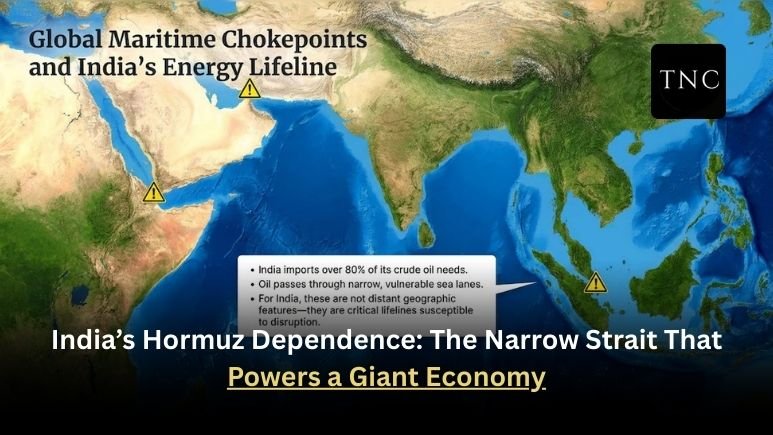
The chokepoint sits thousands of kilometers away, between Iran and Oman. Yet the decisions made around that narrow stretch of water reach directly into India’s factories, markets, and households.
India’s economy one of the fastest-growing in the world depends heavily on trade flowing through the Strait of Hormuz, a maritime corridor that links Gulf energy producers to global markets. Nearly 16% of India’s trade is tied to countries connected to the Hormuz corridor, and a large portion of its energy imports originates from that region.
The dependence goes deeper in the energy sector. Roughly 46% of India’s crude oil imports and more than half of its LNG imports come from Hormuz-linked nations such as Saudi Arabia, the UAE, Qatar, and Kuwait.
That reliance places India among the Asian economies most exposed to geopolitical tensions in West Asia where a disruption in a single narrow strait could quickly reverberate across the country’s economy.
The Strait of Hormuz is not just another shipping route. It is one of the world’s most important energy chokepoints. Around 20% of global oil and a significant share of liquefied natural gas shipments pass through it every day, feeding the energy needs of major Asian economies.
For India, the stakes are particularly high. The country imports roughly 5 million barrels of crude oil daily, and more than half of that energy flows through Hormuz-linked supply chains.
That dependence creates several layers of vulnerability.
Energy security risk.
If conflict or military tension disrupts tanker traffic in the strait, the immediate impact would be on oil prices and supply. Even short disruptions can trigger global price spikes, pushing up India’s fuel costs, inflation, and fiscal pressure.
Trade exposure.
India’s economic links with Gulf economies extend beyond energy. A large share of non-oil exports including food products, chemicals, and engineering goods move through the same corridor. Analysts estimate that tens of billions of dollars in Indian exports depend on stable shipping routes through Hormuz.
Financial and currency impact.
When geopolitical tensions raise oil prices, the effect quickly reaches financial markets. A surge in crude prices can weaken the rupee, increase import bills, and raise hedging costs for Indian companies managing foreign exchange risks.
Supply chain consequences.
Disruptions in the strait have already forced shipping companies to reconsider routes, sometimes diverting vessels thousands of kilometers around Africa, dramatically increasing freight costs and delivery times.
The result is a cascading economic chain reaction: higher fuel costs, rising logistics expenses, inflationary pressure, and slower growth.
To reduce the risk, India has been pursuing several long-term strategies diversifying energy suppliers, building strategic petroleum reserves, expanding renewable energy capacity, and investing in alternative trade routes such as Iran’s Chabahar Port, which provides access to Central Asia without relying solely on Gulf shipping lanes.
But these solutions take years to fully offset a structural dependency built over decades.
The Strait of Hormuz is only about 33 kilometers wide at its narrowest point. Yet for India, it carries far more than oil tankers.
It carries the fuel for economic growth, the stability of trade routes, and the price Indian consumers pay every day.
In a globalized economy, sometimes the most powerful forces shaping a nation’s future flow through the narrowest of passages.
Also Read / Why the U.S. Is Letting India Buy Russian Oil, and What It Means for Global Fuel Prices.











Leave a comment