

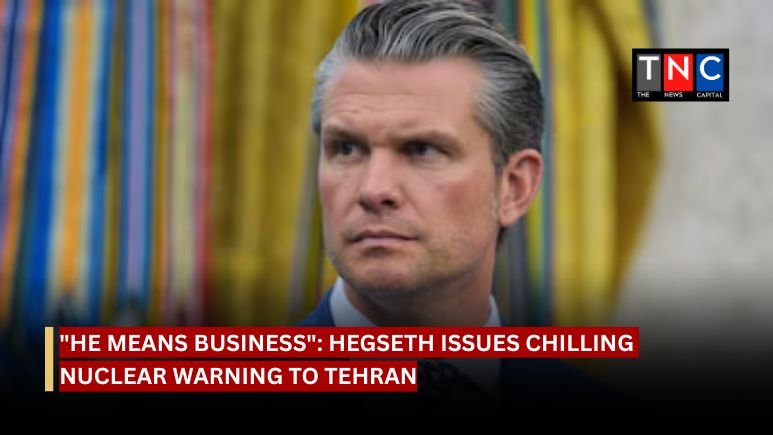

The language was deliberately chosen to send a message: not “Department of Defence,” but “War Department” the name America used when preparing to fight world wars, not manage peacetime deterrence. And the man using it, standing beside the President who just extracted a foreign leader from his own capital at gunpoint, wasn’t engaging in diplomatic posturing. He was delivering what amounted to a final warning before the shooting starts, and everyone in Tehran knows it.
In a high-stakes Cabinet meeting on Thursday (January 29, 2026), Secretary of War Pete Hegseth delivered what can only be described as an ultimatum to Iran, asserting in the bluntest possible terms that the Pentagon is fully prepared to execute “whatever this President expects” to permanently dismantle Tehran’s nuclear weapons program whether through diplomacy, covert action, or overwhelming military force. Standing alongside President Donald Trump in the Roosevelt Room, Hegseth signaled unmistakably that the “window for a diplomatic deal is rapidly closing” and emphasized that the administration’s recent military successes in South America specifically the audacious raid that captured Venezuelan President Nicolás Maduro should be understood globally as demonstrating both American capability and American willingness to use that capability regardless of international law, allied concerns, or conventional diplomatic norms.
The remarks represented not mere saber-rattling or negotiating theater, but rather a formal declaration of the Pentagon’s operational readiness to execute strikes that could fundamentally reshape the Middle East and potentially trigger the region’s first major interstate war in decades.
The Secretary of War’s statement was framed explicitly not as a warning subject to debate, but as a straightforward report on the U.S. military’s total readiness to execute presidential orders:
- Absolute Prohibition on Nuclear Capability: “They should not pursue nuclear weapons capabilities. Period,” Hegseth stated with deliberate emphasis, leaving no room for ambiguity about limited enrichment rights, peaceful nuclear programs, or any of the nuances that characterized previous diplomatic frameworks. Referring directly to Operation Midnight Hammer the devastating June 2025 strikes that destroyed three major Iranian nuclear facilities he added with unmistakable menace: “When President Trump said, ‘We’re not getting a nuclear Iran under any circumstances,’ he meant it literally. That wasn’t a negotiating position. That was a statement of absolute policy that this administration will enforce through any means necessary.”
- The Venezuela Precedent as Global Template: Hegseth explicitly invoked the recent “unmatched and surgical” military operation that led to the capture of Venezuelan President Nicolás Maduro and his wife Cilia Flores, presenting it not as an isolated incident but as a repeatable model demonstrating the administration’s new “warrior-centric” approach that empowers military commanders to act decisively without the bureaucratic constraints and risk-averse legal reviews that characterized previous administrations. “That operation sends an unmistakable message to every capital from Tehran to Pyongyang to Beijing: when President Trump issues a warning or makes a commitment, he absolutely means business. We will do what we say we’re going to do, regardless of whether that makes our allies comfortable or our adversaries angry,” Hegseth declared, his language clearly intended to be heard in foreign capitals as a direct threat.
- The “War Department” Rebrand: Throughout his remarks, Hegseth conspicuously and repeatedly used the administration’s preferred unofficial designation “War Department” rather than the official “Department of Defense” language that signals a fundamental philosophical shift from viewing the military primarily as a defensive deterrent force toward embracing an explicitly offensive, power-projection posture. The name change, while not yet formalized legislatively, reflects Trump’s view that American military power should be used proactively to shape global outcomes rather than reactively to respond to threats.
As inflammatory rhetoric escalates, the physical deployment of overwhelming American military power to the Persian Gulf region has reached levels not seen since the 2003 Iraq invasion, suggesting this is not merely diplomatic theater but genuine preparation for major combat operations:
- Dual Carrier Strike Groups: The USS Abraham Lincoln carrier strike group, which entered the region last week, has now been joined by a second complete carrier battle group the USS Gerald R. Ford, America’s newest and most technologically advanced aircraft carrier creating a combined force that President Trump personally described as “larger and more lethal than anything we deployed to Venezuela, and Venezuela saw what we’re capable of.” Together, these two carrier groups represent approximately 150 combat aircraft, multiple guided-missile cruisers and destroyers, nuclear-powered attack submarines, and roughly 15,000 naval personnel positioned within striking distance of Iranian targets.
- Expanded Strike Options Briefed: Intelligence sources speaking on background indicate that President Trump has received detailed briefings on a comprehensive menu of military options ranging across the entire spectrum of warfare: precision cyberattacks designed to cripple Iranian financial systems and disrupt command-and-control networks; special operations raids to extract or eliminate key nuclear scientists and program leaders; limited surgical strikes targeting specific rebuilt facilities; and “Midnight Hammer II” a potential large-scale air campaign involving sustained bombing of hardened underground nuclear sites, missile production facilities, Revolutionary Guard command centres, and naval bases that would dwarf last year’s operation in both scope and destructiveness.
- Regional Allied Resistance: Demonstrating the deep regional anxiety about potential escalation and blowback, several Gulf Cooperation Council nations including Kuwait, Qatar, and even the United Arab Emirates, traditionally close U.S. security partners have reportedly delivered formal diplomatic notifications to Washington stating explicitly that they will not permit their airspace to be used for offensive military operations against Iran, fearing devastating retaliatory strikes against their own infrastructure, energy facilities, and population centres. This creates significant operational complications for U.S. military planners who have historically relied on Gulf-based aircraft and regional overflight permissions for Middle East operations.
The cascading global consequences:
The confrontation is already generating profound ripple effects across multiple domains, with economic disruption and humanitarian catastrophe looming:
| Impact Area | Current Status (January 30, 2026) |
| Global Oil Markets | Crude prices trading at multi-month highs above $95/barrel on fears of Strait of Hormuz closure or disruption; approximately 21% of world petroleum passes through this chokepoint daily |
| Iran Internal Crisis | Unofficial death toll from ongoing government crackdown on “Rial Rebellion” protesters conservatively estimated at 30,000+ killed by security forces; actual number likely significantly higher |
| Nuclear Program Status | Intelligence reports suggest Iran is rebuilding destroyed enrichment facilities with improved hardening, positioning equipment “significantly deeper underground” at Natanz and Fordow to survive bunker-buster munitions |
| Economic Warfare | New punitive 25% tariffs proposed by Trump administration on any nation maintaining trade relations with Iranian regime directly targeting India, China, Turkey, and European countries |
| Regional Military Posture | Iran has dispersed military assets, relocated leadership to hardened bunkers, activated civil defence protocols; essentially on war footing |
The shrinking diplomatic window:
Despite the overwhelmingly threatening military posture and inflammatory “speed and violence” warnings from senior administration officials, the White House maintains at least publicly that a “fair and equitable diplomatic deal” remains theoretically possible if Iran chooses immediate and complete capitulation on all nuclear enrichment activities, surrender of existing stockpiles, and acceptance of permanent intrusive inspection regimes.
Turkey, positioning itself as a crucial mediator between NATO and the Islamic world, has reportedly stepped forward as the primary diplomatic channel, with Iranian Foreign Minister Abbas Araghchi traveling urgently to Ankara for emergency talks as President Trump’s implicit 24-hour ultimatum clock continues ticking down toward zero.
“They have all the options and opportunities they need to make a deal that addresses our security concerns while allowing Iran to rejoin the international community with sanctions lifted and economic cooperation restored. But make no mistake: we will be fully prepared to deliver whatever outcomes this President expects if diplomacy fails,” Secretary Hegseth stated, his carefully parsed language leaving deliberate ambiguity about whether “whatever this President expects” means limited strikes, regime change, or something even more ambitious.
“Hegseth isn’t bluffing, and more importantly, Iran knows Trump isn’t bluffing. We just watched them extract Maduro from Caracas. We saw them obliterate Iranian nuclear sites last year. The credibility of American threats has been re-established through action, not words. That makes this crisis exponentially more dangerous,” noted Dr. Vali Nasr, professor of international affairs at Johns Hopkins University and former State Department advisor.
“The problem with ultimatums is that once issued, you’ve boxed yourself into a corner. If Iran doesn’t capitulate completely and they won’t, because the regime cannot survive that level of humiliation then Trump either has to back down and look weak, or follow through and start a war that could engulf the entire Middle East,” argued Emma Ashford, senior fellow at the Stimson Centre.
The next 24 to 48 hours will likely determine whether this crisis resolves through some face-saving diplomatic formula that allows both sides to claim victory, or whether the massive military armada currently steaming toward Iranian waters will actually execute the strikes that Hegseth and Trump have now publicly committed to if Tehran doesn’t surrender.
Tehran shows no signs of capitulation. The Supreme Leader remains in his bunker. The military build-up continues. And the clock is ticking toward a confrontation that could reshape the Middle East, spike global energy prices into crisis territory, and potentially draw in regional powers from Israel to Saudi Arabia to Russia in a conflict whose ultimate scope and consequences no one can confidently predict.
Secretary Hegseth has delivered his warning. President Trump has positioned his forces. And Iran now faces the choice the administration has framed in the starkest possible terms: complete surrender of nuclear ambitions, or face military action that will make last year’s strikes look restrained.
The “War Department” is locked and loaded. The question is whether anyone will actually pull the trigger, or whether this represents the most elaborate and dangerous bluff in modern American diplomatic history.
Also Read / Parliament passes SHANTI Bill to privatise nuclear power; India-Oman sign landmark FTA.









Leave a comment