

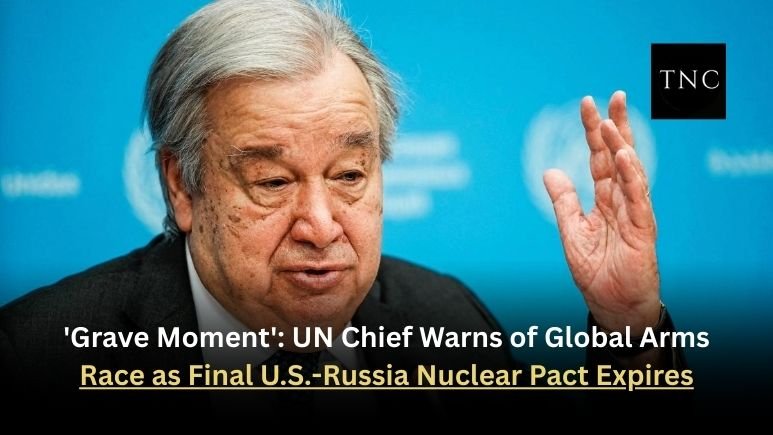

Midnight, Thursday, February 5, 2026. The last remaining nuclear arms control agreement between the world’s two largest nuclear powers just expired. No successor treaty. No framework in place. No legally binding limits on strategic arsenals for the first time in over half a century. The numbers that kept nuclear weapons from spiralling out of control 1,550 deployed warheads, 700 delivery systems, 18 annual inspections all gone overnight. And in their place? Nothing. Just two nuclear superpowers free to expand their arsenals at will, with no verification systems, no data exchanges, and no “window” into each other’s capabilities. UN Secretary-General António Guterres calls it a “grave moment for international peace.” That might be the understatement of the decade.
UNITED NATIONS / WASHINGTON — the global security architecture suffered what António Guterres describes as a historic rupture Thursday as the New Strategic Arms Reduction Treaty (New START) reached its expiration date without any successor framework. In a somber statement from UN Headquarters, the Secretary-General warned that the treaty’s dissolution releases the world’s two largest nuclear powers from all legally binding limits on their strategic arsenals, creating conditions for unchecked nuclear proliferation not seen since the height of the Cold War.
“For the first time in more than half a century, we face a world without any binding limits on the strategic nuclear arsenals of the Russian Federation and the United States,” Guterres stated, urging both capitals to return to negotiations “without delay.”
The urgency in his language reflects what arms control experts have been warning about for months: we just entered fundamentally uncharted and extremely dangerous territory.
What we just lost
The expiration of New START concludes a lineage of arms control stretching back to the SALT talks of the 1970s. For the last 15 years, this treaty served as what diplomats called the “foundation of predictability” between nuclear superpowers, the basic framework that prevented miscalculation and runaway arms racing.
Here’s what existed until midnight Thursday, and what’s now gone:
The warhead cap: New START limited each side to 1,550 deployed strategic warheads. That’s still enough to destroy civilization multiple times over, but it’s a number both sides agreed was sufficient for deterrence without being excessive. Now? No limit. Russia and the United States can deploy as many strategic warheads as they want.
The delivery system limit: 700 deployed missiles and bombers. This constrained not just the number of warheads but the platforms capable of delivering them. Gone.
The verification regime: Perhaps most critically, New START included 18 annual inspections allowing each side to verify the other’s compliance. This wasn’t just about counting warheads. It was about maintaining transparency, building confidence, and ensuring both sides understood the other’s capabilities and intentions. Without inspections, every intelligence assessment becomes more uncertain, every new capability more threatening, every strategic decision based on incomplete information.
Data exchanges: Twice-yearly updates providing detailed information about each side’s nuclear forces. These exchanges allowed military planners to make informed decisions rather than operating on assumptions, rumors, or worst-case scenarios. Suspended.
| What New START Provided | Status as of Feb 5, 2026 |
| Deployed warhead limit | 1,550 per side, now no limit |
| Delivery system limit | 700 deployed, now no limit |
| Annual inspections | 18 verifiable inspections, terminated |
| Data exchanges | Twice yearly updates, suspended |
Why this matters more than most people realize
Arms control treaties aren’t just about limiting numbers. They’re about creating predictability, transparency, and confidence that reduces the risk of catastrophic miscalculation during crises.
Without verification inspections and data exchanges, both sides are now operating blind regarding each other’s nuclear capabilities. When you can’t verify what the other side has, you have to assume worst-case scenarios. When you assume worst-case scenarios, you build your own forces to counter those assumptions. When both sides do this simultaneously, you get arms racing that spirals beyond any rational security requirement.
Here’s the nightmare scenario arms control experts worry about: Russia develops new hypersonic delivery systems. Without inspections, the U.S. can’t verify their capabilities or numbers. American planners assume the worst and develop countermeasures plus expanded offensive capabilities. Russia sees American expansion, can’t verify its scope or intent, and responds with its own buildup. Both sides keep escalating based on incomplete information and mutual suspicion, spending enormous resources on weapons neither actually needs for security but both feel compelled to build because they don’t trust the other side’s intentions or capabilities.
And all of this happens during a period when, as Guterres noted, “the risk of a nuclear weapon being used is the highest in decades.”
How we got here
This didn’t happen overnight. The collapse of New START has been visible for years to anyone paying attention.
Russia offered an extension: In September 2025, Vladimir Putin proposed a one-year extension to buy time for negotiating a successor agreement. That would have maintained the current limits and verification regime while allowing both sides to work on a more comprehensive framework.
Trump remained noncommittal: President Trump didn’t accept the extension, focusing instead on his vision of a broader “reciprocal” framework that would include China, not just Russia. His argument: bilateral U.S.-Russia arms control makes no sense when China is rapidly expanding its own nuclear arsenal without any treaty constraints.
The logic isn’t entirely wrong. China has been building its nuclear forces significantly, and any comprehensive arms control regime probably does need to include all major nuclear powers, not just the original Cold War adversaries.
But here’s the problem: China has shown zero interest in trilateral arms control negotiations. They view their nuclear arsenal as much smaller than the U.S. or Russian forces (which is currently true) and see no reason to accept limits until they reach some undefined level of parity. So Trump’s insistence on including China before extending New START effectively killed the last existing arms control framework without producing any replacement.
The timing couldn’t be worse
Guterres emphasized that New START’s expiration “could not come at a worse time,” and the current global security environment proves his point:
Ukraine conflict: The war continues with no resolution in sight, U.S.-Russia relations at their lowest point since the Cold War, and both sides regularly issuing nuclear threats and conducting nuclear-capable bomber flights near contested territory.
Hypersonic weapons: New technologies like hypersonic missiles create shorter warning times and more complex defensive challenges, making the risk of miscalculation higher even with good intelligence and communication channels. Without those channels, the risks multiply.
Multiple simultaneous crises: The U.S. has a carrier group threatening Iran, tensions with China over Taiwan remain high, North Korea continues its nuclear program, and India-Pakistan dynamics stay volatile. Any of these could escalate, and now there’s no nuclear guardrail between the two largest arsenals.
As Guterres stated: “The risk of a nuclear weapon being used is the highest in decades. This dissolution of decades of achievement increases global insecurity amid rising geopolitical tensions and rapid technological change.”
The “opportunity to reset” that probably won’t happen
Despite the grim assessment, Guterres offered a sliver of hope, characterizing the expiration as an “opportunity to reset” and create an arms control regime fit for a “rapidly evolving context.” He welcomed recent statements from both Washington and Moscow acknowledging that an unconstrained arms race destabilizes security for everyone.
That optimism seems misplaced given current realities:
America First priorities: The Trump administration is focused on “reciprocal” frameworks that address trade, economics, and comprehensive strategic competition. Traditional arms control, which requires accepting some vulnerability in exchange for mutual restraint, doesn’t fit neatly into transactional “America First” thinking that prioritizes American advantages over mutual limitations.
Moscow’s demands: Russia insists on “decisive countermeasures” if its national security is threatened, effectively reserving the right to expand its nuclear forces in response to American conventional military advantages, NATO expansion, or missile defense deployments. Those conditions are non-starters for Washington.
China’s disinterest: Any trilateral framework requires Chinese participation, and Beijing continues showing no interest in accepting limits on its expanding nuclear forces.
Ukraine as obstacle: With the “Board of Peace” attempting to manage the Ukraine conflict and U.S.-Russia relations poisoned by the war, negotiating a complex new arms control regime requires diplomatic bandwidth and mutual trust that simply don’t exist right now.
What happens next (probably?)
Without New START constraints, several predictable dynamics will unfold:
Arsenals will expand: Not immediately, because building new nuclear weapons and delivery systems takes years. But military planners in both countries will begin developing proposals for force expansion, and political leaders will face pressure to approve them to avoid falling behind potential adversaries.
Verification gaps create suspicion: Without inspections and data exchanges, intelligence agencies will struggle to provide accurate assessments of the other side’s capabilities. Those gaps will be filled with assumptions, often worst-case, that drive additional buildups.
New technologies complicate everything: Hypersonic weapons, cyber capabilities that might target nuclear command and control, AI-assisted decision systems, and other emerging technologies create new instabilities that aren’t addressed by Cold War-era arms control frameworks.
Costs escalate: Expanding nuclear arsenals is expensive. Money spent on more warheads and delivery systems is money not spent on conventional forces, infrastructure, education, healthcare, or anything else. Both countries will pay economic costs for an arms race neither actually needs for security.
Allies get nervous: American allies in Europe and Asia, and Russian allies globally, will watch this unfold with growing anxiety. Nuclear instability between superpowers threatens everyone, not just the two countries directly involved.
The vacuum we’re living in now
As of midnight Thursday, the world entered what arms control experts are calling a “verification vacuum” and a “numerical void.” We don’t know what Russia’s actually deploying. They don’t know what we’re deploying. Both sides will assume the worst. And with Ukraine peace talks happening in Abu Dhabi, Iran tensions at crisis levels, and China watching how this all unfolds, the potential for nuclear-tinged crises just increased significantly.
The Board of Peace framework Trump is using to manage Ukraine and other conflicts now operates without the nuclear guardrail that New START provided. That’s a volatile new layer added to an already dangerous global security landscape.
Guterres urged both sides to return to negotiations “without delay.” Given current geopolitics, strategic suspicions, and domestic political incentives on both sides, those negotiations seem unlikely to happen anytime soon.
So we’re living in the most dangerous nuclear environment since the Cold War ended, without the arms control frameworks that prevented catastrophe during the original Cold War, at a moment when multiple regional crises could escalate into great power confrontation.
Guterres called it a “grave moment for international peace.”
Also Read / Russia starts delivering nuclear fuel for India’s Kudankulam Unit 3.








Leave a comment