

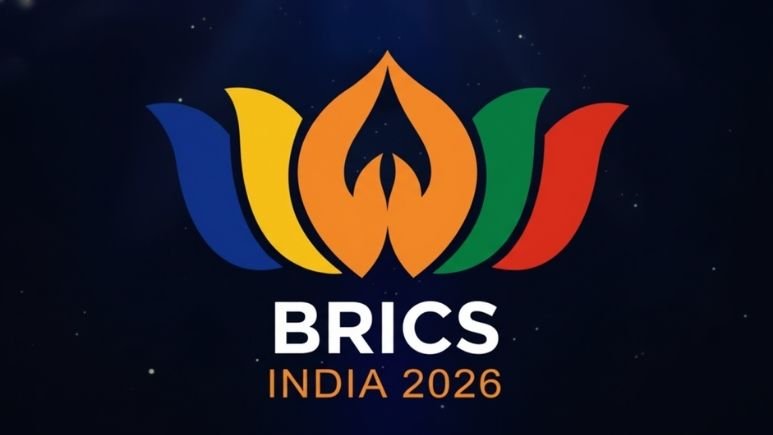

External Affairs Minister S. Jaishankar officially launched the logo, theme, and website for India’s 2026 BRICS chairship on Tuesday, placing “civilizational confidence” and a “humanity-first” approach at the heart of the 18th summit’s identity. Marking the formal commencement of its leadership over the world’s most influential bloc of emerging economies, India unveiled a visual identity featuring the lotus and a ‘Namaste’ salutation, while outlining a vision to transform the grouping into a platform for “global welfare” as BRICS marks its 20th anniversary year.
🪷 The Logo: Symbolism and Design
The newly unveiled logo blends Indian heritage with modern diplomatic cooperation, selected through a nationwide contest on the government’s citizen engagement platform MyGov.
- The Lotus: Inspired by India’s national flower, the lotus symbolizes “deep-rooted heritage and rising resilience.” It reflects the ability to thrive and remain unblemished in a fractured international environment.
- The Colors: The petals incorporate the colors of the BRICS member nations, representing plurality and “unity in diversity” without asserting dominance by any single member.
- The Namaste: At the center of the design, two inner petals form hands joined in a Namaste gesture. This signifies respect, mutual recognition, and a call for dialogue on equal terms among nations.
- Citizen Participation: The selection through a public contest demonstrates India’s commitment to inclusive governance and citizen engagement in shaping its global diplomatic identity.
🎯 The Theme: Four Pillars for 2026
Under the guidance of Prime Minister Narendra Modi, India has adopted the tagline: “Building for Resilience, Innovation, Cooperation and Sustainability.”
Resilience: Strengthening institutional capacities to weather global shocks and geopolitical uncertainties, particularly important given the expanded membership and diverse interests within the bloc.
Innovation: Leveraging new technologies, supporting start-ups, and empowering micro, small and medium enterprises (MSMEs) to build a more equitable world economic order.
Cooperation: Deepening collaboration across economic, financial, and political domains to address shared challenges facing emerging economies.
Sustainability: Addressing climate-related risks and promoting environmentally responsible development pathways that balance growth with ecological preservation.
Jaishankar noted that these four pillars will guide India’s presidency across the three foundational pillars of BRICS cooperation: economic and financial collaboration, political and security dialogue, and cultural and people-to-people exchanges.
📊 BRICS 2026: The Numbers and Timeline
The 2026 chairship comes at a historic juncture as the grouping celebrates 20 years since its inception, with India taking the gavel from Brazil during a period of significant expansion.
| Key Detail | 18th BRICS Summit (2026) |
| Chairship Period | January 1 – December 31, 2026 |
| Member Nations | 11 (Brazil, Russia, India, China, South Africa, Egypt, Ethiopia, Iran, UAE, plus others) |
| Broad Priorities | Resilience, Innovation, Cooperation, Sustainability |
| Official Website | brics2026.gov.in |
| Summit Venue | Likely New Delhi (August/September 2026) |
| Planned Meetings | 100+ meetings across 60 Indian cities |
🌍 India’s Vision: Global South Leadership
Jaishankar emphasized that India seeks to make its chairship inclusive and outcome-oriented, focusing on the Global South’s development gaps and aspirations.
- Showcasing Capacity: By hosting over 100 meetings across 60 Indian cities, New Delhi aims to showcase its emergence as a major global power capable of managing complex multilateral diplomacy.
- Development Focus: The chairship will prioritize addressing development gaps that disproportionately affect emerging economies, from infrastructure deficits to technology access.
- Navigating Complexity: India faces the challenge of managing diverse interests within an expanded BRICS that now includes nations with varying political systems, economic priorities, and geopolitical alignments.
- Balancing Act: New Delhi must navigate the competing interests of members like China and Russia while maintaining its own strategic autonomy and relationships with Western powers.
🔮 The 20th Anniversary Context
The 2026 summit holds special significance as BRICS marks two decades since its formation as BRIC (Brazil, Russia, India, China) in 2006, with South Africa joining in 2010 to create BRICS.
- Expansion Milestone: The recent addition of Egypt, Ethiopia, Iran, and UAE represents the bloc’s most significant expansion, increasing its collective economic and demographic weight.
- Global Influence: BRICS now represents over 40% of the world’s population and approximately 26% of global GDP, making it a counterweight to traditional Western-dominated institutions.
- Institutional Maturity: The 20th anniversary provides an opportunity to assess achievements and chart the next phase of institutional development, including the New Development Bank and other BRICS mechanisms.
The launch of the logo and website marks the beginning of a year-long diplomatic marathon for India, as it seeks to balance its role as chair of an increasingly diverse grouping while advancing its own vision of a multipolar world order centered on Global South solidarity and mutual respect among civilizations.
Also Read / Trade, Minerals & Nukes: Jaishankar and Rubio Talk ‘Next Steps’ in High-Stakes Phone Call.










Leave a comment