

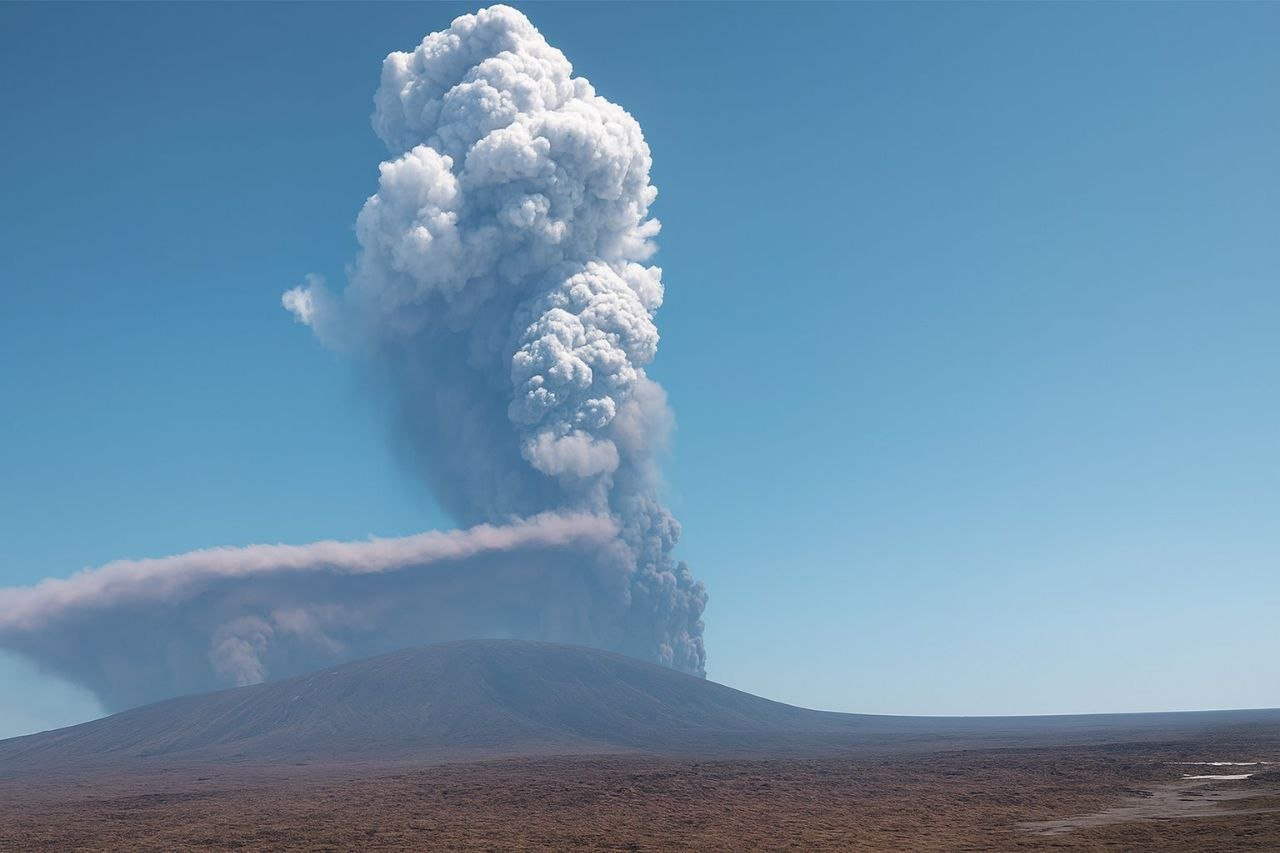

A long-dormant volcano in Ethiopia erupted Sunday for the first time in recorded history, sending massive ash plumes across continents and disrupting flights thousands of miles away in India.
The Hayli Gubbi volcano in Ethiopia’s remote Afar region exploded around 8:30 AM local time, shooting ash nine miles into the sky. The eruption marked the first known activity from this volcano since the end of the last Ice Age approximately 12,000 years ago.
Ash clouds drifted east across the Red Sea, reaching Yemen, Oman, Pakistan, and India by Monday. Indian aviation authorities scrambled to respond, canceling dozens of flights and issuing urgent safety advisories.
“It felt like a sudden bomb had been thrown with smoke and ash,” local resident Ahmed Abdela told The Associated Press.
Historic awakening
The Hayli Gubbi volcano had no previous eruption records during the entire Holocene epoch, the current geological period that began about 12,000 years ago. Scientists considered it dormant.
Sunday’s explosive eruption caught researchers by surprise. The Toulouse Volcanic Ash Advisory Center reported ash reaching altitudes of 45,000 feet, with separate sulfur dioxide clouds climbing even higher.
Professor Simon Carn, a volcanologist, confirmed the eruption through satellite imagery captured at the moment of explosion. “Hayli Gubbi has no record of Holocene eruptions,” he posted on social media.
The volcano sits in Ethiopia’s Danakil Depression, one of the hottest and most inhospitable places on Earth. It’s part of the Erta Ale Range, where the African, Arabian, and Somali tectonic plates meet.
Derek Keir, an earth scientist at the University of Southampton who happened to be in Ethiopia when the eruption occurred, rushed to collect ash samples Monday. These will help reveal what kind of magma caused the eruption.
India scrambles response
By Monday afternoon, ash clouds had entered Indian airspace, prompting aviation authorities to issue sweeping safety warnings.
The Directorate General of Civil Aviation told airlines to avoid volcanic ash-affected airspace, adjust flight levels, and implement precautionary fuel planning. The regulator urged carriers to instantly report any suspected ash encounters, including engine anomalies or cabin smoke.
Airport operators in Delhi, Gujarat, Punjab, Rajasthan, and Maharashtra received orders to inspect runways and taxiways for possible ash deposits.
Air India bore the brunt of disruptions. The carrier canceled at least 11 flights Monday and Tuesday, including long-haul services from Newark and New York JFK to Delhi. Several domestic and Gulf routes were also suspended.
The airline said it canceled flights “to carry out precautionary checks on those aircraft which had flown over certain geographical locations after the Hayli Gubbi volcanic eruption.”
Akasa Air suspended all flights to and from Jeddah, Kuwait, and Abu Dhabi. The budget carrier offered full refunds and free rebooking within seven days for affected passengers.
IndiGo diverted a Kannur-Abu Dhabi flight to Ahmedabad and provided alternative arrangements. KLM canceled both Amsterdam-Delhi flights for Monday, citing passenger and crew safety.
Moving ash clouds
India’s Meteorological Department tracked the ash cloud’s eastward movement at speeds of 100-120 kilometers per hour. The plume entered Gujarat first before crossing Rajasthan, Delhi-NCR, Punjab, and Haryana.
Forecasters predicted the ash would exit Indian airspace by 7:30 PM Tuesday as high-altitude winds pushed it toward China and Southeast Asia.
Pakistan’s Meteorological Department also issued warnings after ash entered its airspace Monday evening.
Despite concerns, IMD officials said Delhi’s severe air pollution crisis wouldn’t worsen significantly because ash was drifting at high altitudes rather than ground level. The capital has been experiencing hazardous smog for weeks.
“Haze due to suspended particles is expected to develop in the ash-affected areas as the ash settles down,” the weather bureau noted.
No casualties but economic fears
Local administrator Mohammed Seid reported no casualties from the eruption. However, he expressed deep concern about economic impacts on the community of livestock herders.
Ash covered the neighboring village of Afdera and surrounding grazing lands. “While no human lives and livestock have been lost so far, many villages have been covered in ash, and as a result, their animals have little to eat,” Ahmed Abdela said.
Tourists heading to the nearby Danakil Desert, a popular attraction, found themselves stranded in ash-covered Afdera.
The remote location of Hayli Gubbi meant limited infrastructure to respond to the crisis. The volcano sits about 800 kilometers northeast of Ethiopia’s capital, Addis Ababa, in one of the world’s most isolated regions.
Why such a dramatic eruption?
Hayli Gubbi is a shield volcano, similar to Hawaii’s Mauna Loa. These volcanoes typically produce gentle lava flows, not explosive ash eruptions.
“To see a big eruption column, like a big umbrella cloud, is really rare in this area,” said Juliet Biggs, an earth scientist at the University of Bristol in England.
The unexpected violence of the eruption has prompted scientific scrambling. Researchers want to understand what triggered such explosive activity after millennia of silence.
One clue emerged from July satellite data. Another nearby volcano, Erta Ale, erupted in a shower of ash. At the same time, imagery revealed magma pushing more than 18 miles below the surface, extending under Hayli Gubbi.
The Afar region sits in the East African Rift Zone, where tectonic plates pull apart at about 0.4 to 0.6 inches annually. This geological activity creates conditions for volcanic eruptions even after thousands of years of dormancy.
“So long as there are still the conditions for magma to form, a volcano can still have an eruption even if it hasn’t had one in 1,000 years, 10,000 years,” said Arianna Soldati, a volcanologist at North Carolina State University.
Aviation safety concerns
Flying through volcanic ash poses severe risks to aircraft. Ash particles can melt inside hot jet engines, causing engine failure. They damage windscreens, contaminate cabin air, and clog sensors.
The 1982 British Airways Flight 9 incident, where a Boeing 747 flew through volcanic ash and lost all four engines, remains burned into aviation safety consciousness. The crew managed to restart engines and land safely, but the incident transformed how airlines respond to volcanic eruptions.
India’s aviation regulator followed international protocols by immediately warning carriers and implementing precautionary measures. Airlines would rather cancel flights than risk passengers’ lives.
“Flight safety first,” multiple carriers emphasized in statements to affected passengers.
Regional impact
Oman’s Environment Authority deployed 68 monitoring stations to track air quality impacts. Officials said no increases in pollutant concentrations had been recorded but continued close surveillance.
Yemen, already devastated by years of civil war, faced additional challenges from ash clouds drifting over its territory. However, the country’s collapsed infrastructure meant limited ability to monitor or respond.
Saudi Arabia and other Arabian Peninsula nations issued advisories to aircraft operating in the region.
When will skies clear?
The Toulouse Volcanic Ash Advisory Center reported that explosive activity from Hayli Gubbi had ended by Monday evening. However, residual ash continued drifting eastward for days.
By Tuesday evening, most ash had moved beyond Indian airspace toward China and Southeast Asia. Airlines began resuming normal operations, though some continued precautionary aircraft inspections.
Meteorologists noted that volcanic ash can circle the globe multiple times at high altitudes, potentially affecting air travel for weeks. However, the concentration typically decreases rapidly with distance from the eruption source.
The bigger picture
Sunday’s eruption adds to growing concerns about under-studied volcanoes in remote regions. Many lack continuous monitoring, making predictions impossible.
“I would be really surprised if [12,000 years ago] really is the last eruption date,” Biggs said. Satellite images hint that Hayli Gubbi may have burped out lava more recently, though no confirmed eruptions exist in geological records.
The Danakil region’s harsh conditions and political instability have limited scientific research. Many volcanoes in the area remain poorly understood despite sitting in one of Earth’s most geologically active zones.
As tectonic plates continue pulling apart, the region could eventually form a new ocean connecting the Arabian Sea and the rift valley. For now, it produces dramatic volcanic activity that can affect continents.
What travelers should know
Passengers with upcoming flights over affected regions should check directly with airlines before heading to airports. Schedules remain fluid as carriers conduct safety inspections and await clearance from aviation authorities.
Most airlines are offering free rebooking or full refunds for canceled flights. Ground teams continue assisting stranded passengers with hotel arrangements.
Aviation experts emphasize that safety protocols, while inconvenient, exist to protect lives. Volcanic ash detection remains imperfect, and pilots cannot visually identify ash clouds at cruising altitudes.
The 12,000-year wait between Hayli Gubbi eruptions serves as a reminder that dormant doesn’t mean extinct. Any volcano that erupted in the past could erupt again, often with little warning.
The numbers
Last known eruption: 12,000 years ago (end of Ice Age)
Eruption time: Sunday, 8:30 AM local time
Ash altitude: Up to 45,000 feet (9 miles)
Location: Afar region, Ethiopia
Distance from capital: 800 kilometers northeast of Addis Ababa
Volcano height: 1,709 feet (521 meters)
Indian flights canceled: At least 11 (Air India alone)
Ash cloud speed: 100-120 km/h
Expected India exit: Tuesday 7:30 PM
Affected Indian states: Gujarat, Rajasthan, Punjab, Haryana, Delhi, Maharashtra
Countries impacted: Ethiopia, Yemen, Oman, Pakistan, India
Tectonic plate movement: 0.4-0.6 inches per year The eruption of Hayli Gubbi after 12,000 years of silence demonstrates nature’s capacity for surprise. While the immediate crisis appears to be passing, the event raises important questions about volcanic monitoring in remote regions and the global interconnectedness that allows ash from Ethiopia to ground flights in India within 24 hours.














Leave a comment