

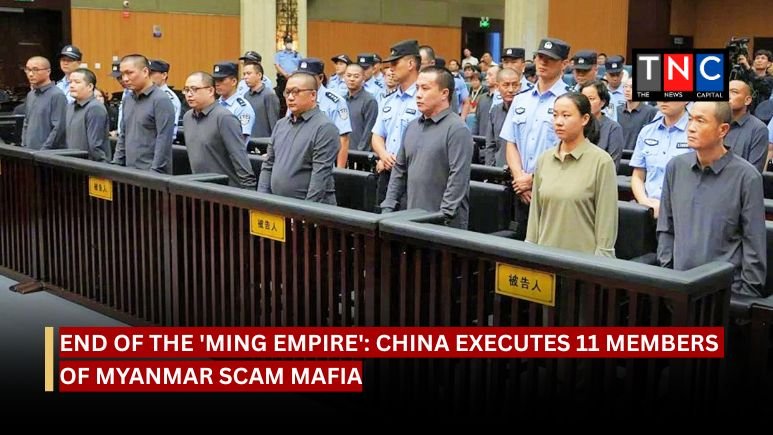

They called themselves businessmen. They built glittering compounds with luxury casinos, high-rise hotels, and neon-lit entertainment districts that could have been mistaken for legitimate resorts if you ignored the electrified fences, the armed guards, and the screams coming from the torture rooms where “employees” who failed to meet their daily scam quotas were beaten with steel pipes. The Ming family ruled a criminal empire that generated $1.4 billion through digital fraud and human trafficking, operating with the impunity of a private state in Myanmar’s lawless border regions. On Thursday, that empire definitively ended not with a whimper, but with 11 executions that sent a message across Southeast Asia’s cybercrime underworld.
The Supreme People’s Court of China authorized the execution of 11 high-ranking members of the Ming family criminal syndicate on Thursday (January 29, 2026), following convictions for running massive telecommunications fraud compounds and illegal gambling operations in northern Myanmar that directly resulted in the deaths of at least 14 Chinese nationals and the enslavement of tens of thousands more. The executions, carried out by lethal injection at the Wenzhou Intermediate People’s Court, represent the definitive collapse of one of the notorious “Four Families” that transformed the Myanmar-China border into what law enforcement officials describe as the world’s most sophisticated hub of “digital slavery” where 21st-century technology meets medieval brutality.
Based in Laukkaing, the dusty capital of Myanmar’s Kokang region a semi-autonomous territory in Shan State controlled by ethnic Chinese warlords with only nominal allegiance to Myanmar’s central government the Ming family transformed what should have been a remote, economically marginal border outpost into a glittering, high-tech fortress of organized crime that operated with shocking openness:
- Industrial-Scale Revenue Generation: Between 2015 and 2023, the syndicate’s sprawling operations centered at the infamous “Crouching Tiger Villa,” a compound that combined the appearance of a luxury resort with the function of a forced labor camp generated more than 10 billion yuan (approximately $1.4 billion) in illicit revenues. This wealth came primarily from systematic telecommunications fraud targeting victims across China, Southeast Asia, Europe, and increasingly the United States, along with illegal online gambling operations and money laundering services for other criminal organizations.
- The “Pig Butchering” Business Model: The Ming family specialized in what fraud investigators call “pig butchering” scams (沙猪盘 in Chinese) elaborately constructed long-term online romance and investment fraud schemes where victims are gradually cultivated over weeks or months, building trust through fake romantic relationships or friendships, before being manipulated into making increasingly large “investments” in cryptocurrency, forex trading, or other financial schemes that are entirely fictitious. The term comes from the practice of “fattening up” the victim emotionally before the final financial “slaughter.”
- Human Trafficking on Massive Scale: To staff these operations, which required thousands of workers making hundreds of calls daily and managing dozens of simultaneous online relationships with potential victims, the Ming family operated sophisticated human trafficking networks. They lured victims primarily young Chinese, Vietnamese, Thai, and Filipino nationals with promises of legitimate customer service or technology jobs offering good salaries. Upon arrival in Myanmar, victims had their passports confiscated, were imprisoned in guarded compounds, and were forced to work as scammers under threat of violence.
- Private Military Protection: Unlike traditional criminal gangs that operate covertly, the Ming syndicate functioned essentially as a private state within Myanmar’s weak governance structure. They maintained armed guards equipped with military-grade weapons who served multiple functions: preventing trafficking victims from escaping, providing security for the sprawling casino and red-light entertainment districts that served as fronts for the fraud operations, and enforcing the family’s control over the territory they dominated.
While the Ming family’s fraud operations generated the revenue that built their empire, it was the “particularly egregious and cruel” violence they employed to maintain absolute control over their enslaved workforce that ultimately led Chinese authorities to pursue capital punishment rather than lengthy prison sentences:
- The Massacre That Changed Everything: The syndicate was convicted of the intentional homicide of 14 Chinese nationals’ killings that weren’t accidents or isolated incidents of excessive force but deliberate murders designed to terrorize others into submission. In one horrific incident in mid-2023 that accelerated China’s determination to dismantle the entire operation, armed guards allegedly opened fire on a group of approximately 30 trafficking victims who attempted a coordinated mass escape during what they thought would be a vulnerable moment while being transferred between compounds. Fourteen were killed instantly; others were severely wounded and dragged back to captivity. The massacre was witnessed by dozens and sparked outrage when details leaked to Chinese social media.
- Industrial Torture Regime: Court testimony revealed a systematic torture apparatus designed to maximize productivity through terror. Trafficking victims who failed to meet daily performance quotas often 100 phone calls per day with specific targets for engagement time and advancement of scam scenarios were subjected to brutal beatings with steel pipes and batons, electric shocks administered through modified cattle prods, prolonged confinement in dark cells without food or water, and in some cases, sexual assault as punishment. Medical experts testified that some survivors bore permanent physical damage from systematic torture.
- Illegal Detention Infrastructure: The compounds operated essentially as private prisons, complete with cells, guard towers, surveillance systems, and punishment facilities. Victims were held for months or years, with some testimony indicating individuals who tried to resist or escape multiple times were eventually killed and their bodies disposed of to serve as warnings to others.
- The Patriarch’s Convenient Death: Ming Xuechang, the family’s founder and patriarch a former member of Myanmar’s state parliament who used his political connections to ensure local authorities never interfered with his operations avoided facing Chinese justice by reportedly taking his own life while in Myanmar custody in late 2023, shortly after Myanmar’s military government began cooperating with Beijing’s crackdown. Whether his death was truly suicide or something more convenient for associates who wanted to ensure his silence remains unclear.
The comprehensive legal reckoning:
The 2026 executions represent the culmination of a massive regional law enforcement operation that saw Myanmar authorities under intense pressure from Beijing and facing their own domestic legitimacy crisis hand over thousands of suspects to Chinese jurisdiction in an unprecedented display of cross-border cooperation:
| Sentence Type | Number of Defendants | Status and Details |
| Death Penalty (Executed) | 11 | Carried out by lethal injection January 29, 2026. Includes Ming family core leadership and operational commanders directly responsible for murders and torture. |
| Death with Two-Year Reprieve | 5 | Death sentences suspended for two years; may be commuted to life imprisonment if defendants show “good behavior” and genuine remorse during reprieve period. |
| Life Imprisonment | 11 | No possibility of parole. Serving sentences in high-security facilities. Includes mid-level managers who participated in violence but weren’t primary decision-makers. |
| Fixed-Term Prison Sentences | 12 | Ranging from 5 to 24 years for lower-level participants, guards, and technical staff who facilitated operations but weren’t directly involved in murders. |
The regional implications:
The comprehensive dismantling of the Ming family empire has sent profound shockwaves through Southeast Asia’s organized crime landscape, particularly affecting the other major criminal families who controlled neighbouring territories in Myanmar’s ungoverned border regions:
- The “Four Families” Collapse: The Ming clan was one of four major Chinese organized crime families along with the Bai, Wei, and Liu syndicates who collectively controlled the Kokang region’s scam industry. Following the Ming prosecutions, Chinese authorities have launched similar investigations and trials against members of these other families, with multiple high-ranking members of the Bai and Wei clans currently facing trial in Chinese courts on similar charges.
- Myanmar’s Complicity Crisis: The collapse of these operations has raised uncomfortable questions about Myanmar’s military junta and previous governments, which allowed these massive criminal enterprises to operate openly for years, suggesting either gross incompetence or active complicity through bribery and profit-sharing arrangements. The current Myanmar government’s cooperation with Chinese crackdown efforts appears motivated primarily by Beijing’s economic leverage rather than genuine concern about crime.
- Regional Trafficking Patterns: With the major Kokang-based operations dismantled, trafficking networks have reportedly shifted operations to Cambodia, Laos, and other countries with weak governance, suggesting the problem is being displaced rather than eliminated. Countries across Southeast Asia are now facing pressure to crack down on similar operations before they reach Myanmar-scale proportions.
“China will continue to deepen international law enforcement cooperation to completely excise the cancer of online gambling and telecommunications fraud. There is no sanctuary, no safe haven, for those who target our citizens through these cruel schemes,” declared Guo Jiakun, spokesperson for China’s Ministry of Public Security, in a statement clearly intended to warn other criminal organizations that they face similar fates.
“These executions send an unmistakable message: the age of impunity for cybercrime syndicates operating in ungoverned spaces is ending. Whether through cooperation or coercion, China will reach across borders to protect its citizens,” noted Dr. John Buchanan, a researcher at the Center for Advanced Defense Studies who tracks transnational organized crime in Southeast Asia.
For the families of the 14 confirmed murder victims and the likely dozens more whose deaths were never officially documented the executions provide a form of closure, though one marked more by grim satisfaction than healing. Their loved ones were lured with promises of legitimate employment, enslaved in compounds designed to look like modern office buildings, tortured when they resisted, and in some cases killed when they attempted escape.
The Ming family built an empire on suffering, generating vast wealth through the systematic exploitation of both their trafficking victims forced to work as scammers and the fraud victims around the world who lost life savings to sophisticated online scams. They operated in the shadows of international borders, exploiting weak governance, corrupting local officials, and counting on the difficulty of cross-border law enforcement to provide immunity.
That immunity died on Thursday, January 29, 2026, in a Wenzhou execution chamber, along with 11 members of a family that mistook operating in ungoverned space for being ungovernable, and learned too late the limits of impunity when a determined state decides the cost of looking the other way has become too high.
The “Ming Empire” is over. The scam compounds are being demolished. The torture chambers are empty. And across Southeast Asia’s remaining cybercrime operations, the message has been received: the business model that worked in lawless Myanmar for a decade may not survive in an era when governments are willing to reach across borders with handcuffs or worse.
Also Read / Georgia Family Massacre: 4 Dead in Lawrenceville Shooting; Children Survive by Hiding in Closet.














Leave a comment