

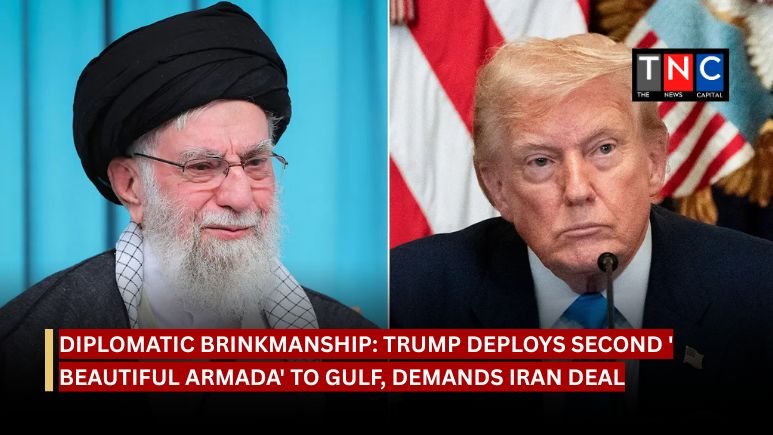

In a signature blend of military muscle and transactional diplomacy, President Donald Trump has announced that a second U.S. naval strike group is end route to the Persian Gulf, with the President insisting that a “perfect deal” is within reach if Iran chooses negotiation over confrontation. Addressing a raucous crowd in Iowa late Tuesday, January 27, 2026, President Trump revealed that a second American “armada” is currently “floating beautifully” toward the Middle East, marking a massive escalation in U.S. power projection intended to force Tehran back to the bargaining table amid a stalled nuclear program and domestic crisis over the crackdown on protesters.
During his 90-minute address in Clive, Iowa, the President framed the naval movement as a continuation of his “maximum pressure” campaign, while referencing past military strikes to underscore the stakes.
- A Massive Fleet: Trump confirmed that an additional set of warships is moving from the Asia-Pacific to join the “massive fleet” already monitoring the Strait of Hormuz. “We have a big armada next to Iran. Bigger than Venezuela,” he told reporters, emphasizing that the U.S. military is currently “locked and loaded.”
- Scale of Deployment: The deployment, which follows the arrival of the USS Abraham Lincoln strike group in regional waters just 24 hours prior, represents one of the largest concentrations of U.S. naval power in the Persian Gulf in years.
- Asia-Pacific Diversion: The movement of additional warships from Asia-Pacific stations signals that the Iran crisis is taking priority over other regional commitments, including potential Taiwan contingencies and freedom of navigation operations in the South China Sea.
- “Floating beautifully”: Trump’s characteristically colloquial language describing the armada as “floating beautifully” reflects his tendency to personalize military assets and project confidence in their deployment.
Trump frequently cited Operation Midnight Hammer the June 2025 strike that “obliterated” key Iranian nuclear facilities warning that any attempt by Tehran to restart enrichment would lead to even more severe consequences.
- The Warning: “They can’t do the nuclear. If they do it, it’s going to happen again,” Trump warned, establishing nuclear enrichment as the ultimate red line that would trigger military response.
- June 2025 Precedent: Operation Midnight Hammer, the “12-day war” that devastated Iranian nuclear infrastructure in June 2025, serves as both proof of American capability and template for potential future strikes.
- Enrichment Intelligence: The renewed warnings suggest U.S. intelligence has detected Iranian attempts to rebuild nuclear capabilities or restart enrichment activities at underground facilities that survived the previous strike campaign.
- Escalation Ladder: The threat of “Midnight Hammer II” represents the maximum escalation Trump can threaten short of ground invasion or regime change operations.
The President claimed that his aggressive posturing has already saved lives, asserting that his threats forced Tehran to cancel the planned executions of nearly 840 protesters earlier this month.
- Execution Halt: Trump credits his “locked and loaded” threats with forcing the cancellation of mass executions that Iran had reportedly scheduled for protesters arrested during the “Rial Rebellion.”
- Humanitarian Framing: By emphasizing protester protection, Trump frames military threats as humanitarian intervention rather than aggression, making the deployment politically palatable domestically.
- Verification Challenges: Independent verification of whether 840 executions were actually planned and cancelled remains difficult given Iran’s information blackout and government opacity.
- Mixed Motives: The narrative conflates nuclear non-proliferation objectives with human rights concerns, creating ambiguity about American priorities and potential negotiation trade-offs.
As the U.S. fleet approaches, the rhetoric from Tehran has reached a fever pitch, with the Islamic Revolutionary Guard Corps warning of comprehensive retaliation while the civilian government pursues diplomatic options.
- IRGC Trigger Warning: Revolutionary Guard commanders reiterated on Wednesday that their missile forces have their “finger on the trigger,” warning neighbouring Gulf states that their territory will be considered “hostile” if used as a Launchpad for American strikes.
- Regional Warning: The threat to Gulf states including Saudi Arabia, UAE, Bahrain, and Qatar that host U.S. military bases aims to deter regional cooperation with American strike planning by threatening massive retaliation.
- Pezeshkian’s Diplomacy: In a phone call with Saudi Crown Prince Mohammed bin Salman, Iranian President Masoud Pezeshkian accused Washington of “disrupting regional security” while emphasizing that Iran seeks peace but warned that U.S. “threats” only lead to instability.
- Bunker Reports: Unconfirmed reports suggest that Supreme Leader Ayatollah Ali Khamenei has moved into an underground bunker in Tehran as a precaution against a potential “Midnight Hammer II” scenario, indicating the regime takes strike threats seriously.
The Deal Framework: Board of Peace Integration
While military tensions dominate the headlines, the ultimate goal remains a new trilateral deal that would include Trump’s signature “Board of Peace” framework connecting Iran crisis resolution to Gaza reconstruction.
| U.S. Demand | Proposed Incentive |
| Total Ban on uranium enrichment | Lifting of “Maximum Pressure” sanctions |
| Missile Cap on long-range delivery systems | Seat on the Board of Peace for regional influence |
| Proxy Withdrawal from Yemen, Syria, and Lebanon | Security guarantees against regime change |
- Comprehensive Scope: The framework demands complete nuclear rollback, missile limitations, and regional proxy withdrawal essentially requiring Iran to abandon all sources of strategic leverage.
- Sanctions Relief: In exchange, the U.S. offers to lift the “maximum pressure” sanctions that have devastated Iran’s economy, though verification and enforcement mechanisms remain unspecified.
- Board of Peace Membership: The offer of a Board of Peace seat represents creative diplomacy giving Iran regional influence through Gaza reconstruction while integrating it into a Trump-led framework that constrains behaviour.
- Security Guarantees: The pledge against regime change addresses Iranian paranoia about U.S. intentions, though the value of such guarantees from an administration threatening massive armadas remains questionable.
Despite the “armada” warnings and military brinkmanship, President Trump maintained that a breakthrough is imminent based on claimed recent Iranian communications.
- 48-Hour Contacts: Trump claimed that Iranian officials have reached out “on numerous occasions” in the last 48 hours to signal their willingness to engage, though details of these communications remain unverified.
- Back-Channel Networks: The contacts likely involve intermediaries possibly Omani, Qatari, or Swiss officials rather than direct U.S.-Iran communication given the absence of formal diplomatic relations.
- Deal Optimism: Trump’s repeated expression of hope for a deal “I hope they make a deal. I hope they make a deal. They should have made a deal the first time. They’d have a country” reflects his transactional belief that sufficient pressure will force rational capitulation.
- Regime Survival Logic: The “they’d have a country” formulation suggests Trump believes Iran’s regime faces existential threat without a deal, though Tehran’s demonstrated resilience over decades of sanctions and isolation challenges this assumption.
“I hope they make a deal. I hope they make a deal. They should have made a deal the first time. They’d have a country.” President Donald Trump, speaking in Clive, Iowa
- Regret Framing: The reference to not making “a deal the first time” evokes Trump’s 2018 withdrawal from the JCPOA nuclear agreement that Iran had been complying with, suggesting he views the current crisis as validation of his hard-line approach.
- Existential Threat: The “they’d have a country” language implies that without a deal, Iran faces destruction or state collapse maximum rhetorical pressure designed to create urgency.
- Transactional Worldview: Trump’s framing reflects his core belief that nations act based on cost-benefit analysis and that sufficient pressure will force even ideological adversaries to accept his terms.
As the global markets react with a “bullion fever” that has seen gold prices shatter records, the escalating Iran crisis serves as the primary driver of safe-haven demand.
- Gold at $5,233: Spot gold surpassing $5,200 per ounce reflects market pricing of significant war risk premium, with the second armada deployment adding urgency to safe-haven positioning.
- Oil Vulnerability: The Strait of Hormuz chokepoint through which 21% of global oil passes creates potential for massive energy price spikes if conflict disrupts shipping.
- Economic Contagion: Beyond commodity prices, the Iran crisis threatens broader economic disruption through energy shocks, supply chain interruptions, and confidence effects on investment and consumption.
- Dollar Paradox: While crises typically strengthen the dollar as safe haven, the current situation sees dollar weakness continuing as the crisis reflects American instability and alliance fractures as much as external threats.
The dual armada deployment represents Trump’s bet that overwhelming military pressure will force Iranian capitulation, but the strategy faces significant challenges.
- Iranian Resolve: Four decades of revolutionary ideology, religious legitimacy claims, and demonstrated willingness to endure economic hardship suggest Iran may not respond to pressure as Trump’s transactional model predicts.
- Domestic Constraints: The regime faces genuine internal pressures from the Rial Rebellion and economic collapse, but hardliners may view capitulation to U.S. demands as more threatening to regime survival than continued confrontation.
- Russian/Chinese Support: Iran’s partnerships with Russia and China provide some sanctions relief and diplomatic support that reduce vulnerability to U.S. pressure alone.
- Asymmetric Options: Iran’s ability to threaten oil shipping, activate regional proxies, and impose costs through asymmetric warfare means military superiority doesn’t guarantee favourable negotiation outcomes.
The crisis places Gulf Arab states in an impossible position between their American security patron and Iranian neighbour.
- Basing Dilemma: U.S. military bases in Saudi Arabia, UAE, Bahrain, Kuwait, and Qatar become both assets for American strike planning and vulnerabilities to Iranian retaliation.
- Economic Exposure: Gulf states’ oil infrastructure refineries, export terminals, pipelines represents high-value targets that Iranian missiles could devastate in response to U.S. strikes launched from their territory.
- Diplomatic Balancing: Saudi Arabia and UAE are simultaneously hosting U.S. military assets while maintaining back-channel communications with Tehran to manage tensions and prevent escalation.
- IRGC Warning Impact: The explicit threat that Gulf territory will be “considered hostile” if used for strikes aims to drive wedges between the U.S. and regional partners by raising the costs of cooperation.
As the second armada approaches the Gulf, multiple potential outcomes remain possible with dramatically different implications.
- Deal Scenario: Iran accepts framework terms in exchange for sanctions relief and security guarantees, Trump claims victory through strength, and crisis de-escalates with Board of Peace integration.
- Standoff Scenario: Both sides maintain threatening postures without kinetic conflict, executing limited strikes or proxy attacks while avoiding full-scale war that neither side truly wants.
- Escalation Scenario: Miscalculation, accident, or deliberate provocation triggers exchanges that spiral into sustained conflict involving Strait of Hormuz closure, regional proxy activation, and oil price spikes.
- Regime Collapse: Internal pressures from protests and economic crisis combine with external military threats to trigger regime fragmentation or coup, though this represents the least predictable scenario.
Trump’s deployment of a second “beautiful armada” to the Persian Gulf represents maximum pressure diplomacy backed by overwhelming naval power, betting that the threat of “Midnight Hammer II” strikes combined with the offer of Board of Peace membership will force Iran to abandon nuclear enrichment, cap missiles, and withdraw regional proxies the President claims Iranian outreach in the last 48 hours signals deal prospects, but Tehran’s “finger on the trigger” warnings and Khamenei’s reported bunker relocation suggest the regime remains defiant even as economic collapse and protest crackdowns create internal vulnerabilities that may make confrontation seem less risky than capitulation to American demands.
Also Read / ‘Ready for Everything’: Iran’s Representative Shrugs Off Trump’s ‘Wipe Out’ Threat.







Leave a comment