

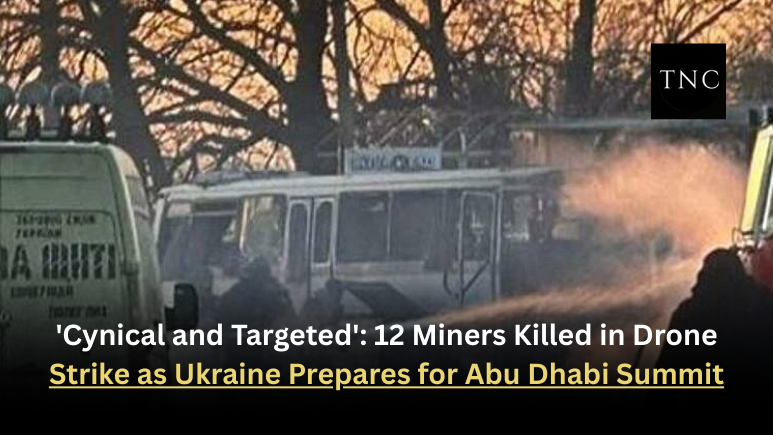

Twelve miners. Just finishing their shift. Riding a bus home after hours underground keeping Ukraine’s power plants running. And a Russian drone strike kills them on a Sunday afternoon, their bodies burned beyond recognition, their families learning the news just hours after President Zelenskyy announced the next round of peace talks. This is what Trump’s “energy ceasefire” looks like on the ground: a mangled bus, charred bodies, and a brutal reminder that agreements made in luxury hotels mean nothing when drones are already in the air targeting workers who never held a weapon.
KYIV / TERNIVKA — A Russian drone struck a shuttle bus carrying coal miners home from their shift in the town of Ternivka on Sunday, February 1, 2026, killing at least 12 people and wounding 15 others. First Deputy Prime Minister Denys Shmyhal condemned the attack as “cynical and targeted,” language that barely captures the reality of workers burned alive for the crime of trying to keep their country’s lights on during the coldest winter in a decade.
The massacre came precisely as the Kremlin’s week-long commitment to halt strikes on energy infrastructure reached what Ukrainian officials are calling “dangerous ambiguity.” Russia claims the pause ended Sunday. Ukraine insists it should last a full week. And while diplomats argue about timelines, twelve families are planning funerals.
Targeting the people who keep the lights on
The strike occurred approximately 65 kilometers from the frontline in the Pavlohrad district, a hub for Ukraine’s vital coal mining operations. This wasn’t a military convoy. This wasn’t a weapons depot. This was a bus operated by DTEK, Ukraine’s largest private energy firm, carrying exhausted workers home after a grueling shift.
DTEK accused Russia of a “large-scale terrorist attack” on its facilities, emphasizing that the miners were non-combatants. They were doing one of the hardest, most dangerous jobs in the country, descending into coal mines day after day to extract the fuel that keeps power plants running so millions of Ukrainians don’t freeze to death in -20°C temperatures.
Images released by the State Emergency Service show a charred, mangled bus with shattered windows. Firefighters worked in sub-zero temperatures to extinguish the blaze, pulling bodies from wreckage that was barely recognizable as a vehicle. The heat was so intense it melted metal. The workers inside never had a chance.
It wasn’t just Ternivka
Beyond the bus attack, Russian drones hit multiple civilian targets across Ukraine the same day:
- A maternity ward in Zaporizhzhia was struck, wounding nine people. Pregnant women and newborns. The most vulnerable civilians imaginable.
- A residential neighborhood in Dnipro was hit, killing two more people in their homes.
This is the pattern: systematic attacks on civilians, infrastructure, and the workers who keep essential services running. And it’s happening as peace talks are supposedly imminent, as an “energy ceasefire” is supposedly in effect, as diplomats prepare to negotiate in Abu Dhabi.
Peace talks proceed despite the bloodshed
Despite the escalating violence, President Zelenskyy signaled Ukraine remains committed to the U.S.-backed diplomatic path. A second round of trilateral talks involving Ukraine, Russia, and the United States is scheduled for February 4-5 in Abu Dhabi, delayed from the original weekend slot due to “scheduling coordination.”
Zelenskyy stated Kyiv is ready for “substantive talks” aimed at a “real and dignified end to the war.” But how do you have substantive talks with a country that just killed twelve miners on their way home from work? How do you negotiate in good faith with a regime that strikes maternity wards?
The core deadlock remains unchanged: Russia demands total cession of the Donbas region. Ukraine refuses. And while that fundamental incompatibility persists, drones keep killing civilians.
The “energy ceasefire” that never really existed
The Ternivka attack highlights the complete breakdown of the humanitarian pause President Trump supposedly brokered last week.
| What Was Promised | What Actually Happened |
| Putin agreed to halt strikes on “Kyiv and various towns” | Drones hit civilian targets across multiple regions |
| Ceasefire to foster peace talks | Twelve miners killed, maternity ward struck, residential areas bombed |
| Duration dispute | Russia claims pause ended Sunday; Ukraine says it should last a full week |
| Tactical shift | While energy grids got brief respite, Russia reoriented attacks toward railway junctions, logistics, and apparently workers |
Zelenskyy noted that while energy infrastructure was mostly spared for a few days, Russia simply pivoted its targeting strategy. Instead of hitting power plants directly, they’re hitting the transportation networks that supply them and the workers who operate them.
It’s a distinction without a difference. If you kill the miners who extract the coal, you’ve still attacked the energy sector. If you destroy the railways that transport fuel, you’ve still crippled power generation. The ceasefire was always illusory, a PR exercise that gave diplomatic cover while attacks continued under different justifications.
The brutal arithmetic of winter warfare
As peace talks approach, Ukraine is caught in a vise between military assault and environmental catastrophe.
Arctic freeze: Temperatures hovered around -15°C on Sunday, with forecasts predicting drops below -20°C by Monday night. That’s cold enough to kill people in their homes if heating fails, cold enough that infrastructure damage becomes life-threatening.
Kyiv’s heating crisis: Nearly 700 apartment buildings in the capital remained without heat following a cascade grid malfunction Saturday, exacerbated by previous Russian attacks on infrastructure. Families in high-rises, elderly people unable to leave their apartments, children trying to sleep in freezing rooms.
Record energy imports: Ukraine imported 41.9 gigawatt hours in January, the highest in its history. The country that was once energy self-sufficient now depends on neighbors to keep basic services running because Russia has systematically destroyed domestic generation capacity.
The workers keeping Ukraine alive
Think about what those twelve miners were doing. They were descending into dangerous underground shafts every day, extracting coal in conditions most people couldn’t endure for an hour, doing backbreaking labor for modest pay, all to keep their country’s power plants running so millions of people don’t freeze.
They weren’t politicians making grand statements. They weren’t generals planning strategies. They were workers doing essential jobs under wartime conditions, showing up day after day despite the danger, despite the exhaustion, despite everything.
And Russia killed them for it. Deliberately. With a drone strike on a clearly civilian bus carrying clearly non-combatant workers. As a message, as terrorism, as another data point in the systematic campaign to break Ukrainian society by targeting the people who keep it functioning.
The veteran’s reality check
Anatoliy Veresenko, a 65-year-old veteran, captured the disconnect between diplomatic optimism and ground-level reality:
“We hope for peace, but we still need to fight and secure victory. Talks are talks, but the reality is what we see in Dnipro today.”
Talks are talks. The reality is twelve bodies pulled from a burned bus. That’s the gap Ukrainian civilians live in every day, between the hopeful rhetoric of peace negotiations and the brutal fact of ongoing attacks on non-combatants.
Veresenko has lived through enough to know that peace talks don’t stop drones, ceasefires don’t prevent strikes, and diplomatic progress measured in Abu Dhabi hotel conference rooms means nothing to people dying in Ukrainian streets.
The cynicism of the timing
The attack came hours after Zelenskyy announced the next round of talks. That timing isn’t coincidental. It’s a message from Russia: we’ll participate in your diplomatic theater while continuing to kill your civilians. We’ll send negotiators to Abu Dhabi while sending drones to Ternivka. We’ll discuss peace while waging war.
It’s the same pattern seen throughout this conflict. Russia agrees to humanitarian corridors while shelling evacuation routes. They promise ceasefires while launching attacks. They participate in negotiations while systematically targeting civilian infrastructure.
The purpose isn’t just military. It’s psychological. It’s meant to demonstrate that Russia can operate on multiple tracks simultaneously, diplomatic engagement and violent assault, and that Ukraine’s hope for peace won’t stop Russian aggression.
What Abu Dhabi can actually accomplish
The February 4-5 talks face a fundamental question: how do you negotiate with a party that’s actively demonstrating bad faith?
Ukraine will send envoys to discuss substantive peace while mourning twelve miners. Russia will send negotiators who’ll discuss ceasefires while their military plans the next attack. American mediators will try to bridge positions between a country defending its existence and a country trying to conquer territory through systematic brutality.
Maybe they’ll reach some narrow agreements on prisoner exchanges or localized pauses. Maybe they’ll establish frameworks for future discussions. But the core issue remains: Russia wants territorial concessions Ukraine won’t give, and Russia is willing to kill civilians to increase pressure for those concessions.
No amount of diplomatic finesse changes that equation. The peace talks will produce statements, frameworks, and possibly narrow agreements. Meanwhile, more buses will be hit, more workers will die, more families will grieve.
That’s not cynicism. That’s the reality Ukrainians live every day, the reality Anatoliy Veresenko articulated: talks are talks, but the reality is what you see when drones strike civilian buses.
The twelve miners who died Sunday were keeping Ukraine alive by keeping power plants running. Russia killed them for that essential work. And diplomats will gather in Abu Dhabi to discuss peace while both sides know the attacks will continue regardless of what gets signed in conference rooms thousands of miles from the front lines.
Also Read / Abu Dhabi Breakthrough: Ukraine and Russia Face Off in First Direct Peace Talks.














Leave a comment