

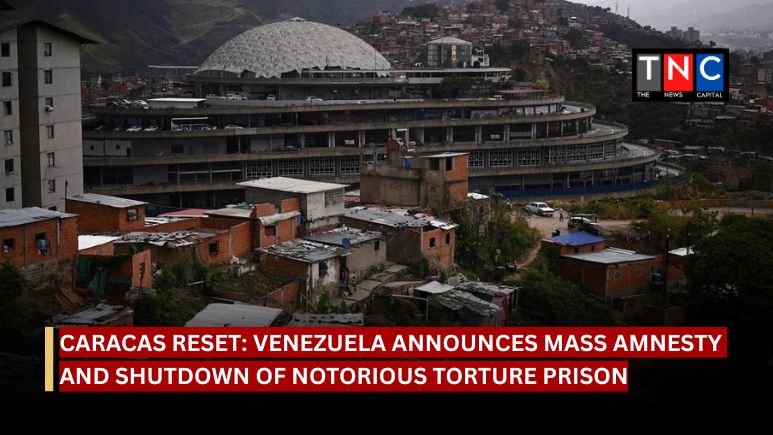

One law. Seven hundred eleven political prisoners. A spiral-shaped building that became synonymous with torture, arbitrary detention, and the systematic crushing of dissent. And now, Acting President Delcy Rodríguez says she’s shutting it all down, turning Venezuela’s most infamous prison into a sports complex while releasing everyone jailed for political reasons since 1999. The question everyone’s asking: is this genuine reform, or a desperate play for American dollars and international legitimacy?
Venezuela’s Acting President Delcy Rodríguez stood before a televised gathering of justices and military brass on Friday (January 30, 2026) and announced what she’s calling a “General Amnesty Bill,” a sweeping proposal to end decades of political persecution. The law would cover everyone caught up in what she termed “political violence” from 1999 to right now, potentially freeing hundreds still rotting in cells for the crime of opposing the government.
The announcement comes as Rodríguez tries to stabilize a nation still reeling from the January 3 rendition of former dictator Nicolás Maduro, who was brazenly snatched by U.S. forces and now sits in an American prison. With Maduro gone and Venezuela’s future hanging in the balance, Rodríguez is making moves that would have been unthinkable just weeks ago.
El Helicoide: From architectural marvel to torture chamber to sports complex?
The most shocking part of Rodríguez’s announcement wasn’t the amnesty itself but what she plans to do with El Helicoide, the spiral-shaped Caracas landmark that served as headquarters for the SEBIN intelligence service.
For years, this building has been Venezuela’s heart of darkness. The UN and Amnesty International have documented systematic torture, arbitrary detention, and conditions so horrific that inmates have died from lack of medical care. Former prisoners describe electric shocks, beatings, isolation cells so small you couldn’t stand up, and interrogations that lasted days without food or water. It became the global symbol of Maduro-era repression, a place where political opponents simply disappeared.
Now Rodríguez says she’s shutting it down permanently and converting the massive structure into a “sports, cultural, and commercial center” for police families and the surrounding community. “May this law serve to heal the wounds left by political confrontation,” she said, as if decades of torture could be erased by basketball courts and shopping stalls.
Rights groups report that transfers of high-profile detainees have already begun, though many are just being moved to military prisons while the government figures out the amnesty criteria. Trading one cell for another isn’t exactly freedom.
Who gets out and who stays locked up
While the full text hasn’t been released, Rodríguez outlined who qualifies for amnesty and who doesn’t:
| Who You Are | Do You Get Released? |
| Journalists, activists, protesters | Yes. Anyone jailed for political dissent since 1999 is eligible. |
| Violent criminals | No. Murder or drug trafficking convictions don’t get relief. |
| Corrupt officials | No. If you embezzled state funds, you stay in prison. |
| Human rights abusers | No. Perpetrators of crimes against humanity remain under investigation. |
It sounds straightforward on paper. The reality is messier. Who decides what counts as “political dissent” versus “violent crime”? In Venezuela, the government has routinely labeled peaceful protesters as terrorists and charged opposition leaders with treason. Will those distinctions suddenly become fair and transparent?
The opposition isn’t buying it
Despite celebrations in some Caracas neighbourhoods, opposition figures and human rights groups are responding with scepticism that borders on cynicism.
Opposition leader María Corina Machado didn’t pull punches in her statement: these actions weren’t “taken voluntarily, but rather in response to pressure from the U.S. government.” She emphasized that many detainees have already lost decades of their lives to “illegal captivity.” Getting released now doesn’t give those years back, doesn’t undo the torture, and doesn’t reunite broken families.
Alfredo Romero, president of Foro Penal, a rights group that tracks political prisoners, welcomed the amnesty but warned it must not become a “cloak of impunity” for the state’s repressive apparatus. His organization currently counts roughly 711 active political prisoners across the country. He wants to see every single one walk free, not just the ones the government finds politically convenient to release.
The slow, opaque reality on the ground
While Rodríguez makes televised speeches about healing and reconciliation, families gathered outside prisons across Venezuela tell a different story. They’re condemning the “opaque” and glacially slow pace of actual releases.
Yes, 104 people were freed earlier this week in what the government trumpeted as proof of its commitment to reform. But hundreds remain in what families describe as legal limbo, neither formally charged nor released, existing in a bureaucratic nightmare where nobody can tell them when or if their loved ones will come home.
The government hasn’t explained the selection process. Why were those 104 chosen? What criteria determined their release? And most importantly, when will the rest follow?
The real reason: American money and legitimacy
This amnesty proposal doesn’t exist in a vacuum. Rodríguez is attempting a delicate diplomatic dance with extremely high stakes.
By offering these concessions, her interim administration hopes to secure what Trump has called “Board of Peace” legitimacy, basically international recognition that she’s a legitimate transitional leader rather than just another Venezuelan strongman. More concretely, she’s angling for access to the $100 billion reconstruction fund the Trump administration has dangled in exchange for Venezuela’s transition to “true democracy.”
That’s a lot of money for a country whose economy Maduro drove into the ground. It could rebuild infrastructure, restart oil production, provide basic services that have been absent for years. But the money comes with strings: genuine democratic reform, free and fair elections, accountability for past abuses.
Rodríguez is betting she can give just enough reform to unlock the cash without actually surrendering the power structures that keep her in control.
The test nobody’s talking about
Here’s what matters more than any televised speech or legislative text: will El Helicoide actually empty?
Not just the high-profile journalists and opposition leaders whose cases get international attention. Not just the 104 carefully selected releases designed for maximum PR impact. But the unknown activists, the student protesters, the local organizers, the people whose families have been fighting for years just to get confirmation they’re still alive.
Will every political prisoner walk free, or will the government find reasons to keep the inconvenient ones locked up? Will the amnesty apply equally, or will it become another tool of political manipulation where release depends on loyalty and connections?
And critically, will anyone be held accountable for what happened in El Helicoide? Because turning a torture chamber into a sports complex is great symbolism, but it’s not justice. The people who ordered the beatings, administered the electric shocks, denied medical care until prisoners died, they’re still out there. Many still have government jobs.
What happens next
The National Assembly is supposed to take up this bill with urgency, whatever that means in Venezuelan politics. If it passes as proposed, we could see mass releases in the coming weeks.
Or we could see the process drag out for months with endless bureaucratic hurdles and arbitrary exclusions. We could see a partial amnesty that frees enough people to satisfy international observers while keeping the government’s real enemies locked up. We could see the whole thing collapse if Rodríguez’s grip on power weakens.
For the families waiting outside those prison gates, for the activists who’ve spent years or decades in cells, for the survivors of El Helicoide’s torture chambers, the speeches and proposals mean nothing until the prison doors actually open.
Venezuela has had plenty of moments that looked like turning points before. The question is whether this time is actually different, or whether it’s just another false dawn in a country that’s seen too many of them.
The spiral building stands in Caracas, its architecture still striking, its history still dark. Soon it might host basketball games instead of interrogations. Whether that represents genuine change or just a new coat of paint on an unchanged system, only time will tell.
Do you think this amnesty is real reform or political theater? Share your thoughts below.
Also Read / ‘Make a Deal Before It’s Too Late’: Trump Issues Ultimatum to Cuba as Venezuelan Oil Lifeline Vanishes.










Leave a comment