

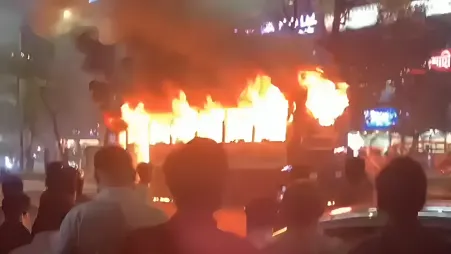

Bangladesh election violence 2025 has become a defining crisis as the nation prepares for crucial parliamentary elections in February 2026. With candidates shot, houses burned, and political tensions escalating, the country’s democratic transition hangs in the balance.
In early November 2025, violence erupted across Bangladesh as campaign season began. A BNP candidate was shot in Chittagong during the election campaign, while another candidate in Comilla alleged that his house was set on fire. These incidents marked a troubling beginning to what many hope will be the country’s first truly free and fair election in years.
From Uprising to Uncertainty
Last summer, 26-year-old student activist Nahid Islam and his companions set the stage to bring down authoritarian Prime Minister Sheikh Hasina and her government in Bangladesh’s first ever Gen-Z uprising. The movement came at a devastating cost. According to the United Nations, up to 1,400 people were killed in crackdowns as Hasina clung to power.
Hasina hastily fled to India in a helicopter, leaving behind a power vacuum and a nation traumatized by violence. Nobel Peace Prize laureate Muhammad Yunus stepped in to head an interim government tasked with steering Bangladesh toward democratic elections.
Yet the violence that characterized Hasina’s fall continues to haunt the nation. Bangladesh election violence 2025 represents not just isolated incidents but a systematic pattern threatening to derail the country’s democratic hopes.
The Current Crisis: Shootings and Arson
The recent violence has targeted political candidates directly. The interim government strongly condemned the violent attack at an election campaign event of Ershad Ullah, the nominated BNP candidate for Chittagong-8. While initial investigations suggested he wasn’t the primary target, the shooting sent shockwaves through the political establishment.
BNP’s nomination-seeking candidate from central Comilla district, Monowar Sarkar, alleged that miscreants set fire to many things in his house. These acts of intimidation reveal how Bangladesh election violence 2025 extends beyond street clashes into calculated attacks on candidates’ property and safety.
The interim government has responded with concern. The Chief Adviser directed security forces to spare no effort in identifying and apprehending the perpetrators and to bring them swiftly to justice. However, many question whether these assurances can translate into actual security on the ground.
A Pattern of Political Bloodshed
Bangladesh election violence 2025 must be understood within a broader context of endemic political violence. A Human Rights Support Society report notes a steady climb in political deaths: 82 in 2021, 92 in 2022, 96 in 2023, and 160 between September 2024 and September 2025.
These aren’t merely statistics. They represent a political culture that has normalized violence as an instrument of power. For decades, political dialogues have been replaced by hostility, with rival parties treating political competition as warfare where victory is measured not by fair votes or vision, but by the dominance one can impose on the streets.
The most troubling aspect is how violence has become accepted. Violence is now seen not as a breakdown of politics, but as its active instrument, with party operatives mobilized as foot soldiers and young supporters taught that confrontation is proof of loyalty.
The Battle for Political Space
The upcoming election is complicated by the exclusion of major political players. The interim government has banned the Awami League under amendments to the antiterrorism act, citing national security threats and war crimes investigations into the party’s senior leaders.
Sheikh Hasina warned that excluding her Awami League party from elections would deepen divisions, as millions of her supporters are set to boycott the vote. Human Rights Watch has condemned this ban as “draconian,” raising questions about whether elections can be truly inclusive without the participation of what was once a major political force.
Meanwhile, new tensions have emerged between established parties. BNP blames Jamaat-e-Islami for spoiling the election environment after the Jamaat-supported students’ wing’s victory in the student union. This rivalry adds another layer of complexity to an already volatile situation.
BNP candidate Anwarul Haque stated that Jamaat-e-Islami and others, along with a few government advisers and foreign stakeholders, created an unfavorable environment in the upcoming election. These accusations of foreign interference and domestic manipulation highlight the deep mistrust pervading Bangladesh’s political landscape.
The Human Cost
Beyond politicians and party operatives, ordinary Bangladeshis bear the heaviest burden of Bangladesh election violence 2025. The people most affected by political violence are not politicians but workers, teachers, and day laborers struggling for stability amid chaos.
When security forces are deployed for crowd control instead of community safety, essential services from healthcare to relief distribution suffer, and for women and children in low-income areas, the intersection of poverty, insecurity, and gender-based violence becomes particularly severe.
The violence has also targeted religious minorities. The Bangladesh Hindu Buddhist Christian Unity Council documented 2,442 attacks between August 2024 and June 2025. Even Muslim minorities face danger, with dozens of Sufi shrines and Ahmadia mosques, traditionally targets of Islamic militants, razed.
A Fragile Electoral Framework
Despite the Election Commission’s 24-point reform roadmap, implementation on the ground remains partial, with districts such as Cox’s Bazar, Bhola, and Khulna reporting incomplete voter list updates and limited deployment of trained polling staff.
These administrative weaknesses compound security concerns. Analysts warn that even small disruptions such as delayed polling or localized violence could escalate into nationwide instability. Bangladesh election violence 2025 threatens not just individual candidates but the entire electoral process.
International Pressure and Domestic Reform
The international community watches Bangladesh nervously. The United States and European Union have called for inclusive and peaceful elections, emphasizing the need for a transparent process. Regional powers have strategic interests at stake. India views Dhaka’s stability as vital for security in the Northeast corridor, while China remains a key investor in infrastructure and energy projects.
The United Nations, European Union, and Human Rights Watch have called for international observation to ensure transparency and accountability. However, civic watchdogs argue observation alone isn’t enough. Organizations like Manusher Jonno Foundation call for structural reforms including independent judiciary oversight, media protection laws, and digital transparency mechanisms to prevent systemic manipulation.
The Path Forward
Ending Bangladesh election violence 2025 requires more than security crackdowns. Political leaders must publicly commit to zero tolerance for violence and back it with disciplinary action, while police and judiciary must act with transparency and impartiality.
Depoliticizing law enforcement is crucial to restoring public confidence, and an independent national observatory on political violence could document incidents, track accountability, and recommend legal action.
The interim government has pledged to create conditions for peaceful elections. The government stated it will take all necessary measures to guarantee the secure and peaceful conditions required for free, fair, credible, and festive elections across Bangladesh.
But words must translate into action. The interim government called on all political actors and their supporters to uphold calm, show restraint, and ensure that the February general election takes place in an atmosphere of peace, dignity, and fairness.
A Nation at the Crossroads
Bangladesh’s 2025 election is not simply a political event it is a litmus test of state stability and the government’s capacity to uphold human rights under pressure. The outcome will determine whether Bangladesh emerges as a functioning democracy or descends into further chaos.
If the process remains transparent and inclusive, it could reinforce global confidence and domestic trust, but if polarization deepens and violence spreads, the country risks entering another cycle of crisis including economic stagnation, civic disillusionment, and diplomatic isolation.
The young activists who risked their lives to topple an authoritarian regime deserve better than a return to the politics of violence. Only four national elections have been widely regarded as free and fair in Bangladesh’s history, underscoring a persistent legitimacy deficit.
As February 2026 approaches, Bangladesh election violence 2025 stands as both warning and challenge. The nation must choose between perpetuating cycles of bloodshed or finally building the democratic institutions its people have sacrificed so much to achieve.
True political strength does not emerge from fear or force; it emanates from the courage to listen, compromise, and lead without bloodshed. Whether Bangladesh’s political class can embrace this truth will determine not just the election outcome, but the country’s future itself. The world watches. The people wait. And the violence continues, a grim reminder that democracy is never guaranteed it must be fought for, protected, and above all, kept peaceful.





Leave a comment