

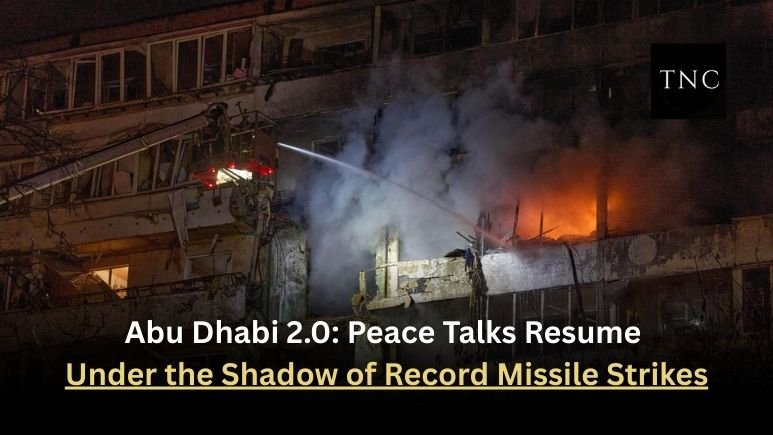

Twenty-eight cruise missiles. Forty-three ballistic missiles. All launched on Tuesday, the day before peace talks were scheduled to resume. Energy facilities across Ukraine destroyed during a brutal cold snap when millions were already struggling with 20-hour blackouts and -20°C temperatures. And now diplomats sit in climate-controlled luxury in Abu Dhabi discussing ceasefires while Ukrainian civilians huddle in the dark wondering if this is the night the heating stops working permanently. If Russia wanted to send a message about what it thinks of peace negotiations, seventy-one missiles targeting civilian infrastructure the day before talks begin is about as clear as messages get.
ABU DHABI, UAE — High-level delegations from Kyiv, Moscow, and Washington opened their second round of peace negotiations Wednesday (February 4, 2026), attempting to salvage a U.S.-backed framework to end a four-year war that’s killed hundreds of thousands and displaced millions. Ukrainian Security Council chief Rustem Umerov and Russian military intelligence director Igor Kostyukov are leading the talks at a high-security venue in the Emirati capital, but the atmosphere is being described as “fraught” for reasons that go far beyond normal diplomatic tension.
The reason is simple: Russia launched what President Volodymyr Zelenskyy called a “record strike” on Tuesday, just hours before negotiations were set to resume, shattering whatever remained of the fragile “energy ceasefire” that was supposed to create space for productive talks.
The missile barrage that destroyed the ceasefire
Tuesday’s assault consisted of 28 cruise missiles and 43 ballistic missiles, targeting energy facilities across Ukraine. The timing wasn’t coincidental. Russia launched the attack specifically to coincide with a severe cold snap, maximizing the humanitarian impact by destroying heating and power infrastructure when Ukrainians need it most desperately.
The “energy ceasefire” that supposedly protected civilian infrastructure? Dead. The seven-day truce the White House claims it negotiated? Moscow says that ended on February 1st, and Tuesday’s attack was their way of making that position abundantly clear.
Zelenskyy mocked the discrepancy in a statement: does Moscow believe “the week has 4 days instead of 7”? The sarcasm barely conceals the fury. His people are freezing in the dark, energy workers are trying to repair infrastructure under constant threat of follow-up strikes, and the country that just destroyed civilian heating during an Arctic freeze is sending negotiators to Abu Dhabi to discuss peace terms.
In a press conference with NATO chief Mark Rutte, Zelenskyy announced the Ukrainian negotiating team would “adjust” its position to reflect Russia’s continued aggression. Translation: whatever flexibility Ukraine might have shown before Tuesday’s attack just evaporated.
The positions that won’t move
Despite U.S. Special Envoy Steve Witkoff’s optimism that a deal is “very close” (a phrase he’s been using for weeks now), the fundamental incompatibilities remain exactly where they’ve always been.
Russia’s ultimatum: Moscow continues demanding Ukraine withdraw forces from the entire Donbas region, including heavily fortified cities Russia doesn’t currently occupy. They want Ukraine to surrender territory it still controls militarily, with nothing offered in exchange except an end to attacks that Russia claims are defensive operations anyway.
Ukraine’s red line: Kyiv has flatly rejected unilateral pullback from territory it holds. Zelenskyy clarified today that any major territorial agreement is “impossible” without direct contact with Vladimir Putin, signalling a push for leader-level summits rather than negotiations between envoys who lack authority to actually compromise.
The U.S. “freeze” proposal: Reports suggest the American framework involves freezing the conflict along current front lines, combined with international security guarantees and a potential 20-year moratorium on Ukraine’s NATO membership.
That last element, the NATO moratorium, is particularly contentious. It essentially tells Ukraine: surrender your sovereign right to choose alliances for two decades, accept that the territory Russia currently occupies is functionally lost even if we don’t formally recognize it, and trust that “international security guarantees” from countries that watched you get invaded will actually protect you next time.
For Ukraine, that’s a formula for cementing Russian gains and ensuring they’ll be attacked again once Moscow rebuilds its forces and the international community’s attention shifts elsewhere. For Russia, even that isn’t enough because they want formal territorial concessions, not just frozen conflict lines.
The humanitarian catastrophe continues
While diplomats debate framework proposals in Abu Dhabi, the situation on the ground has become increasingly desperate due to the combined impact of war and Arctic weather.
| What’s Happening in Ukraine | The Reality as of Feb 4 |
| Temperatures | Dropping to -20°C across northern regions, cold enough to kill without heating |
| Power grid status | National operator Ukrenergo imposing planned outages nationwide after Tuesday’s strikes |
| Military casualties | 780 Russian soldiers killed in last 24 hours according to Ukrainian estimates |
| Civilian casualties | Dozens injured in Kharkiv drone strikes; total civilian toll from 2025 being called highest on record |
| Russian public opinion | 61% now favor peace talks, but remain unwilling to concede any occupied land |
That last statistic is telling. Russian public opinion has shifted toward supporting negotiations, but not toward accepting compromise. They want peace, but only peace that validates everything Russia has taken. That’s not negotiation. That’s waiting for Ukraine to surrender.
The week that wasn’t
The dispute over the “energy ceasefire” duration reveals how fundamentally broken trust is between these parties. The White House claims it negotiated a seven-day truce. The Kremlin insists the agreement only lasted until February 1st. They’re either lying about what was agreed, or the agreement was so vaguely worded that both sides could interpret it differently.
Either way, the result is the same: Russia launched the largest missile barrage in weeks on Tuesday, targeting civilian energy infrastructure during an Arctic freeze, and showed up for peace talks Wednesday as if nothing happened. The message is clear: Russia will participate in negotiations while simultaneously demonstrating through violence that it doesn’t need a negotiated settlement because it can simply continue destroying Ukraine until Kyiv accepts Moscow’s terms.
Zelenskyy’s accusation
The Ukrainian president didn’t mince words about what Tuesday’s attack means: “Each such Russian strike confirms that attitudes in Moscow have not changed: they continue to bet on war and the destruction of Ukraine.”
He’s right, and the evidence supports him. If Russia genuinely wanted a negotiated settlement, you don’t launch record missile strikes the day before talks resume. You demonstrate restraint, show good faith, create diplomatic space for compromise. Russia did the opposite, maximizing humanitarian suffering specifically when negotiations were about to start.
The calculation seems to be that increased suffering will make Ukraine more desperate for any deal, even a bad one. Freeze enough people, destroy enough infrastructure, kill enough civilians, and eventually Zelenskyy will be forced to accept territorial concessions just to stop the bleeding.
What “very close” actually means
Witkoff keeps saying a deal is “very close,” but close to what? If the U.S. proposal is a front-line freeze with security guarantees and a NATO moratorium, and Russia won’t accept that without full Donbas withdrawal while Ukraine won’t accept any territorial concessions without direct Putin contact, then nothing is actually close.
The U.S. mediators are reportedly pushing for a “preliminary memorandum” that would at least reinstate the energy ceasefire. But why would Ukraine trust that after Tuesday? Russia already violated whatever ceasefire existed. A new memorandum would just give Moscow another agreement to violate whenever it becomes tactically convenient.
Human Rights Watch labelled 2025 the “deadliest year for civilians” in this conflict. February 2026 started with record-breaking missile strikes targeting energy infrastructure during the coldest weather in years. The trajectory isn’t toward peace. It’s toward escalation dressed up in diplomatic language.
The talks that might produce nothing
The Abu Dhabi talks are scheduled to conclude Thursday, February 5th. Several outcomes seem possible:
Narrow agreement: Maybe they reach some limited understanding on prisoner exchanges, humanitarian corridors, or energy infrastructure targeting. Enough to claim progress without addressing core territorial disputes.
Ceasefire restoration: Possibly reinstate some version of the energy ceasefire, though Ukraine’s trust in Russian compliance must be near zero after Tuesday.
Complete stalemate: Both sides restate incompatible positions, talks end without meaningful progress, violence continues escalating.
Framework without substance: U.S. mediators produce a document outlining principles for future negotiations without actually resolving anything, allowing everyone to claim diplomatic success while changing nothing on the ground.
The most likely outcome is some combination of narrow agreements on peripheral issues while core disputes remain frozen, accompanied by statements about continued dialogue and incremental progress. Enough to justify the next round of talks without actually ending the war.
The logic being tested
The fundamental question these talks are testing is whether Russia believes negotiation serves its interests better than continued war. Based on Tuesday’s missile barrage, the answer appears to be no.
Russia thinks it can win militarily or at least grind Ukraine down until Kyiv accepts Moscow’s terms. Why compromise at a negotiating table when you believe time and violence are on your side? Why accept a frozen conflict when you think you can conquer the territory you want?
Ukraine faces the opposite calculation. Continue fighting with Western support that may not last forever, or accept a bad deal that cements Russian gains and probably just delays the next war. Neither option is good, which is why Zelenskyy keeps insisting on direct Putin contact, he knows envoys can’t make the fundamental strategic decisions required for actual peace.
Sitting in Abu Dhabi right now are diplomats who can discuss frameworks and principles and incremental steps. They cannot decide whether Russia keeps Crimea, whether Donbas goes to Moscow, whether Ukraine gets real security guarantees or just worthless paper promises. Those decisions require Putin and Zelenskyy, and they’re not in Abu Dhabi.
So the talks will continue, the statements will be carefully worded, and back in Ukraine people will keep freezing in the dark wondering if this is all just theatre while the real war continues regardless of what gets discussed in luxury hotels thousands of miles away.
Also Read / ‘Cynical and Targeted’: 12 Miners Killed in Drone Strike as Ukraine Prepares for Abu Dhabi Summit.












Leave a comment